General News
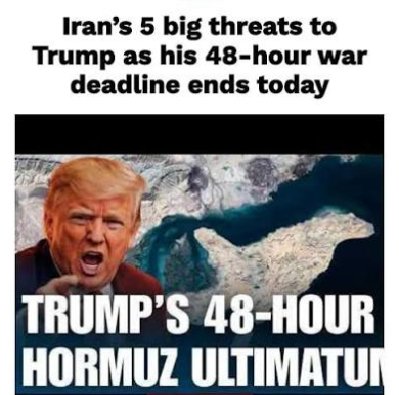
Trump Pauses Iran Strike Threat, Gives Tehran Deadline Over Strait Of Hormuz
Former U.S. President Donald Trump has announced a temporary halt to planned military strikes on Iran’s energy infrastructure, granting a five-day pause following what he described as “productive” talks between Washington and Tehran.
Despite the pause, Trump issued a stern warning that Iran must reopen the Strait of Hormuz within 48 hours or face potential military action targeting its power plants and energy facilities.
In a social media post late Saturday, Trump threatened that the United States would “obliterate” Iranian power infrastructure if the country fails to comply, escalating tensions around one of the world’s most critical oil transit routes.
The warning came amid heightened rhetoric from Tehran, which reportedly threatened to deploy naval mines across the Persian Gulf if its coastlines or islands are attacked. The threat was conveyed through a semi-official Iranian news agency.
The Strait of Hormuz remains a vital artery for global energy supply, accounting for roughly one-fifth of the world’s oil shipments. Any disruption to the waterway has the potential to trigger significant economic and geopolitical consequences.
The developments have raised fresh concerns across the region, with analysts warning of possible escalation if diplomatic efforts fail to yield a resolution within the stated timeframe.
General News
TEF Unveils $16m Boost for 3,200 Young African Entrepreneurs
The Tony Elumelu Foundation (TEF) has unveiled 3,200 young African entrepreneurs as beneficiaries of its 2026 entrepreneurship programme, committing over $16 million in funding, training, and mentorship to drive business growth across the continent.
Each selected entrepreneur will receive a $5,000 seed grant under the initiative, which aims to stimulate job creation, reduce poverty, and promote inclusive economic development in Africa.
The programme is backed by a consortium of global and regional partners, including the European Commission, United Nations Development Programme, UNICEF, IKEA Foundation, and the Government of the Netherlands, among others.
Founder of the foundation, Tony Elumelu, said the initiative goes beyond financial support by equipping beneficiaries with mentorship, coaching, and training needed to build sustainable businesses.
“We aim to drive job creation, alleviate poverty, and promote inclusive economic empowerment across Africa,” he said, noting that the foundation’s vision is to democratise opportunity and prosperity across communities.
Elumelu stressed that collective action remains critical to transforming the continent, adding that empowering young entrepreneurs is central to Africa’s long-term development. He also commended President Bola Ahmed Tinubu for policies supporting entrepreneurship and economic growth.
Chief Executive Officer of the foundation, Somachi Chris-Asoluka, highlighted the programme’s impact since its launch in 2015, revealing that over $100 million has been disbursed to 24,000 entrepreneurs across Africa.
According to her, the initiative has created approximately 1.5 million jobs, generated $4.2 billion in revenue, and lifted over 3.1 million people out of poverty, while impacting more than 4.1 million households.
She emphasised that mentorship remains a key pillar of the programme, with global partnerships helping entrepreneurs navigate challenges and scale effectively.
The 2026 cohort spans diverse sectors including agriculture, technology, artificial intelligence, education, healthcare, retail, and the green economy, reflecting a broad-based approach to economic development.
The event also recognised six outstanding alumni from Nigeria, Kenya, South Africa, Algeria, Mali, and the Democratic Republic of Congo, who have successfully transformed their initial grants into thriving enterprises.
The latest intervention reinforces TEF’s commitment to nurturing Africa’s next generation of business leaders, positioning entrepreneurship as a major driver of sustainable growth and economic resilience across the continent.
General News
Pope Leo Urges Global Ban on Aerial Military Strikes
The head of the Catholic Church, Pope Leo XIV, has called for a worldwide ban on aerial military strikes, warning that modern warfare tactics are causing devastating harm to civilians and eroding moral boundaries in conflict zones.
Speaking during a recent address at the Vatican City, the Pope strongly criticized the increasing reliance on airstrikes in contemporary warfare. He described such attacks as “indiscriminate in impact,” often leading to the loss of innocent lives, destruction of homes, and long-term humanitarian crises.
The pontiff urged global leaders, policymakers, and international organizations to prioritize diplomacy over violence, stressing that technological advancements in warfare should not come at the expense of human dignity. He called for renewed international agreements that would limit or outright prohibit the use of aerial bombardment, especially in densely populated areas.
According to Vatican sources, the Pope’s remarks align with the Church’s long-standing position on the ethics of war, particularly the principles of just war theory, which emphasize the protection of civilians and proportional use of force.
Human rights groups have echoed similar concerns in recent years, citing conflicts in parts of the Middle East, Eastern Europe, and Africa, where airstrikes have resulted in significant civilian casualties. Analysts say the Pope’s statement could reignite global debate on the regulation of modern warfare tactics and the enforcement of international humanitarian law.
While no immediate policy changes are expected, the Pope’s call adds moral weight to ongoing discussions within bodies such as the United Nations, where proposals to strengthen protections for civilians in conflict zones have faced political and strategic hurdles.
The Vatican has indicated that further diplomatic engagement on the issue is likely, as the Church continues to advocate for peace-building efforts worldwide.
General News
Nigeria’s Mining Sector Gains Momentum with $2.6bn Investment Inflow
Nigeria’s Minister of Solid Minerals Development, Dele Alake, has called for the establishment of regional energy hubs across Africa as a key strategy to accelerate mining industrialization and strengthen the continent’s role in the global supply of critical minerals.

Speaking at the Powering Africa Summit in Washington, D.C., Alake said deeper collaboration between African nations and global partners, particularly the United States remains essential to meeting the growing global demand for minerals critical to the energy transition.
He emphasized the need to develop cross-border industrial corridors similar to the Lobito Corridor. According to him, initiatives such as the Lagos–Abidjan corridor, which spans Nigeria, Benin, Togo, Ghana, and Côte d’Ivoire, and the Walvis Bay Corridor, could unlock vast mineral resources while boosting regional integration.
Alake explained that such corridors would serve as economic engines by improving infrastructure, expanding energy access, and enabling industrial growth across borders. He added that shared energy solutions; such as nuclear power, could support multiple countries within a corridor, creating opportunities for local processing, manufacturing, and technology transfer.
“If three to five such corridors are developed across Africa, it would significantly fast-track industrialization and deliver mutual benefits for both Africa and its global partners,” he said.
Highlighting recent reforms under President Bola Ahmed Tinubu, the minister noted that improvements in governance, regulatory frameworks, and licensing processes have made Nigeria’s mining sector more attractive to investors.
He said the government has strengthened the security of mineral titles, ensuring long-term stability for investors, while also expanding the availability of internationally certified geological data to guide investment decisions.
On tackling illegal mining, Alake pointed to the creation of Mining Marshals, revealing that over 350 suspects; including foreign nationals, have been arrested within the past year, with more than 150 currently facing prosecution.
Reaffirming Nigeria’s commitment to attracting foreign investment, he highlighted incentives such as tax waivers on imported mining equipment and the ability for investors to fully repatriate profits after fulfilling tax obligations.
“We have de-risked the sector and created a more transparent environment for investment. In the last two and a half years, Nigeria has attracted over $2.6 billion in foreign direct investment into mining,” Alake stated.
Also speaking at the event, Sarah Whitten of the U.S. Export-Import Bank stressed that sustainable partnerships and long-term policy consistency are critical to unlocking financing for mining projects.
She noted that while American financial institutions are ready to support projects, their role is largely to catalyze private sector investment.
The panel also featured key stakeholders from across the mining and finance sectors, underscoring growing international interest in Africa’s mineral resources amid the global push for clean energy.