
International
Trump Revives Birthright Citizenship Fight With New ‘Birth Tourism’ Order


President Donald Trump has launched a fresh attempt to restrict birthright citizenship and curb so-called “birth tourism,” only weeks after the U.S. Supreme Court rejected his broader effort to deny citizenship to many children born on American soil.
President Donald Trump’s renewed campaign against birthright citizenship is heading into another potentially bruising legal battle after his administration issued two new executive orders targeting children born in the United States and foreign nationals accused of travelling to the country specifically to give birth.
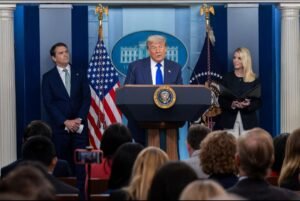
The new measures come just weeks after the Supreme Court delivered a major setback to Trump’s first attempt to overhaul birthright citizenship, ruling in June that children born in the United States to parents who are unlawfully or temporarily present are citizens at birth under the 14th Amendment.
The administration has now narrowed its approach, focusing on what it describes as specific exceptions and immigration fraud rather than attempting to eliminate birthright citizenship across the board.
But legal experts say the new policy still faces formidable constitutional obstacles.
Trump made birthright citizenship a central part of his immigration agenda immediately after returning to the White House.
His original January 2025 executive order instructed federal agencies not to recognise citizenship for certain children born in the United States when their mothers were unlawfully present or temporarily in the country and their fathers were neither U.S. citizens nor lawful permanent residents.
That order was quickly challenged in federal court.
The dispute eventually reached the Supreme Court in Trump v. Barbara, where the justices considered whether the administration could deny citizenship to children born in the United States under those circumstances.
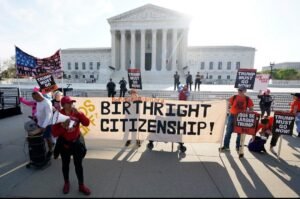
On June 30, the Supreme Court rejected Trump’s position in a 6-3 judgment, reaffirming the broad understanding of the 14th Amendment’s Citizenship Clause.
The court’s ruling said children born in the United States to parents who are unlawfully or temporarily present are “subject to the jurisdiction” of the country and therefore receive citizenship at birth.
That decision has made the administration’s latest strategy considerably more difficult.
The term “birth tourism” generally refers to foreign nationals travelling to the United States with the specific intention of giving birth so that their child can obtain U.S. citizenship.
The Trump administration argues that the practice exploits America’s birthright-citizenship system and should not be permitted.
One of the new executive orders specifically targets foreign nationals who deliberately enter the United States for the purpose of giving birth.
The administration has also directed officials to take action against visa applications involving suspected birth tourism.
That part of Trump’s strategy could prove legally different from simply declaring that a child born in America is not a citizen.
The government has broad authority over visas and admission to the United States, meaning restrictions aimed at preventing fraudulent or improper use of temporary visas may have a stronger legal footing than an attempt to rewrite the constitutional citizenship rule.

However, questions could arise over how officials determine whether a pregnant traveller genuinely intends to give birth in the United States and whether the policy is applied consistently.
The latest executive actions are deliberately narrower than Trump’s original order.
They seek to exclude certain categories from automatic birthright citizenship, including children connected to foreign diplomats, certain foreign government employees and people described by the administration as “alien enemies” or members of terrorist organisations.
The orders also address cases involving alleged fraud in obtaining citizenship or immigration benefits.
The White House appears to be relying on historical exceptions to the Citizenship Clause.
American law has long recognised limited exceptions, including children of foreign diplomats who enjoy diplomatic immunity.
The administration is attempting to argue that some additional categories fall within the same constitutional framework.
That interpretation, however, is already attracting legal criticism.
The central problem for Trump’s administration is the Supreme Court’s recent interpretation of the 14th Amendment.
The Citizenship Clause states that people born or naturalised in the United States and subject to U.S. jurisdiction are citizens.
In Trump v. Barbara, the court reaffirmed that this protection covers children born in America to parents who are unlawfully or temporarily present.
That makes it difficult for the executive branch to simply create new citizenship exceptions through an executive order.
The constitutional question is particularly important because an executive order cannot override the Constitution.
If the new policy effectively denies citizenship to children whom the Supreme Court has already determined fall within the Citizenship Clause, federal courts are likely to face another challenge.
Reuters reported that legal experts broadly expect Trump’s latest effort to encounter serious difficulties in court.
The Supreme Court’s ruling was not entirely uniform in its reasoning.
Justice Brett Kavanaugh agreed with the judgment but wrote separately, while Justices Clarence Thomas and Samuel Alito dissented.
Kavanaugh’s opinion suggested that there could be a constitutional debate over additional categories of people in the future, including some children of foreign citizens unlawfully or temporarily present in the United States.
That has given Trump’s administration some legal arguments to pursue.
But the majority’s ruling remains binding, and the administration cannot simply disregard the court’s conclusion.
The challenge will therefore be to determine whether the new executive orders genuinely address categories outside the court’s ruling or merely repackage the same broader attempt to restrict birthright citizenship.
The administration’s attempt to combat birth tourism through visa policy could prove more difficult to challenge than the citizenship provisions.
The United States has substantial authority over who receives temporary visas and who is admitted to the country.
If officials conclude that an applicant is seeking a visa primarily to give birth in the United States, the government could attempt to deny entry on immigration grounds without necessarily deciding whether the eventual child would be an American citizen.
That distinction is crucial.
Stopping someone from entering the country is legally different from declaring that a child born in the country is not a citizen.
The first involves immigration and visa authority.
The second raises a direct constitutional question under the 14th Amendment.
The scale of birth tourism has also become part of the political dispute.
Trump has spoken of large numbers of foreign nationals travelling to America specifically to give birth.
But estimates vary substantially, and critics of the administration say the phenomenon is far smaller than some political claims suggest.
The Associated Press reported that official estimates indicate fewer than 10,000 births in 2024 to foreign mothers whose addresses were outside the United States; although that figure does not necessarily capture every instance of birth tourism.
That makes reliable measurement difficult because not every foreign mother giving birth in the United States is necessarily engaging in birth tourism.
Some may be tourists who unexpectedly give birth, students, temporary workers, visitors with family in the country or people receiving legitimate medical treatment.
Opponents of Trump’s policy argue that aggressive screening of pregnant travellers could create discriminatory outcomes.
Questions include how immigration officers would determine someone’s intentions, what evidence would be sufficient to establish that a traveller plans to give birth in the United States and whether certain nationalities or ethnic groups could face disproportionate scrutiny.
The new orders are therefore likely to generate challenges not only over constitutional citizenship rights but also over implementation and equal treatment.
Connecticut officials, among others, have already criticised the latest action as inconsistent with the 14th Amendment.
Trump’s supporters argue that the policy addresses what they see as an abuse of American immigration and citizenship laws.
They contend that travelling to the United States specifically to give birth exploits a constitutional provision intended to establish citizenship, rather than provide an incentive for immigration.
The administration also argues that stricter visa enforcement could discourage people from deliberately entering the country for that purpose.
The disagreement therefore goes beyond immigration enforcement.
At its core is a debate over what the 14th Amendment means in modern America and whether the executive branch has authority to define exceptions that the Supreme Court has not recognised.
The latest orders appear to set the stage for another round of litigation.
Immigrant-rights organisations, affected families and potentially state governments are expected to challenge the measures.
Federal judges could be asked to suspend parts of the policy while the constitutional arguments are considered.
Ultimately, the dispute could again return to the Supreme Court.
But unlike Trump’s first attempt, the administration is now operating after the justices have already issued a direct ruling affirming broad birthright citizenship.
That makes the legal terrain significantly more difficult.
Trump’s latest campaign is therefore unlikely to be settled simply by deciding whether “birth tourism” should be restricted.
The bigger question is whether the president can use executive power to redefine the circumstances under which children born in the United States become citizens.
The Supreme Court’s June decision strongly reaffirmed the constitutional protection.
Trump is now attempting a narrower route, targeting specific categories, alleged immigration fraud and the visa practices associated with birth tourism.
Whether that narrower strategy survives the courts will depend heavily on whether judges view the new orders as legitimate enforcement of existing exceptions or another attempt to circumvent the Constitution’s citizenship guarantee.
For now, the political battle has entered a new phase.
Trump has made clear that he intends to continue challenging the longstanding interpretation of birthright citizenship.
The courts, however, have already signalled that the Constitution places significant limits on how far the executive branch can go.
The next legal battles will determine whether Trump’s revised approach can survive those limits, or whether the administration’s second attempt will meet the same constitutional wall as the first.