
Opinion
The FIFA Mutiny Widens: New Zealand Breaks With Oceania — is Infantino’s Global Coalition Starting to Fracture?

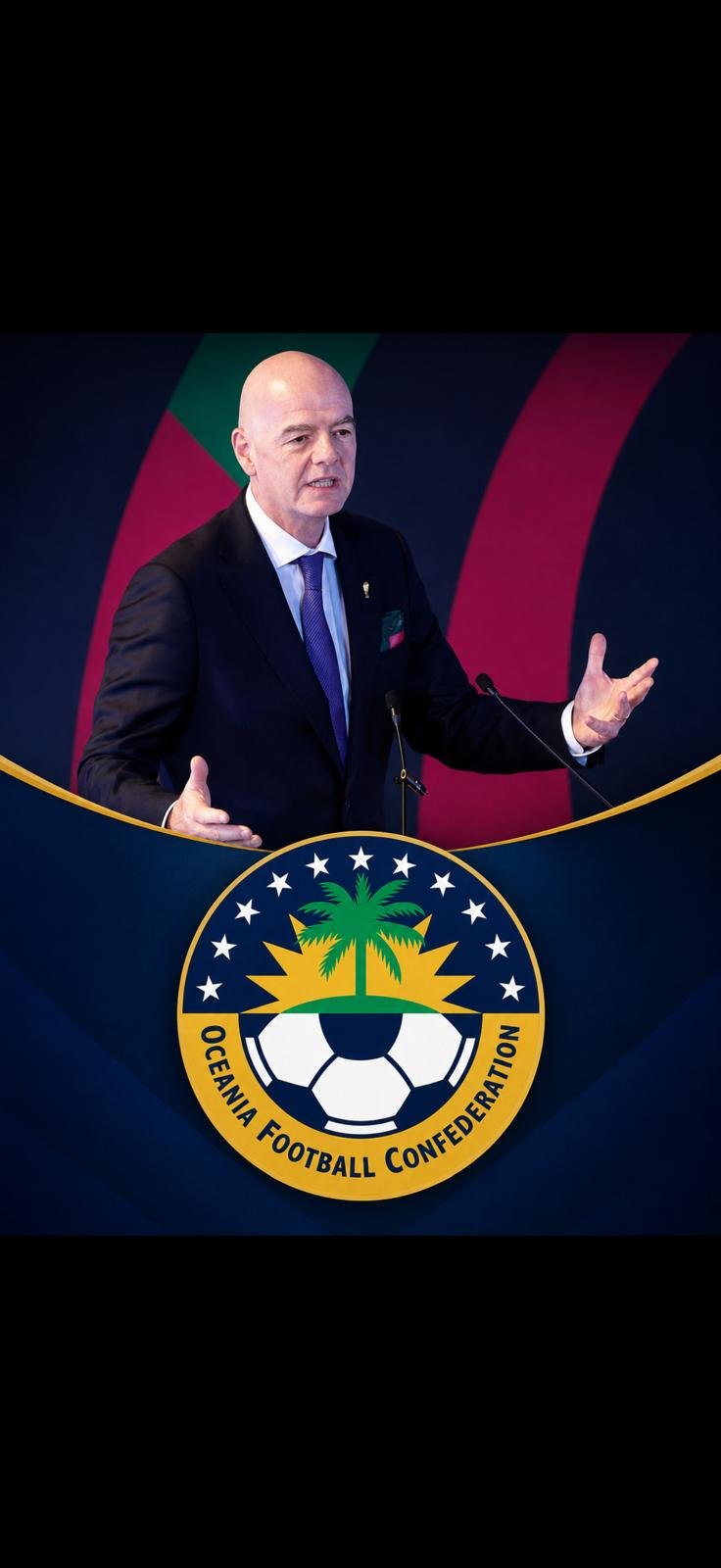
By Paul Lucky Okoku
ONE CONTINENT, TWO POSITIONS
THE OFC STILL BACKS FIFA’S LEADERSHIP, BUT NEW ZEALAND SAYS TRUST HAS BROKEN DOWN — AND ITS DECISION SHOWS WHY CONTINENTAL SUPPORT DOES NOT GUARANTEE INDIVIDUAL VOTES
New Zealand has done something more significant than simply adding its name to the growing list of football associations questioning Gianni Infantino’s leadership.
It has broken ranks with its own continental football family.
On August 14, 2026, New Zealand Football withdrew its support for Infantino’s bid for another term as FIFA president and called for an independent review of the controversial FIFA Forward Enterprise proposal.
NZF said the controversy had caused a loss of confidence and trust in FIFA’s leadership. Chief executive Andrew Pragnell said an independent review was necessary because New Zealand did not want the matter dealt with through what he described as an internal exercise that might simply wash over the issues.
That alone makes the decision important.
But the wider context makes it considerably more significant.
New Zealand belongs to the Oceania Football Confederation — OFC — the governing body for football across the Pacific.
And OFC has not followed New Zealand.
Instead, the confederation has acknowledged the controversy while also recognising what it considers substantial progress in Oceania under FIFA’s current leadership. OFC welcomed the withdrawal of the disputed commercial proposal and encouraged FIFA to use the review process to identify and implement whatever changes may be necessary.
New Caledonia has gone further, publicly reaffirming its support for Infantino and praising FIFA’s governance, equal funding and development work in the Oceania region.
So we now have an unusual situation:
Oceania’s continental leadership remains broadly supportive of Infantino, while New Zealand has independently withdrawn its endorsement.
That difference may ultimately be more important than the withdrawal itself.
WHY DID NEW ZEALAND WITHDRAW?
The immediate controversy concerns FIFA Forward Enterprise, a plan to bring private investment into FIFA’s commercial operations.
The proposal involved selling roughly 20 percent of a commercial-rights vehicle connected to FIFA competitions, potentially raising about $4.2 billion. It triggered intense opposition over the way the project had been developed and the extent to which FIFA’s major stakeholders had been consulted.
The proposal was eventually abandoned on July 31.
Following a crisis meeting in Morocco, FIFA apologised to its 211 member associations for mistakes in the handling of the proposal.
For New Zealand, however, withdrawing the proposal was not enough.
The question was no longer simply whether the commercial plan would proceed.
The deeper issue became:
How did FIFA reach that point in the first place?
Who was consulted?
What oversight existed?
How were decisions made?
And were FIFA’s governance structures working as they should?
Pragnell said the review should examine decision-making and oversight and should be genuinely independent. He also said the scope should be carefully agreed and that the process should begin urgently.
That distinction is crucial.
New Zealand is not merely saying:
We disagreed with the proposal.
It is saying that the process surrounding such an important proposal has damaged trust sufficiently to require independent examination.
That is a governance issue.
NEW ZEALAND STANDS APART IN OCEANIA
Oceania is FIFA’s smallest continental confederation, with 11 FIFA member associations.
As of August 14, New Zealand is the OFC association publicly reported to have withdrawn its support for Infantino amid this crisis, while OFC itself remains broadly supportive of his leadership.
That means it would be inaccurate to say:
Oceania has turned against Infantino.
It has not.
And that is precisely why New Zealand’s decision deserves attention.
OFC has reasons for evaluating Infantino positively.
Smaller football nations depend heavily on development programmes that can help finance infrastructure, technical programmes, competitions, headquarters and grassroots initiatives.
New Zealand itself has benefited from developments during Infantino’s presidency.
It co-hosted the 2023 FIFA Women’s World Cup with Australia, while the expansion of the men’s World Cup created a guaranteed direct qualification place for Oceania. Pragnell himself previously acknowledged that New Zealand had benefited from FIFA initiatives while still insisting that those benefits should not prevent the federation from raising governance concerns.
That makes New Zealand’s position stronger, not weaker.
It is not arguing that nothing positive happened under Infantino.
Its decision demonstrates a more important principle:
Development benefits do not remove the responsibility to ask governance questions.
A national association can appreciate FIFA investment and still conclude that institutional trust has been damaged.
Those positions can coexist.
NEW ZEALAND IS NOT ALONE
New Zealand’s decision also forms part of a wider challenge to Infantino’s leadership.
Several national associations have withdrawn or reconsidered previous support, while others have openly questioned whether he should remain FIFA president.
Norway Football Federation president Lise Klaveness has gone as far as calling for Infantino to resign, arguing that the necessary institutional trust in his leadership no longer exists.
Other associations have withdrawn endorsements or expressed loss of confidence without necessarily demanding immediate resignation.
Those distinctions matter.
Withdrawing an electoral endorsement is not automatically the same as demanding resignation.
Losing confidence does not prove misconduct.
Criticism of governance does not establish that a FIFA rule or law was violated.
But the recurring concerns are difficult to ignore:
governance, transparency, consultation, judgment, accountability and trust.
New Zealand’s importance is geographical as well as political.
The resistance is no longer confined to European football.
It has visibly reached Oceania.
THREE CONFEDERATIONS HAVE CHALLENGED INFANTINO
The institutional split extends well beyond individual countries.
Three of FIFA’s six continental confederations — UEFA, the Asian Football Confederation and Concacaf— jointly issued a powerful open letter challenging Infantino’s conduct over the abandoned commercial proposal and demanding an independent review.
Together, those three confederations represent 136 of FIFA’s 211 national associations.
Their criticism went beyond disagreement over financial strategy.
They alleged that trust had been broken and argued that FIFA required leadership serving the collective interests of the football family. They also called for a review in which FIFA itself would have no role.
Those are serious accusations.
But they remain institutional allegations and political positions unless established through an appropriate investigative process.
That distinction is essential.
Opposition is not proof of guilt.
But neither can criticism of this magnitude simply be dismissed.
When half of FIFA’s continental confederations publicly challenge its president over governance and trust, the issue has moved far beyond an ordinary disagreement over commercial policy.
INFANTINO STILL HAS POWERFUL SUPPORT
It would be equally inaccurate to suggest that Infantino has lost world football.
He has not.
The Confederation of African Football — CAF — remains firmly behind him.
On August 6, CAF’s Executive Committee unanimously reconfirmed its support for Infantino and thanked him for his support for African football over the years. That position appears in CAF’s own official statement.
South America’s CONMEBOL also continues to support him.
Several Arab federations — including Qatar, Morocco, Egypt, Lebanon, Sudan and Mauritania — publicly reaffirmed their backing on August 13.
New Caledonia supports him.
Mexico has also remained supportive despite belonging to Concacaf, one of the confederations challenging his leadership.
So this is not a straightforward revolt in which one side controls world football.
It is a divided football family.
And that division creates another important distinction.
CONFEDERATION SUPPORT DOES NOT MEAN GUARANTEED VOTES
The New Zealand situation demonstrates something fundamental about FIFA elections.
A continental confederation can support a candidate.
But it does not vote on behalf of all its national associations.
The associations themselves vote.
New Zealand has one vote.
Fiji has one vote.
Brazil has one vote.
Germany has one vote.
Nigeria has one vote.
England has one vote.
The same principle applies everywhere.
Reuters reported on August 13 that even though CAF has formally backed Infantino, there is no guarantee that all 54 African associations will vote for him. African federations have historically departed from CAF positions in important FIFA elections and decisions.
In the 2016 FIFA presidential election, for example, CAF backed Sheikh Salman bin Ebrahim Al Khalifa, yet a number of African associations supported Infantino.
During the vote to host the 2026 World Cup, CAF supported Morocco, but several African associations voted for the joint United States-Canada-Mexico bid instead.
That history matters.
It tells us that continental endorsements create political influence, but they do not necessarily produce automatic bloc voting.
New Zealand is now demonstrating the same principle inside Oceania.
OFC can remain supportive of Infantino.
New Zealand can disagree.
Both institutions can hold their positions.
THIS MAY NOT BE A BATTLE OF CONTINENTS
It is therefore tempting — but misleading — to describe the current crisis this way:
UEFA, AFC and Concacaf against Infantino.
CAF, CONMEBOL and OFC behind him.
The reality is more complicated.
New Zealand has broken from the wider OFC position.
Mexico differs from the leadership position of Concacaf.
Individual associations inside other confederations may also reach decisions that do not perfectly correspond with their continental bodies.
The eventual FIFA presidential contest may therefore be decided less by continental declarations than by individual associations.
Association by association.
Vote by vote.
That is one reason New Zealand’s decision is important beyond the Pacific.
It reminds every federation that membership of a confederation does not eliminate independent judgment.
AND WHAT ABOUT NIGERIA?
Nigeria is relevant to this discussion for precisely that reason.
Reuters reported that African associations had expressed support for Infantino’s re-election ambitions before the present crisis. CAF has since reaffirmed its support following the Forward Enterprise controversy.
But Nigeria possesses its own FIFA vote.
And the New Zealand example raises a simple principle:
Nigeria does not have to reach a conclusion simply because CAF has reached one.
That does not mean Nigeria should withdraw its support.
Nor does it mean that continuing to support Infantino would be wrong.
It means only that Nigeria’s position should represent an independent judgment by the Nigeria Football Federation.
CAF President Patrice Motsepe himself has said that Infantino’s future should ultimately be decided by FIFA’s 211 member associations through the 2027 election.
That is where the responsibility belongs.
For Nigeria, however, the question of whether its pre-crisis position remains unchanged deserves separate examination.
That is a discussion substantial enough to stand on its own.
ONE ASSOCIATION, ONE VOTE
At the heart of this entire debate is one of FIFA’s most important democratic principles.
Every member association has a vote.
New Zealand’s vote has the same numerical value as Brazil’s.
Fiji’s has the same value as Germany’s.
Nigeria’s has the same value as England’s.
The confederations are enormously influential politically, but it is FIFA’s 211 member associations that elect the president.
That structure explains why individual withdrawals matter.
One country changing its position does not destroy a candidacy.
But it demonstrates that endorsements are not permanent possessions.
A federation can support a candidate today and reconsider tomorrow if circumstances change.
New Zealand has done so.
Other federations have reconsidered their positions.
And there is still time before FIFA members vote again in 2027.
SUPPORT IS NOT IMMUNITY — OPPOSITION IS NOT GUILT
One principle should remain constant throughout this dispute.
CAF supporting Infantino does not establish that every decision during his presidency has been correct.
OFC supporting him does not eliminate legitimate questions about governance.
But the reverse is equally important.
New Zealand withdrawing its support does not prove wrongdoing.
UEFA, AFC and Concacaf challenging Infantino do not establish guilt.
Multiple allegations do not become established facts simply because they are repeated.
That is why the demand for an independent review deserves serious consideration.
The review should establish how the Forward Enterprise proposal was developed.
Who was involved?
Who was consulted?
What approval was obtained?
What oversight existed?
Were FIFA’s procedures followed?
And what changes, if any, are necessary to prevent a similar breakdown in trust?
Those findings should then be available for FIFA’s member associations to evaluate.
That is accountability.
It is not a presumption of guilt.
NEW ZEALAND HAS MADE ITS POSITION CLEAR
New Zealand controls only one of FIFA’s 211 votes.
But politically, its decision may mean considerably more.
It has demonstrated that continental solidarity and independent national judgment do not always have to lead to the same conclusion.
OFC can recognise the development achieved under Infantino.
New Zealand can acknowledge those benefits.
And New Zealand Football can still decide that recent events have damaged its trust sufficiently to withdraw its support.
Those positions are not mutually exclusive.
The question now is whether New Zealand remains largely alone within Oceania or whether other national associations — there or elsewhere — begin reconsidering their own positions.
Infantino still has powerful allies.
CAF supports him.
CONMEBOL supports him.
OFC remains broadly supportive.
Several individual federations have publicly backed him.
But UEFA, AFC and Concacaf have mounted an extraordinary institutional challenge.
National associations have withdrawn endorsements.
New Zealand has now joined them.
The football world is divided.
And perhaps that is why New Zealand’s decision matters most.
It reminds everyone that, ultimately, FIFA’s future should not be dictated by continental loyalty alone.
Each association must make its own judgment.
On August 14, 2026, New Zealand Football made its judgment clear.
It withdrew its support for Gianni Infantino.
Not because Oceania instructed it to.
But despite the fact that Oceania did not.
And that may be the most important part of the story.