
War
Ukraine Targets Russia’s Second-Largest Online Retailer in Drone Strikes

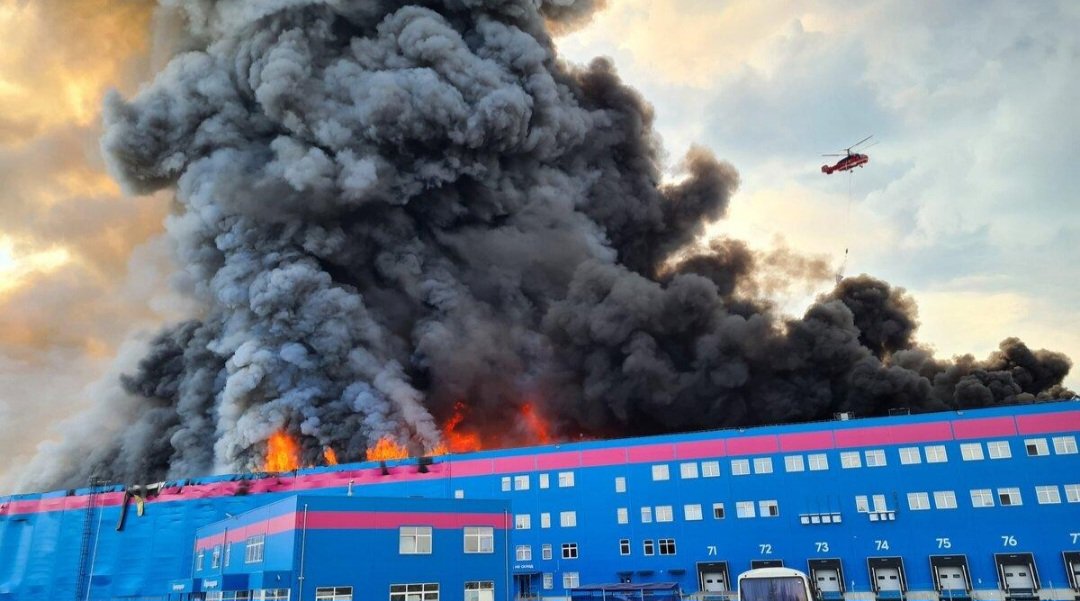
Ukraine has expanded its campaign against Russia’s commercial and logistics infrastructure, targeting several facilities belonging to Ozon, Russia’s second-largest online retailer, in a series of drone strikes across southern Russia.
Ozon said four of its logistics hubs came under attack on Monday, with fires reported at facilities in Makhachkala in Dagestan and Enem in the Krasnodar region. Workers were evacuated from warehouses in Adygeysk and Nevinnomyssk after further drone threats.

The attacks brought to six the number of Ozon facilities targeted in three days, according to Reuters. A logistics centre in Russia’s Samara region had been hit on Saturday, while operations were also suspended at a facility in the Orenburg region after hundreds of workers were evacuated.
Ozon said several people were injured after the Makhachkala facility was attacked, although their injuries were reportedly not life-threatening. Operations at the site were suspended following the incident.
The overnight strikes also caused casualties away from the warehouses.

Russian authorities said drone debris struck a private children’s centre in Krasnodar. Anadolu Agency reported that three teenagers aged 13, 15 and 16 were killed, while seven others were injured. Russian officials attributed the incident to debris from a Ukrainian drone that had been intercepted by air defences.
Euronews, citing regional authorities, initially reported two children killed and nine people injured, illustrating that casualty figures were still developing as reports emerged

The strikes mark a significant expansion of Ukraine’s attacks on Russia’s e-commerce sector.
Kyiv had previously focused heavily on Wildberries, Russia’s largest online marketplace, targeting its logistics infrastructure. Ukraine’s Defence Ministry said Ozon was now being targeted after attacks on Wildberries’ major logistics hubs.
Ukrainian authorities argue that logistics centres operated by major retailers can store dual-use goods and form part of supply networks supporting Russia’s military effort.

The attacks are therefore part of a broader Ukrainian strategy aimed at disrupting Russian economic infrastructure and logistics while increasing the cost of Moscow’s war effort.
Russia, however, has condemned the attacks, describing the targeted facilities as civilian infrastructure.
The attacks also had an immediate impact on financial markets.
Ozon’s shares fell by almost 30% on the Moscow Exchange on Monday, while shares in its major shareholder, AFK Sistema, dropped by more than 13%, according to Reuters.
The sharp market reaction reflects the growing importance of Ozon’s logistics network to Russia’s rapidly expanding e-commerce industry.
Reuters reported that Ozon had been one of Russia’s strongest-performing stocks since the market turmoil that followed the start of the full-scale war in 2022, with its shares having risen almost 300% before the latest attacks.

The attacks come as Russia faces increasing disruption to commercial infrastructure.
President Vladimir Putin has already called for state assistance to help restore warehouses damaged in attacks, while Russia’s Finance Ministry has prepared measures including tax breaks for businesses affected by attacks on logistics facilities.
The Central Bank has also advised creditors to support businesses whose warehouses and logistics centres have been affected.
The latest attacks underline how Ukraine’s long-range drone campaign is increasingly reaching beyond traditional military targets to infrastructure considered important to Russia’s wider economy and war-supporting supply chains.
With Ozon now joining Wildberries as a major target, Russia’s sprawling logistics and retail networks are facing a new security challenge as the war continues.