
Opinion
When A Nation Normalizes Lawlessness: Nigeria at The Edge of The Abyss

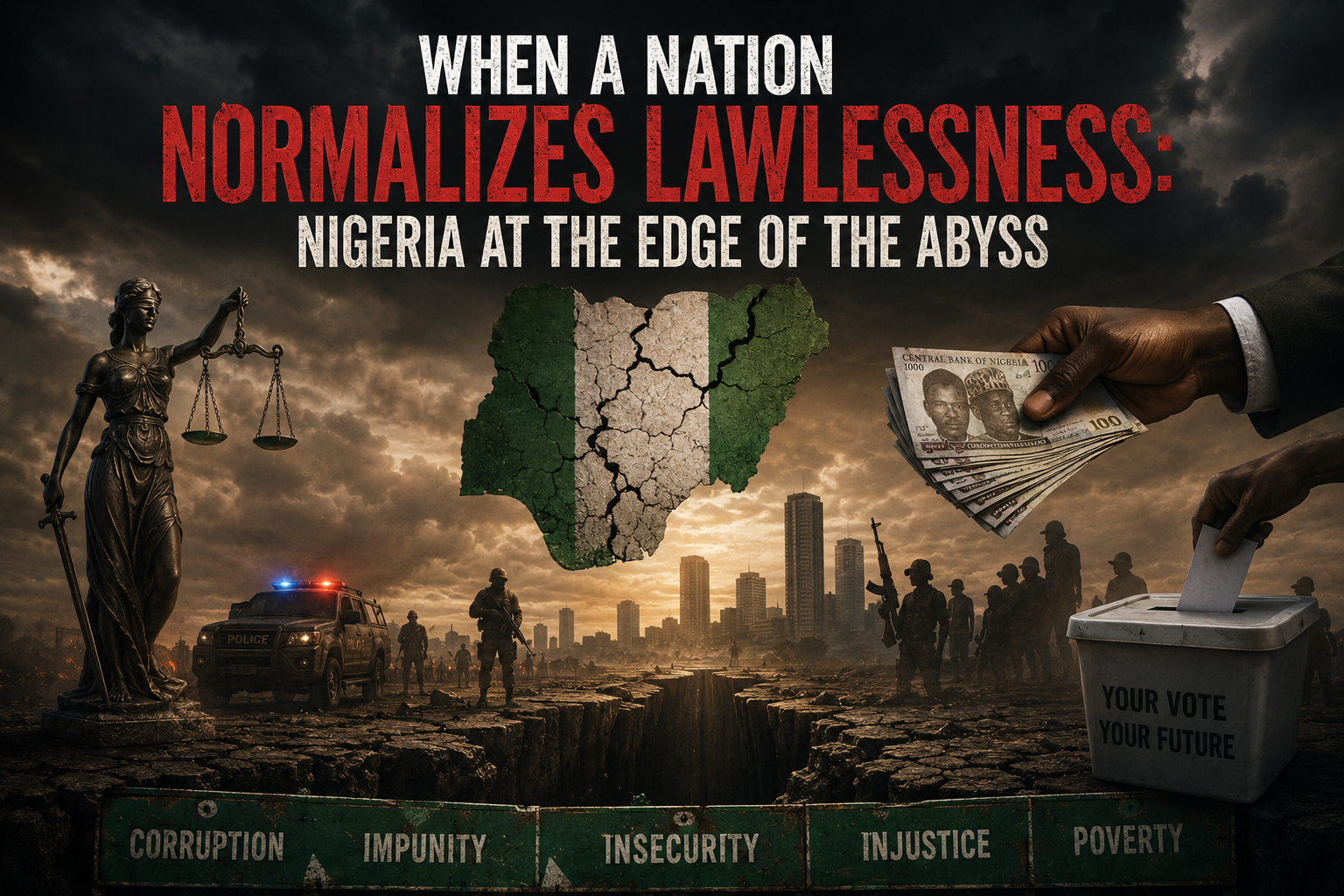
By Chris Okobah, PhD Award-Winning Author
Nigeria’s greatest danger is no longer corruption, kidnapping, banditry, electoral manipulation, political violence or institutional abuse considered separately. The greater danger is what happens when all of them begin to feed one another—when corruption weakens institutions, weakened institutions embolden criminals, criminality intimidates justice, political connections manufacture impunity, and an exhausted population gradually learns to live with conditions that should provoke national outrage.
That is the frightening threshold Nigeria has reached.
Nations rarely collapse in one dramatic moment. They deteriorate gradually, almost imperceptibly, until yesterday’s outrage becomes today’s inconvenience and eventually tomorrow’s accepted reality.
A country first learns to tolerate corruption. Then it tolerates injustice. It becomes accustomed to unexplained wealth, selective prosecution, compromised elections, political thuggery, kidnapping, extortion, abuse of police powers and the manipulation of public institutions.
What was once scandalous becomes familiar.
What was once unacceptable becomes manageable.
What was once considered a national emergency becomes just another headline.
And eventually, abnormality becomes normal.
That is the road Nigeria is travelling.
Mexico offers an uncomfortable warning of what can happen when criminal organizations grow powerful enough to challenge the authority of the state. In parts of that country, criminal groups have extorted businesses, intimidated officials, attacked political candidates, terrorized communities and used spectacular violence to demonstrate that government does not possess a monopoly over coercive power.
Nigeria must never comfort itself with the assumption that such degeneration cannot happen here.
Some of the warning signs are already before us.
There are communities where farmers fear going to their farms. There are highways where a journey once considered routine has become an exercise in risk assessment. There are communities in which citizens negotiate with armed groups because government cannot adequately guarantee their safety. Businesses now calculate insecurity and private protection alongside electricity, taxation, transportation and operating expenses.
When citizens begin paying criminals, militias or armed groups for the safety that the state is constitutionally obligated to provide, something profound has already gone wrong.
But insecurity is only a symptom.
The deeper disease is impunity.
When politically connected citizens can break the law and confidently expect protection while ordinary people encounter the full weight of government, the foundation of justice begins to disintegrate.
When corruption allegations suddenly disappear because an accused person has entered the correct political camp, institutions lose credibility.
When security agencies appear aggressive toward opponents but accommodating toward allies, law enforcement gradually degenerates into political enforcement.
When elections are manipulated, bought, intimidated or institutionally compromised, citizens begin to conclude that their votes are meaningless.
When people begin to suspect that access, influence and connections matter more in court than facts and law, the courthouse ceases to represent justice in the public imagination.
And when citizens lose faith simultaneously in elections, police, prosecutors and courts, they begin searching for alternative ways of protecting themselves and settling disputes.
That is how institutional collapse begins.
The most dangerous stage arrives when fear enters the administration of justice.
Imagine a country in which a judge must secretly ask himself, not simply, “What does the Constitution require?” but, “What will happen to my family if I deliver this judgment?”
Imagine prosecutors avoiding difficult cases because defendants are politically untouchable.
Imagine witnesses refusing to testify because nobody can guarantee their safety.
Imagine police officers hesitating to arrest dangerous criminals because those criminals enjoy political connections.
At that point, justice has not merely become weak.
Justice has surrendered.
And whenever justice surrenders, criminals become courageous.
Crime flourishes wherever punishment becomes uncertain.
A kidnapper who discovers that kidnapping pays and punishment rarely follows expands his operation.
A corrupt public official who watches others enjoy stolen wealth without consequences becomes encouraged to steal even more.
A politician who successfully manipulates one election acquires every incentive to manipulate the next.
An armed group that successfully terrorizes one community moves confidently toward another.
Impunity, therefore, is not merely the absence of punishment.
Impunity is an advertisement for more crime.
The consequences are not confined to security. They eventually destroy the economy.
No serious economy can prosper where entrepreneurs must simultaneously budget for government taxation, generators, private security, transportation failures, bribery and criminal extortion.
Eventually, businesses relocate.
Farmers abandon their land.
Transportation costs increase.
Food becomes more expensive.
Investors retreat.
Professionals emigrate.
Young people lose confidence in legitimate enterprise.
Capital begins to flee from uncertainty, insecurity and injustice.
Nigeria increasingly resembles two countries occupying the same geographical space.
There is one Nigeria for the wealthy—the Nigeria of fortified compounds, armed escorts, private electricity, private schools, private hospitals and air travel.
Then there is another Nigeria for millions of ordinary citizens—the Nigeria of collapsing roads, overcrowded hospitals, failing public schools, unreliable electricity, insecurity and journeys that sometimes amount to gambling with one’s life.
One Nigeria can purchase protection from national failure.
The other must endure it.
No nation can sustain such an arrangement indefinitely.
This is why Nigeria’s crisis is not merely economic.
It is moral.
It is political.
It is institutional.
And increasingly, it is existential.
The political consequences are perhaps even more dangerous.
When criminal wealth begins influencing elections, determining candidates, financing political machinery or negotiating directly with public officials, democracy becomes hostage to money and violence.
The ballot paper may still exist.
Campaign posters may still cover the streets.
Political rallies may still be televised.
Election dates may still be announced.
But democracy risks becoming theatre if political power is ultimately determined by intimidation, illicit wealth, patronage networks and institutional manipulation rather than the freely expressed will of the people.
A democracy in which citizens cannot freely choose their leaders eventually becomes democratic only in name.
This is why Nigeria must begin treating corruption as a national-security emergency.
A corrupt customs officer can compromise a border.
A corrupt police officer can protect kidnappers.
A corrupt public servant can divert money meant for security.
A compromised investigator can destroy evidence.
A compromised prosecutor can sabotage a case.
A compromised judge can place the appearance of legality around injustice.
A corrupt politician can provide criminals with the protection of political power.
These failures are not isolated.
They form an ecosystem.
Corruption does not merely steal public money.
Corruption dismantles the state one institution at a time.
Institutional abuse is equally dangerous.
Government institutions must never become weapons against citizens or instruments for settling political scores.
A police force citizens fear more than criminals has lost its purpose.
An anti-corruption institution widely perceived as selective eventually loses moral authority.
An electoral body that cannot command public trust weakens democracy itself.
A judiciary that loses public confidence threatens society’s ability to resolve conflicts peacefully.
The moment citizens believe government institutions primarily exist to protect powerful people rather than uphold the law, resentment deepens, patriotism weakens and national cohesion begins to fracture.
But perhaps the most frightening development is psychological.
Nigerians are becoming accustomed to suffering.
That should terrify us.
The first kidnapping shocks the nation.
Then another happens.
Then another.
Eventually kidnapping becomes another news item between politics and entertainment.
The first terrible road produces outrage.
Years later, citizens merely develop alternative routes.
The first corruption scandal causes anger.
Eventually people laugh about corruption as though theft from the public treasury were part of Nigerian culture.
The first injustice provokes condemnation.
Eventually somebody shrugs and says:
“That is Nigeria.”
Those may be among the most dangerous words in our national vocabulary.
Because institutional failure achieves its greatest victory not when roads collapse, criminals flourish or politicians steal.
It wins when citizens stop expecting anything better.
A population that believes nothing can change becomes easier to govern badly.
A people who expect corruption will tolerate corruption.
A people who believe elections cannot matter become willing to sell their votes.
A people who believe justice belongs only to the powerful eventually stop demanding justice altogether.
That is how nations lose themselves.
Nigeria must reject that fatalism.
Military operations alone cannot rescue a society suffering institutional decay. A country cannot shoot its way into good governance.
Nigeria needs professional policing, credible intelligence, forensic investigation, effective border management, financial tracking of criminal networks, witness protection, protection of judicial officers, independent prosecution, transparent elections and uncompromising accountability for public officials.
But above everything else, Nigeria must restore one principle without which every constitution is merely paper:
Nobody must be above the law.
Not the President.
Not the governor.
Not the senator.
Not the minister.
Not the billionaire.
Not the security officer.
Not the party chairman.
Not the political godfather.
Not the criminal kingpin.
The law must have no preferred political party, no favourite ethnicity, no privileged religion and no protected social class.
The moment justice becomes negotiable according to wealth, political affiliation or personal connections, the Republic begins to crack.
Nigeria still possesses one enormously powerful instrument for peaceful renewal: the vote.
But voting alone is insufficient if citizens sell their votes, surrender them to intimidation or refuse to defend the integrity of the electoral process.
Nigerians must vote.
They must protect their votes.
They must reject inducements.
They must refuse to exchange four years of their children’s future for a bag of rice, a few thousand naira or temporary political patronage.
They must demand competence instead of slogans, character instead of propaganda and measurable performance instead of empty promises.
History teaches that nations do not receive unlimited opportunities to correct institutional decay.
Every country has criminals. Criminals alone do not destroy nations.
The real danger begins when criminals discover that institutions are weak enough to manipulate, politicians are desperate enough to protect them, officials are cheap enough to purchase, justice is vulnerable enough to intimidate and citizens are exhausted enough to remain silent.
Then criminals stop fearing the state.
Soon afterward, the state begins fearing the criminals.
And when that happens, sovereignty starts changing hands without a single constitutional amendment.
Nigeria must therefore stop speaking about institutional collapse only as a distant possibility.
We must examine what already surrounds us.
Lawlessness has become dangerously familiar.
Corruption is too often celebrated rather than condemned.
Political defection can appear capable of washing away yesterday’s accusations.
Injustice is rationalized.
Incompetence is defended along partisan lines.
Public institutions struggle for credibility.
Citizens increasingly provide privately what government was created to provide publicly.
And suffering is gradually being incorporated into everyday life.
That is why the defining battle for Nigeria’s future is not APC against PDP, North against South, Christian against Muslim or one ethnic group against another.
It is law against lawlessness.
It is justice against impunity.
It is citizenship against political servitude.
It is institutional integrity against institutional capture.
It is the struggle to determine whether Nigeria will remain a republic governed by laws or deteriorate into a territory governed by influence, money, fear and connections.
The greatest tragedy would not be that Nigeria suddenly collapsed.
The greater tragedy would be that we watched it deteriorate gradually, defended the politicians responsible because they belonged to our party or ethnic group, collected inducements during elections, laughed at corruption, adjusted to insecurity and finally awakened in a country whose institutions existed only in name.
A nation can survive poverty.
It can recover from recession.
It can rebuild roads and power stations.
But once its people lose faith in justice, once criminals lose their fear of government, and once government loses the moral authority to demand obedience to the law, rebuilding the nation becomes infinitely more difficult.
Nigeria is standing before that historic choice.
We can continue normalizing the abnormal until lawlessness becomes our national culture.
Or we can decide that enough is enough.
We can insist that public office is a trust, not an inheritance.
That elections belong to voters, not political financiers.
That the police exist to protect citizens, not intimidate them.
That courts belong to justice, not influence.
That public wealth belongs to Nigerians, not political families.
And that no person, however wealthy, connected or powerful, is greater than the Nigerian Republic.
Because when a nation normalizes lawlessness, it does not simply lose security.
It loses justice.
It loses investment.
It loses talent.
It loses trust.
It loses hope.
And eventually, it loses the authority to govern itself.
That is the future Nigeria must refuse.
The tragedy, however, is that elements of that future are no longer approaching from a distant horizon.
They are already standing at our doorstep.
The question before Nigerians is therefore no longer whether the danger is coming.
The question is whether we still possess the courage, patriotism and collective wisdom to stop it.