
Business
Global Bond Sell-Off Deepens as Japan’s 10-Year Yield Hits 3% for First Time Since 1996

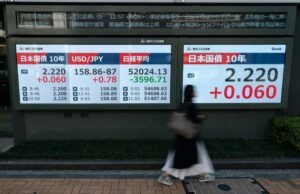
The global bond sell-off intensified on Tuesday after Japan’s benchmark 10-year government bond yield reached 3% for the first time since September 1996, sending a fresh warning through international financial markets.
The rise in Japanese yields came as investors became increasingly concerned about inflation, government debt and the possibility of faster interest-rate increases, while renewed conflict in the Middle East pushed energy prices higher and added to inflation fears.
The milestone is particularly significant for Japan, where interest rates and government bond yields remained exceptionally low for decades. The 10-year yield has now more than tripled over the past two years as the Bank of Japan moves away from the ultra-loose monetary policies that had long defined the country’s financial system.
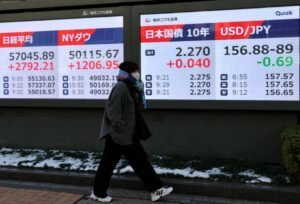
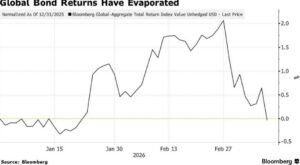
Japan’s move higher has coincided with a broader sell-off in government bonds around the world.
In the United States, the benchmark 10-year Treasury yield climbed to about 4.80%, while Germany’s 10-year government bond yield reached around 3.35%.
In Britain, the 10-year gilt yield rose to 5.25%, its highest level since 2008.
Bond yields rise when bond prices fall, meaning investors are demanding greater returns to hold government debt.
The latest moves suggest markets are reassessing how long central banks will be able to keep interest rates low as inflationary pressures build.

The renewed fighting between the United States and Iran has added another complication for investors.
Oil prices have climbed as concerns grow over disruptions to energy supplies and shipping through the Strait of Hormuz, one of the world’s most important oil-transit routes.
Higher energy prices can feed into transportation, manufacturing and consumer costs, potentially forcing central banks to maintain higher interest rates or delay planned rate cuts. Reuters reported that the combination of rising energy prices and higher bond yields has intensified concerns about inflation across major economies.
Japan’s bond market has long played an important role in international finance.
For years, Japanese interest rates were among the lowest in the world, encouraging investors to borrow cheaply in yen and invest in higher-yielding assets elsewhere.
As Japanese yields rise, some investors may find domestic government bonds more attractive, potentially reducing the flow of Japanese capital into overseas markets.
That shift could affect everything from US and European government bonds to currencies and global equity markets.
Investors are also watching Japan’s fiscal position closely.
The country carries one of the world’s largest government debt burdens relative to the size of its economy, meaning higher borrowing costs could eventually increase the government’s interest expenses.
Markets are therefore paying close attention to government spending plans and the amount of debt Japan will need to issue.
The recent surge in yields has raised questions about how comfortably Tokyo can finance additional spending while maintaining investor confidence. Reuters previously described Japan as the epicentre of the global bond sell-off, citing concerns about its debt burden, inflation and fiscal policy.
The rise in yields is also putting the Bank of Japan under greater pressure.
Investors are increasingly betting that persistent inflation could require the central bank to raise interest rates more quickly than previously expected.
That possibility has already contributed to movements in the Japanese yen and increased volatility across financial markets.

The challenge for policymakers is balancing the need to control inflation against the risk that significantly higher borrowing costs could place additional pressure on Japan’s heavily indebted government and economy.
The 3% milestone is therefore more than a symbolic number.
It represents a major shift in a bond market that spent decades operating under exceptionally low interest rates and massive central-bank intervention.
With yields also climbing in the United States, Europe and Britain, investors are confronting a new environment in which government debt is no longer automatically viewed as a low-risk, low-volatility asset.
The combination of higher energy prices, persistent inflation concerns, heavy government borrowing and expectations of tighter monetary policy could keep global bond markets under pressure in the weeks ahead.
For Japan, meanwhile, the question is whether the 3% yield represents a temporary market shock, or the beginning of a much deeper transformation in the country’s financial system.