
Business
Shein Retreats From Vietnam, Pours $1.5bn Into Chinese Supply Chain

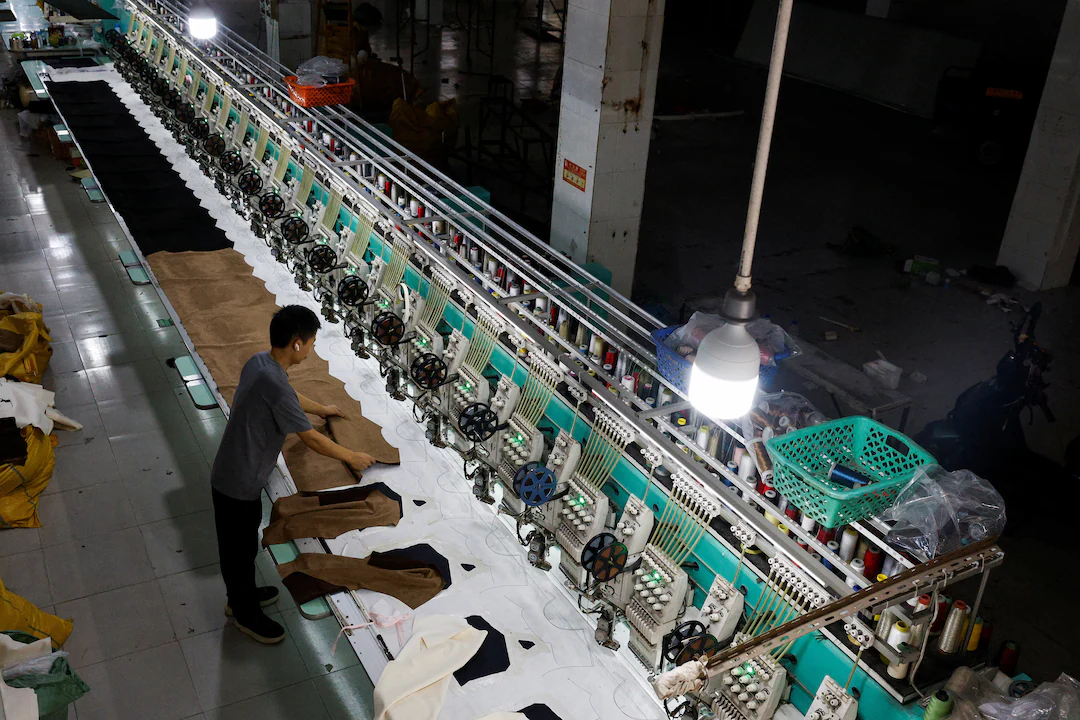
Chinese fast-fashion giant Shein is scaling back a major attempt to establish Vietnam as an alternative manufacturing and export base, after the experiment struggled to match the speed, flexibility and low-cost production network the company has built in China.
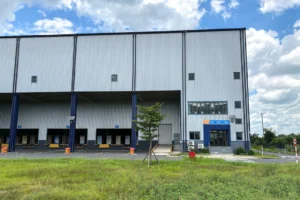
The retreat comes just over a year after Shein leased almost 15 hectares of warehouse space near Ho Chi Minh City, an ambitious move designed partly to reduce the company’s exposure to escalating US-China trade tensions and tariffs. By mid-2026, however, the company had reportedly reduced the footprint to about six hectares, while large parts of the facility were sitting underused.
According to a Reuters investigation, mass layoffs began at the Vietnamese operation in April, with workers saying some teams had been reduced to roughly one-quarter of their previous size. During a Reuters visit in late July, only a small number of workers and trucks were visible at the facility.
Shein’s Vietnam push was initially seen as a hedge against the rapidly changing US trade environment.
When the company made the move, Washington was intensifying tariffs on Chinese imports and there were growing expectations that the US would eliminate the de minimis duty exemption that had helped companies such as Shein send inexpensive individual parcels directly to American consumers.
Shein therefore encouraged some of its major Chinese suppliers to establish operations in Vietnam, hoping the Southeast Asian country could become a significant manufacturing and distribution centre for the brand.
But the economics changed dramatically.
The US subsequently removed the de minimis exemption for low-value shipments from China, while tariffs and other trade restrictions also complicated the case for shifting production. Reuters reported that later US tariffs affected both Chinese and Vietnamese goods, reducing the advantage Shein had hoped to gain by relocating operations.
At the heart of Shein’s problem is not simply the cost of manufacturing.
The company’s business model depends on an enormous network of small suppliers capable of producing tiny batches of new clothing styles extremely quickly, then rapidly increasing production when an item proves popular.
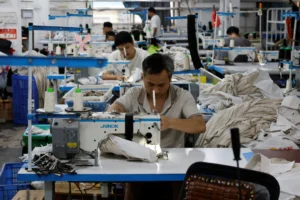
Reuters reported that Shein’s Chinese supplier network can produce millions of styles in small batches, with some suppliers accepting margins as low as about 1 yuan (roughly 15 cents) per item. Orders can be fulfilled within days and quickly repeated based on consumer demand.
That ecosystem is difficult to reproduce elsewhere.
Sheng Lu, a professor of fashion and apparel studies at the University of Delaware, told Reuters that diversification beyond China has practical limits for companies whose competitive advantage depends on speed, flexibility and extremely small production runs.
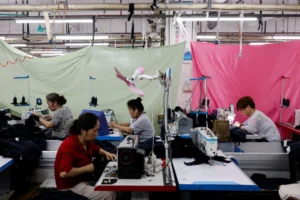
Vietnam offered cheaper labour, but Shein’s demanding production model required a workforce and supplier network capable of operating at extraordinary speed. Sources familiar with Shein’s suppliers told Reuters that finding Vietnamese workers willing to work the long hours associated with the company’s production model had also proved difficult.
The result has been a reversal of the diversification strategy.
Instead of Vietnam becoming the major alternative to China that Shein envisioned, many suppliers have returned their focus to the Chinese manufacturing base.
China’s advantage lies in the dense ecosystem around Shein’s supply chain, particularly in Guangdong, where thousands of manufacturers and supporting businesses operate close to one another.
The company has now signalled that it intends to strengthen that ecosystem rather than move away from it. Shein founder Xu Yangtian pledged in February to invest more than 10 billion yuan ($1.5 billion) in Guangdong over three years to strengthen the company’s supply chain and cross-border e-commerce capabilities.
The investment represents a striking change from Shein’s earlier efforts to emphasise its global identity and reduce attention on its Chinese roots.
The reversal comes at a challenging time for Shein.
The company is facing tougher competition from rivals such as Temu and Amazon, while its US sales have come under pressure. Reuters reported that Shein’s US sales declined by 14%, adding another challenge to a business model already being squeezed by tariffs and higher logistics costs.
Shein is also preparing for a potential Hong Kong stock-market listing after years of uncertainty surrounding its plans to go public. The company secured Chinese regulatory approval to proceed with a Hong Kong IPO, potentially valuing it at more than $40 billion, according to The Wall Street Journal.
The renewed investment in China could therefore serve two purposes: maintaining the manufacturing system that has powered Shein’s extraordinary growth while strengthening its relationship with Chinese authorities as it prepares for the next stage of its corporate expansion.
Shein’s experience illustrates the difficulty facing companies pursuing a “China Plus One” strategy, the idea of maintaining Chinese manufacturing while building alternative production bases elsewhere.
Vietnam has become one of the world’s most important manufacturing centres and has attracted companies seeking to diversify away from China. But simply moving warehouses or factories does not automatically recreate China’s extensive network of suppliers, logistics providers, skilled workers and supporting industries.
For Shein, that network is particularly important because its entire business model revolves around getting new designs from concept to customer at remarkable speed.
The company’s Vietnam experiment therefore appears to have delivered a lesson that many manufacturers have discovered before: moving production is easier than moving the ecosystem that supports it.
For now, Shein is betting that the fastest route to maintaining its competitive advantage still runs through China.