General News
INEC Moves Against Election Deepfakes, Defends Exclusion of Some 2027 Governorship Candidates

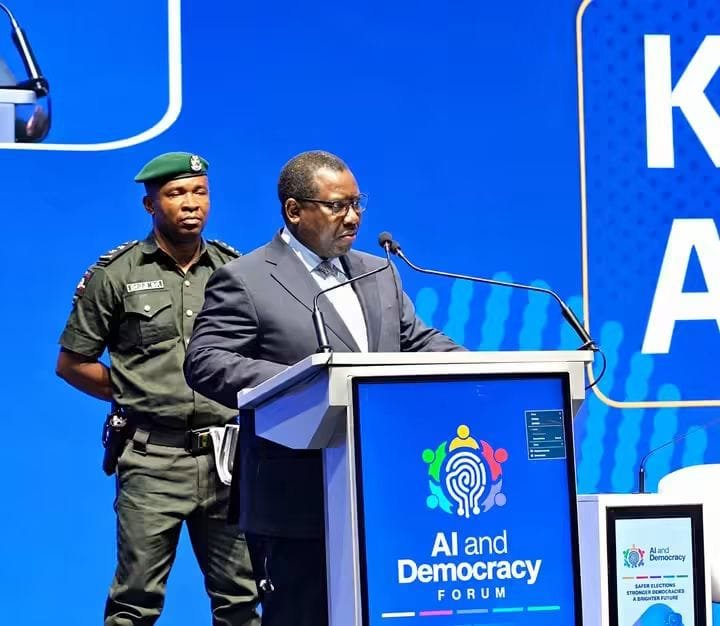
The Independent National Electoral Commission (INEC) has unveiled measures to tackle artificial intelligence-generated misinformation ahead of the 2027 general elections, warning that deepfakes and fabricated digital content could mislead voters and undermine electoral credibility.
INEC Chairman, Prof. Joash Amupitan, announced the measures on Wednesday in Abuja at the 2026 Artificial Intelligence and Democracy Forum, organised in collaboration with Yiaga Africa.
Amupitan said the commission had established an AI Unit within its Information and Communication Technology Directorate to monitor digital threats, detect deepfakes and identify attempts to manipulate election-related information.
He maintained that while artificial intelligence could improve election management, it would not be allowed to replace human judgement in critical electoral decisions.
“Algorithms will not, and must never, decide the 2027 vote,” he said, stressing that the choice of leaders remained the responsibility of Nigerian voters.
The INEC chairman warned that generative AI had made it increasingly easy to produce convincing fake videos, cloned voices and fabricated announcements that could be circulated rapidly on social media.

He said such content could falsely announce a candidate’s withdrawal, announce a postponement of elections, issue fraudulent voting instructions or impersonate electoral officials.
“The greatest threat we face is not the hacking of a ballot box, but the hacking of the voter’s mind,” Amupitan said.
He added that INEC would maintain human oversight over voter accreditation, result collation and candidate qualification, while any AI systems deployed for operational support would undergo rigorous audits for security, fairness and transparency.
AI To Support Logistics, Result Verification
Amupitan said AI could help the commission improve the deployment of election personnel and materials to 176,846 polling units by analysing traffic conditions, weather forecasts, road networks and security incidents.
He also identified statistical analysis of polling unit result sheets, biometric verification of voters and cybersecurity monitoring as areas where the technology could strengthen electoral administration.
According to him, AI-assisted checks could flag mathematical inconsistencies and unusual patterns in result sheets uploaded through the INEC Result Viewing Portal for further administrative review.
He said the technology could also support the detection of duplicate facial and fingerprint records in the National Register of Voters, which contains more than 103 million records.
The commission is also working with technology platforms to promote the rapid identification and labelling of AI-generated electoral content.
The INEC chairman called on Meta, X, Google, TikTok and Telegram to respond quickly to synthetic media impersonating candidates, election officials and security personnel.
He urged political parties and candidates to adopt an ethical AI code of conduct prohibiting deepfakes, synthetic impersonation, deceptive political advertisements and automated bot networks.

He also called for stronger collaboration among INEC, media organisations, civil society groups, fact-checkers and telecommunications operators to identify and counter election-related falsehoods.
INEC Cites Supreme Court Ruling On Candidate Exclusion
In a separate statement, the commission explained that some candidates were omitted from the final list for the 2027 governorship elections because their political parties failed to comply with statutory requirements for submitting membership registers.
INEC said the decision followed the Supreme Court judgement delivered on September 24, 2026, in INEC v. Zenith Labour Party, Appeal No. SC/CV/495/2026.
National Commissioner and Chairman of the Information and Voter Education Committee, Mohammed Kudu Haruna, said the court upheld the constitutionality and mandatory nature of Section 77(5)–(7) of the Electoral Act, 2026.
The provisions require political parties to submit their membership registers as a prerequisite for conducting valid party primaries.
According to Haruna, the court also upheld INEC’s timetable requiring parties to submit the registers between April 21 and May 10, 2026.

He said the judgement established that political parties that failed to comply with the requirements were ineligible to sponsor candidates for the election.
Haruna explained that INEC applied the ruling while finalising the governorship candidates’ list in accordance with Section 287(1) of the 1999 Constitution, as amended.
He noted that the final list of presidential and National Assembly candidates had been published on September 12, 2026, before the Supreme Court delivered its judgement.
The commissioner further reminded political parties that Section 32(2) of the Electoral Act, 2026, allows a party that believes its candidate was wrongly omitted from a published list to notify the commission within 14 days.
He said the deadline for the relevant notifications was October 24, 2026.
INEC reiterated its commitment to conducting credible elections through adherence to electoral laws, transparency and the protection of voters’ rights.