
Opinion
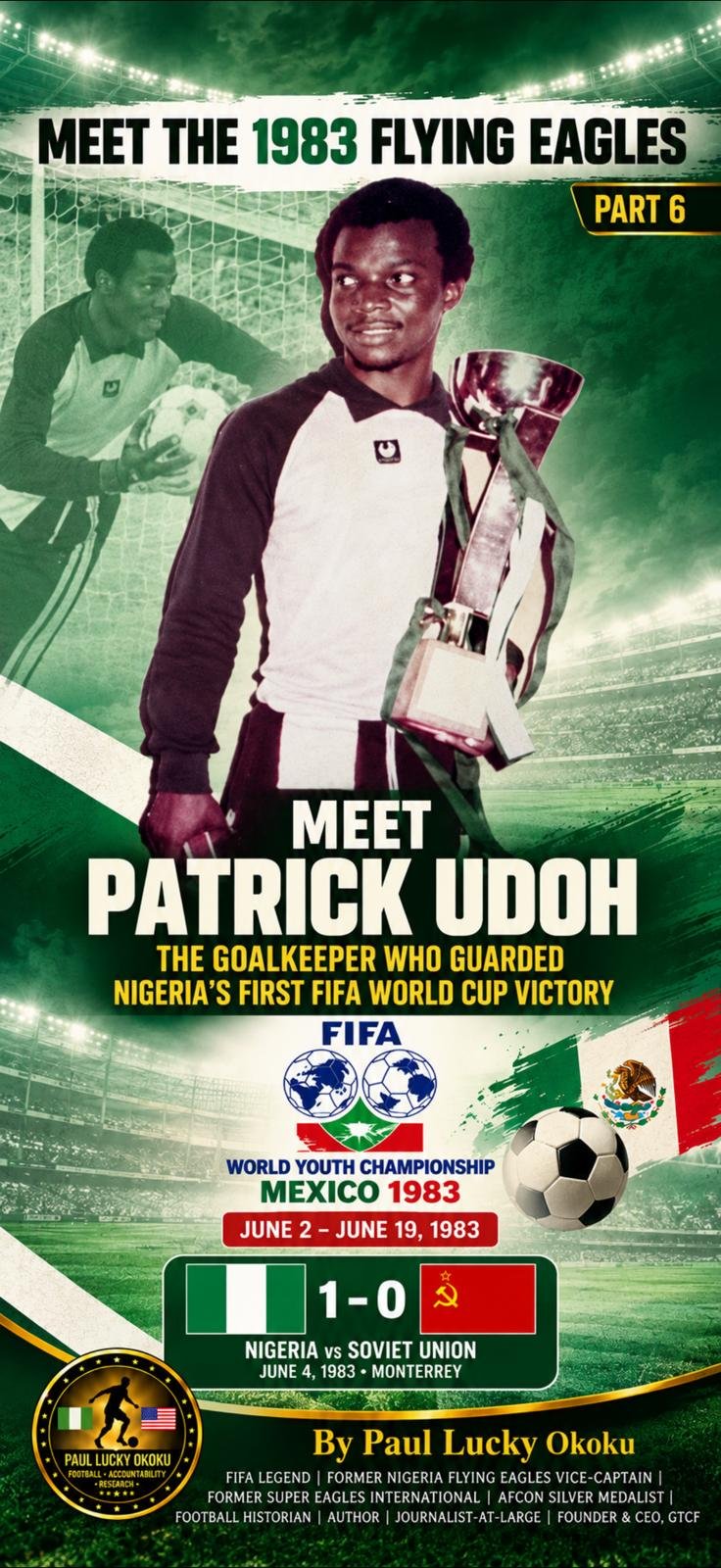
Meet The 1983 Flying Eagles: Part 6 — Meet Patrick Udoh

𝐁𝐲 𝐏𝐚𝐮𝐥 𝐋𝐮𝐜𝐤𝐲 𝐎𝐤𝐨𝐤𝐮
𝐓𝐇𝐄 𝐆𝐎𝐀𝐋𝐊𝐄𝐄𝐏𝐄𝐑 𝐖𝐇𝐎 𝐆𝐔𝐀𝐑𝐃𝐄𝐃 𝐍𝐈𝐆𝐄𝐑𝐈𝐀’𝐒 𝐅𝐈𝐑𝐒𝐓 𝐅𝐈𝐅𝐀 𝐖𝐎𝐑𝐋𝐃 𝐂𝐔𝐏 𝐕𝐈𝐂𝐓𝐎𝐑𝐘
Long before Patrick Udoh stood between the goalposts in Mexico, helping Nigeria achieve its first FIFA World Cup victory, he was a young boy in Ajegunle watching the Green Eagles play a practice match against the Nigerian Navy.
He stood among the spectators at the Navy Sports Ground, fascinated by the footballers representing his country.
Something happened that day.
As Patrick recently recalled to me, watching that match inspired his dream of one day wearing Nigeria’s national colours.
Years later, that childhood dream would carry him from the football grounds of Lagos to the world stage.
On June 4, 1983, Patrick became the goalkeeper who guarded Nigeria’s goal as our pioneering Flying Eagles defeated the Soviet Union 1–0 at the FIFA World Youth Championship in Mexico.
Tarila Okorowanta scored the historic winning goal in the 78th minute.
Patrick kept the clean sheet.
But his story extends far beyond that unforgettable afternoon.
It is a story of childhood ambition, sporting versatility, international achievement, professional determination, football administration and a continuing commitment to developing young Nigerian players.
𝐅𝐑𝐎𝐌 𝐀𝐉𝐄𝐆𝐔𝐍𝐋𝐄 𝐓𝐎 𝐓𝐇𝐄 𝐃𝐑𝐄𝐀𝐌 𝐎𝐅 𝐑𝐄𝐏𝐑𝐄𝐒𝐄𝐍𝐓𝐈𝐍𝐆 𝐍𝐈𝐆𝐄𝐑𝐈𝐀
Patrick’s football journey was influenced by his family and the sporting environment in which he grew up.
His father was a footballer, well known in his community.
In a 2021 interview with journalist Emeka Obasi, Patrick recalled a family story about his father’s promise to buy him a football if he learned to walk before his first birthday. According to Patrick, he fulfilled that challenge and received the promised ball.
His early football experiences included street-against-street competitions in Ajegunle and primary-school tournaments in Badagry Local Government Area.
His performances earned him selection to represent Badagry at the Lagos State Sports Festival.
He subsequently played for Western College of Commerce and Gaskiya College, Ijora Badiya, participating in organised school competitions, including the Lagos State Principals Cup.
Those competitions were important foundations of Nigerian football development.
Before the proliferation of modern academies, school competitions and grassroots programmes provided pathways through which talented youngsters could be discovered.
Patrick was a beneficiary of that system.
But perhaps the most revealing detail of his childhood is the memory he recently shared with me.
Watching the Green Eagles play the Nigerian Navy in Ajegunle awakened his ambition to represent Nigeria.
That memory gives his journey a remarkable symmetry.
The young spectator who admired Nigerian internationals would eventually become one himself.
𝐀 𝐑𝐀𝐑𝐄 𝐂𝐇𝐎𝐈𝐂𝐄 — 𝐇𝐀𝐍𝐃𝐁𝐀𝐋𝐋 𝐎𝐑 𝐅𝐎𝐎𝐓𝐁𝐀𝐋𝐋?
Patrick has also revealed a fascinating detail about his sporting abilities.
In the same year he was invited to join the Flying Eagles, he received an invitation to represent Nigeria in handball at an international assignment in Portugal.
Two national sporting opportunities had presented themselves.
One involved football. The other involved handball.
Patrick chose the Flying Eagles.
That decision proved consequential.
It placed him on the journey that culminated in Nigeria’s historic appearance at the 1983 FIFA World Youth Championship.
It also tells us something about his athletic versatility. Patrick was not simply a goalkeeper who happened to possess good reflexes. He had sufficient ability in another sport to attract national-team attention.
His choice of football ultimately helped shape his place in Nigerian sporting history.
𝐘𝐒𝐅𝐎𝐍 — 𝐖𝐇𝐄𝐑𝐄 𝐎𝐔𝐑 𝐆𝐄𝐍𝐄𝐑𝐀𝐓𝐈𝐎𝐍 𝐃𝐄𝐕𝐄𝐋𝐎𝐏𝐄𝐃
Before Mexico 1983, Patrick and several of us had already experienced international youth football through the Youth Sports Federation of Nigeria (YSFON).
In 1980, our Nigerian youth team emerged victorious at the Gothia Cup in Gothenburg, Sweden.
Patrick was part of that experience, alongside players such as Tajudeen Disu, Loveday Omoruyi, Simeon “Bremner” Allada, Femi and Segun Olukanni, and me.
Our generation also participated in international youth tournaments in Denmark, the United States and Brazil.
The Dana Cup, Dallas Cup and competitions in Rio de Janeiro introduced us to different football environments and playing styles.
Those experiences helped develop the confidence and understanding necessary for international competition.
We were young footballers, but we were already learning what it meant to carry Nigeria’s identity beyond our borders.
Long before we became the Flying Eagles, friendships had been formed, responsibilities understood and dreams shared.
Patrick belonged to that pioneering developmental journey.
𝐓𝐇𝐄 𝐉𝐎𝐔𝐑𝐍𝐄𝐘 𝐓𝐎 𝐌𝐄𝐗𝐈𝐂𝐎 𝟏𝟗𝟖𝟑
Under head coach Christopher Udemezue, assisted by Isiaka Yakubu, our Flying Eagles qualified for the 1983 FIFA World Youth Championship after overcoming Gabon, Zimbabwe and Ivory Coast.
Our late captain, Ali Jeje, led the team, while I served as vice-captain.
It was a historic achievement.
Nigeria had never previously qualified for a FIFA World Cup finals tournament at any level.
We were a generation of young footballers entrusted with opening a door that had remained closed to Nigerian national teams.
For Patrick, another unexpected responsibility awaited.
Wilfred Agbonavbare, our first-choice goalkeeper, remained in Nigeria to complete his West African School Certificate examinations.
Patrick was selected to guard our goal against the Soviet Union.
Our opponents were no ordinary footballing nation.
The Soviet Union had won the inaugural FIFA World Youth Championship in 1977 and finished runners-up in 1979.
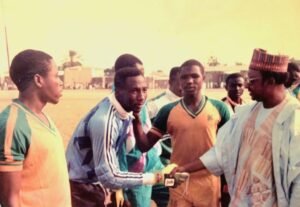
Nigeria was making its debut.
But football history is not determined by reputation alone.
𝐖𝐇𝐄𝐍 𝐃𝐀𝐕𝐈𝐃 𝐃𝐄𝐅𝐄𝐀𝐓𝐄𝐃 𝐆𝐎𝐋𝐈𝐀𝐓𝐇
On June 4, 1983, we faced the Soviet Union in Monterrey, Mexico, before 37,837 spectators.
The match remained goalless until the 78th minute.
Then Tarila Okorowanta scored.
Nigeria led 1–0.
Patrick remained between the goalposts as we defended our advantage and completed an unforgettable victory.
Afterward, the result was celebrated through the biblical imagery of David defeating Goliath, a headline Patrick still remembers more than four decades later.
The comparison captured the significance of what had happened.
A Nigerian team making its World Cup debut had defeated a nation with an established history of success in the competition.
An account of the match preserved in Russian football records also praised Patrick’s goalkeeping, describing how he prevented Soviet opportunities from becoming goals.
This is important because it places his contribution beyond the final scoreline.
Patrick did not merely occupy the goalkeeper’s position. He performed the responsibility entrusted to him against formidable opposition.
In his 2021 interview, Patrick recalled kneeling and making the sign of the cross following Tarila’s goal.
It was an expression of gratitude during an extraordinary moment.
We had achieved something no Nigerian national team had previously accomplished at a FIFA World Cup finals tournament.
Tarila became Nigeria’s first World Cup goalscorer.
Patrick became the goalkeeper who helped secure Nigeria’s first World Cup victory and clean sheet.
Two teammates. Different responsibilities. One historic achievement.
𝐁𝐑𝐀𝐙𝐈𝐋, 𝐓𝐇𝐄 𝐍𝐄𝐓𝐇𝐄𝐑𝐋𝐀𝐍𝐃𝐒 𝐀𝐍𝐃 𝐓𝐇𝐄 𝐋𝐄𝐒𝐒𝐎𝐍𝐒 𝐎𝐅 𝐌𝐄𝐗𝐈𝐂𝐎
Our second match, against Brazil on June 6, presented a difficult challenge.
Brazil defeated Nigeria 3–0 in Guadalajara.
Patrick started in goal, with Wilfred Agbonavbare replacing him at halftime after Brazil had scored all three goals.
Years later, Patrick explained that problems involving our jerseys disrupted preparations, resulting in the team arriving late and entering the match without a proper warm-up.
He also recalled tensions surrounding Tarila Okorowanta’s interactions with journalists following the Soviet Union victory.
These are important recollections of the pressures surrounding our young team during a historic tournament.
Brazil eventually won the championship, demonstrating the quality of that generation.
In our final group match, Nigeria drew 0–0 with the Netherlands, whose squad included Marco van Basten and Gerald Vanenburg.
Wilfred started that encounter.
We did not advance beyond the group stage, but the significance of our qualification, victory and participation remained.
Our generation had opened Nigeria’s FIFA World Cup history.
𝐓𝐇𝐄 𝐖𝐀𝐅𝐔 𝐂𝐔𝐏 𝐀𝐍𝐃 𝐓𝐇𝐄 𝐆𝐑𝐄𝐄𝐍 𝐄𝐀𝐆𝐋𝐄
Patrick’s international football experience was not limited to Mexico.
He has identified his involvement in a victorious West African Football Union (WAFU) Cup campaign as another memorable achievement of his career.
He also progressed into the senior Green Eagles environment in 1984.
That year, he participated in the Great Wall Cup in China, where he developed a close friendship with fellow goalkeeper Patrick Okala.
Patrick recalled replacing Okala following an injury during the competition.
Other difficulties, including injuries and missing luggage, placed considerable demands on the Nigerian squad.
The relationship between the two goalkeepers continued well beyond that tournament.
Patrick travelled from Lagos to Enugu to attend Okala’s wedding, a reflection of a friendship that endured until Okala’s death in 1991.
These memories reveal something about football that statistics cannot capture.
International competition creates achievements that enter record books, but it also creates relationships that remain meaningful throughout life.
𝐓𝐇𝐄 𝐅𝐎𝐎𝐓𝐁𝐀𝐋𝐋𝐄𝐑 𝐖𝐇𝐎 𝐀𝐋𝐒𝐎 𝐁𝐔𝐈𝐋𝐓 𝐀 𝐁𝐀𝐍𝐊𝐈𝐍𝐆 𝐂𝐀𝐑𝐄𝐄𝐑
Another aspect of Patrick’s life deserves recognition.
While playing competitive football, he also pursued a professional career in banking.
This required him to balance the demands of employment with training, matches and the responsibilities of a footballer.
His playing career included First Bank Lagos, NITEL Lagos, Water Corporation Ilorin and NEPA Lagos.
Patrick was also capable of playing outside the goalkeeping position, occasionally appearing as an outfield player during his club career.
His professional life illustrates an important reality about Nigerian footballers of our generation.
Many players pursued education, employment or other careers while continuing to represent their clubs and country.
Football was an important part of our lives, but it was not necessarily the only part.
Patrick’s ability to combine banking with his sporting ambitions reflects that broader experience.
𝐅𝐑𝐎𝐌 𝐆𝐎𝐀𝐋𝐊𝐄𝐄𝐏𝐄𝐑 𝐓𝐎 𝐀𝐖𝐀𝐑𝐃-𝐖𝐈𝐍𝐍𝐈𝐍𝐆 𝐂𝐎𝐀𝐂𝐇
Patrick eventually moved from playing into coaching.
He began at First Bank, where he progressed to become head coach.
His subsequent assignments included Starlets Uyo, Bridge FC Lagos, Akwa United and Vandrezzer FC.
One notable achievement came during his time at Akwa United.
In March 2014, Patrick received the League Bloggers Award for Manager of the Month after guiding Akwa United through an unbeaten run of five league matches.
The recognition was significant.
It acknowledged his work not as a former international relying on past reputation, but as a coach achieving results in competitive Nigerian domestic football.
His football journey had entered another chapter.
The goalkeeper who once depended on teammates to execute a collective plan was now responsible for preparing and directing an entire team.
In May 2025, Patrick was also reported as head coach of Godswill Akpabio United in the Nigeria National League.
His continued involvement reflected decades of service across different levels of Nigerian football.
𝐀 𝐒𝐏𝐄𝐂𝐈𝐀𝐋 𝐀𝐒𝐒𝐈𝐆𝐍𝐌𝐄𝐍𝐓 — 𝐀𝐅𝐂𝐎𝐍 𝟐𝟎𝟎𝟎
Patrick has also disclosed another important appointment that deserves a place in his historical record.
He served as a member of the Technical Committee during the 2000 African Cup of Nations, jointly hosted by Nigeria and Ghana.
This assignment placed him within the technical organisation of one of Africa’s most important football competitions.
The tournament remains memorable to Nigerians because the Super Eagles reached the final before losing to Cameroon on penalties in Lagos.
Patrick’s involvement in the Technical Committee illustrates another dimension of his contribution to football.
He had participated as a player, developed his career as a coach and undertaken responsibilities connected with an international continental championship.
His experience was no longer confined to the goalposts or the touchline.
It extended into the technical affairs of the game.
𝐓𝐎𝐃𝐀𝐘 — 𝐃𝐄𝐕𝐄𝐋𝐎𝐏𝐈𝐍𝐆 𝐓𝐎𝐌𝐎𝐑𝐑𝐎𝐖’𝐒 𝐅𝐎𝐎𝐓𝐁𝐀𝐋𝐋𝐄𝐑𝐒
Patrick’s latest personal update provides an especially fitting continuation of his story.
As of October 2026, he serves as 𝐒𝐩𝐨𝐫𝐭𝐬 𝐃𝐢𝐫𝐞𝐜𝐭𝐨𝐫 𝐨𝐟 𝐏𝐈𝐎 𝐅𝐨𝐨𝐭𝐛𝐚𝐥𝐥 𝐀𝐜𝐚𝐝𝐞𝐦𝐲, located at KM 5 Airport Road, Uyo, Akwa Ibom State.
More than four decades after helping Nigeria make history in Mexico, he remains connected to the development of young football talent.
There is something profoundly meaningful about that continuity.
A young Patrick once watched the Green Eagles at the Navy Sports Ground in Ajegunle and imagined himself wearing Nigeria’s colours.
Today, he occupies a position where he can help another generation of youngsters pursue similar ambitions.
The spectator became an international.
The international became a coach.
The coach became a developer of future footballers.
His journey has come full circle.
𝐖𝐇𝐘 𝐎𝐔𝐑 𝐏𝐈𝐎𝐍𝐄𝐄𝐑𝐈𝐍𝐆 𝐆𝐄𝐍𝐄𝐑𝐀𝐓𝐈𝐎𝐍 𝐌𝐔𝐒𝐓 𝐁𝐄 𝐑𝐄𝐌𝐄𝐌𝐁𝐄𝐑𝐄𝐃
During our recent correspondence, Patrick expressed his gratitude for this historical series while raising a concern shared by many former internationals of our generation.
He observed that Nigerian football discussions frequently celebrate the 1994 Super Eagles while giving comparatively little attention to earlier pioneers.
The achievements of the 1994 generation deserve their recognition.
But Nigerian football history did not begin in 1994.
There were generations of footballers whose sacrifices, qualification campaigns and international performances helped establish the foundation for what followed.
Our 1983 Flying Eagles generation was the first Nigerian national team to qualify for a FIFA World Cup finals tournament.
That achievement deserves a permanent place in the country’s sporting memory.
Patrick’s personal recollections also demonstrate why these stories must be documented while the participants can still contribute.
Without his latest account, how many people would know that his ambition began while watching the Nigerian Navy play the Green Eagles?
How many would know that he received invitations to represent Nigeria in two different sports?
Or that his football career extended into banking, a coaching award, AFCON technical responsibilities and his current academy work?
History becomes richer when the people who lived it are given the opportunity to tell it.
𝐌𝐘 𝐏𝐄𝐑𝐒𝐎𝐍𝐀𝐋 𝐓𝐑𝐈𝐁𝐔𝐓𝐄 𝐓𝐎 𝐏𝐀𝐓𝐑𝐈𝐂𝐊
Patrick, I am grateful that you took the time to review your story and share additional memories with me.
Your recollections have helped reveal dimensions of your life and career that deserve to be remembered.
As your former teammate and vice-captain of our pioneering Flying Eagles generation, I am proud of what we accomplished together.
I am equally proud that, decades after Mexico, you continue to contribute to Nigerian football.
Our generation’s history cannot be told through match scores alone.
It must include the childhood dreams, difficult choices, personal sacrifices, professional achievements and friendships that shaped the people behind those results.
Your story contains all of these.
I hope the young footballers passing through PIO Football Academy understand that their Sports Director once stood between Nigeria’s goalposts on a day when our country made FIFA World Cup history.
And I hope they recognise that the journey from their own training ground to international football is possible through commitment, preparation and opportunity.
Thank you, Patrick, for your contribution to our pioneering generation.
Thank you for your continued service to Nigerian football.
And thank you for helping preserve a history that belongs not only to us, but also to future generations.
𝐓𝐡𝐞 𝐠𝐨𝐚𝐥 𝐛𝐞𝐥𝐨𝐧𝐠𝐬 𝐭𝐨 𝐓𝐚𝐫𝐢𝐥𝐚.
𝐓𝐡𝐞 𝐜𝐥𝐞𝐚𝐧 𝐬𝐡𝐞𝐞𝐭 𝐛𝐞𝐥𝐨𝐧𝐠𝐬 𝐭𝐨 𝐏𝐚𝐭𝐫𝐢𝐜𝐤.
𝐓𝐡𝐞 𝐯𝐢𝐜𝐭𝐨𝐫𝐲 𝐛𝐞𝐥𝐨𝐧𝐠𝐬 𝐭𝐨 𝐍𝐢𝐠𝐞𝐫𝐢𝐚𝐧 𝐟𝐨𝐨𝐭𝐛𝐚𝐥𝐥 𝐡𝐢𝐬𝐭𝐨𝐫𝐲.
𝐏𝐚𝐮𝐥 𝐋𝐮𝐜𝐤𝐲 𝐎𝐤𝐨𝐤𝐮
FIFA Legend | Former Nigeria Flying Eagles Vice-Captain | Former Super Eagles International | AFCON Silver Medalist | Football Historian | Football Analyst | Investigative Football Writer | Journalist-at-Large | Founder & CEO, Greater Tomorrow Children’s Fund (GTCF).
𝐀𝐔𝐓𝐇𝐎𝐑’𝐒 𝐍𝐎𝐓𝐄
Part 6 of the Meet the 1983 Flying Eagles historical series, preserving the achievements and personal journeys of Nigeria’s pioneering youth internationals.
This profile incorporates additional firsthand information provided by Patrick Udoh in October 2026.
𝐑𝐄𝐒𝐄𝐀𝐑𝐂𝐇 𝐓𝐑𝐀𝐍𝐒𝐏𝐀𝐑𝐄𝐍𝐂𝐘
Sources include the author’s firsthand experiences, historical match records, Patrick Udoh’s 2021 interview with Emeka Obasi in The Next Edition, contemporary football reporting and Patrick’s direct contributions to this biography.
𝐅𝐎𝐑 𝐅𝐄𝐄𝐃𝐁𝐀𝐂𝐊 𝐀𝐍𝐃 𝐂𝐎𝐌𝐌𝐄𝐍𝐓𝐒
PaulOkokuMediaHub@gmail.com
Please feel free to share this article so that the achievements of our pioneering football generation are preserved for those who follow us.