
General News
Atiku Faults Tinubu’s 30-Day Petrol Discount, Revives Call For Production-Based Subsidy

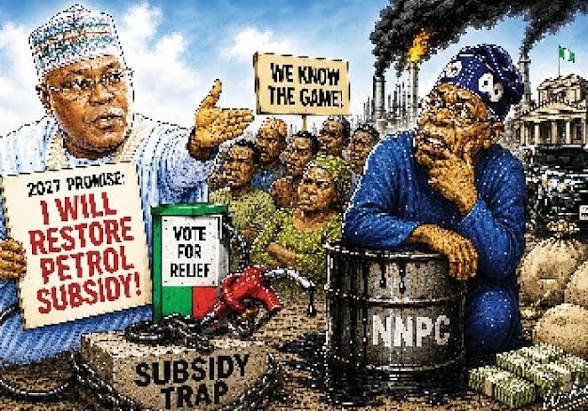
Former Vice President and African Democratic Congress (ADC) presidential candidate, Atiku Abubakar, has criticised the Federal Government’s proposed 30-day petrol discount at Nigerian National Petroleum Company Limited (NNPCL) stations, describing it as temporary relief that does not address the underlying cost-of-living crisis.
Atiku, in a statement issued by his media office on Thursday, also renewed his call for a transparent, production-based subsidy tied to petrol refined locally, arguing that such an approach would provide more sustainable relief while supporting domestic refining.
The reaction followed the Federal Government’s announcement of a 30-day discount on petrol sold at NNPCL retail outlets as part of measures to cushion consumers against high fuel prices and stabilise pump prices. Finance Minister and Coordinating Minister of the Economy, Taiwo Oyedele, said the arrangement was neither a subsidy nor price control, but a mechanism designed to smooth out petrol prices.
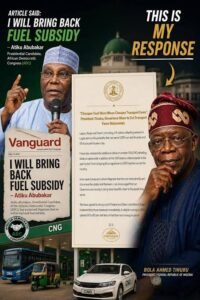
Atiku, however, questioned the scope and duration of the intervention, asking what would happen when the 30-day period ends.
He argued that Nigerians require lasting measures to reduce petrol and transportation costs rather than a short-term intervention.
“Today, the same administration is announcing government-negotiated price ceilings, discounted petrol sales and arrangements to cushion consumers against market fluctuations,” the statement said.
The former vice president said the development raised questions about the Federal Government’s previous rejection of his proposal for production-based support for locally refined petrol.
According to him, the administration and its supporters had previously dismissed the proposal as economically unsound, yet it was now considering measures aimed at influencing petrol prices.
Atiku said his proposal was based on transparent, targeted and time-bound support for domestic refining, with safeguards to ensure that lower production costs translated into lower pump prices for consumers.
He also questioned the accessibility of the government’s intervention, which is initially focused on NNPCL retail outlets.
“NNPC Retail has a network of more than 900 outlets nationwide. Spread across Nigeria’s 36 states and the Federal Capital Territory, that represents an average of roughly 25 stations per state and the FCT, although the actual distribution is far from uniform,” the statement said.
He argued that Nigerians living in communities without NNPCL stations could be excluded from the benefit or forced to travel longer distances to access discounted petrol.
Atiku further challenged the government to explain how the proposed intervention would work if petrol availability remained uneven across the NNPCL retail network.
The ADC candidate also questioned the distinction drawn by the government between its proposed intervention and a subsidy.
He asked how any shortfall created by a price ceiling would be recovered and whether the cost would eventually be borne by public resources, NNPCL revenues or consumers.
“If an intervention transfers costs, postpones their recovery or uses public resources to make petrol cheaper, it raises legitimate subsidy-related questions that cannot be dismissed by changing its name,” he said.
Atiku also linked the renewed debate over fuel-price intervention to the Federal Government’s reported consideration of forward crude sales to domestic refiners, arguing that production-side measures deserved greater attention.
He said supporting domestic refining could reduce avoidable costs, strengthen local production and create a mechanism for delivering more sustainable relief to consumers.
The former vice president’s criticism came a day after President Bola Tinubu’s Special Adviser on Policy Communication, Daniel Bwala, acknowledged that more Nigerians had fallen into poverty following the administration’s economic reforms, while maintaining that the government had made progress since introducing the measures. Bwala made the comments during an appearance on Channels Television’s Politics Today on Wednesday.
Atiku said the acknowledgement underscored the need for the government to reassess measures affecting the welfare of Nigerians.
The statement urged the administration to publish details of the proposed petrol price intervention, including its financial implications and participating outlets, and explain how Nigerians without access to NNPCL stations would benefit.
It also called for clarity on how the intervention would translate into lower transport fares, reduced food prices and broader reductions in the cost of living.
Atiku maintained that the government’s response should focus on policies capable of delivering sustained relief rather than temporary measures.
“Nigerians need an enduring policy response, not temporary political relief calculated against the electoral calendar,” the statement said.
He further challenged the administration to explain the policy shift from its earlier position on subsidy and production support, insisting that the welfare of Nigerians should remain the central consideration in determining economic policy.