Foreign
China Launches Shenzhou-24 With First Pakistani Astronaut Aboard

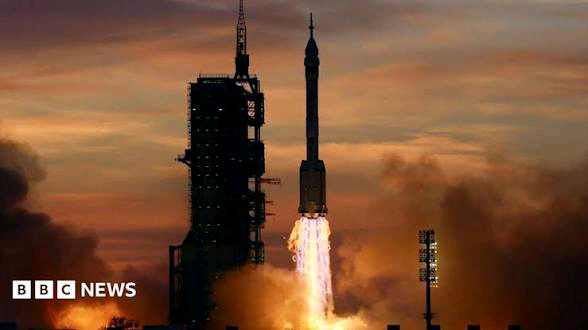
China launched the Shenzhou-24 crewed spaceship on Wednesday morning, sending three astronauts to the Tiangong space station, including the first foreign astronaut ever to visit the orbital outpost.
The Long March-2F carrier rocket carrying the spacecraft blasted off from the Jiuquan Satellite Launch Center in northwest China at 8:18 a.m. Beijing Time, according to the China Manned Space Agency.
About ten minutes after liftoff, the spaceship separated from the rocket and entered its designated orbit. The CMSA declared the launch “a complete success” and confirmed that the astronauts were in good condition.
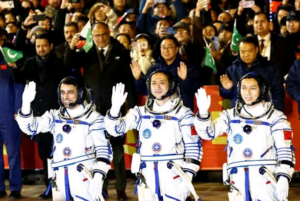
The crew consists of mission commander and spacecraft pilot Tang Hongbo, flight engineer Wu Yi, and Pakistani payload specialist Muhammad Zeeshan Ali.
The Shenzhou-24 mission marks the first joint flight involving Chinese and foreign astronauts in the history of China’s manned space program.
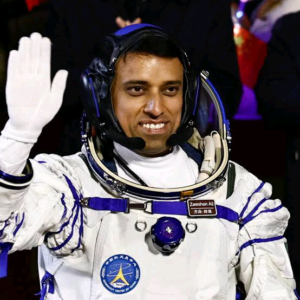
Ali, a 40-year-old Pakistani Air Force pilot, will become the first non-Chinese national to board the Tiangong space station.
He will conduct a short-term mission focused on China-Pakistan cooperative experiments, including an in-orbit study on photosynthetic cyanobacteria and tests on the effects of spaceflight on quinoa seeds.
Speaking at a pre-launch press conference, Ali reflected on the significance of his mission.
“I carry the name of Pakistan on my shoulder, the hopes of 250 million Pakistanis,” he said. “To every child who is watching while I’m in orbit, just look up at the sky and remember that I am up there with your dreams”.
He also described the challenges of his training, noting that mastering technical Chinese was his biggest hurdle. “All the switches, all the software, all the programs, all the voice announcement. Everything is in Chinese, so we had to learn that, master that technical Chinese”.
Pakistani Prime Minister Shehbaz Sharif hailed the mission as a testament to the bond between the two nations, stating that “Pakistan-China friendship is surpassing the heights of the Himalayas, in its journey to outer space”.
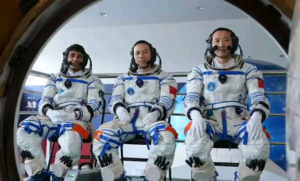
The CMSA spokesperson Zhang Jingbo noted that more than 90 scientific experiments and technology tests are planned for the mission, covering space life sciences, microgravity fluid physics, and space medicine, among other fields.
After completing his short orbital stay, Ali is scheduled to return to Earth aboard the Shenzhou-23 spacecraft alongside two crew members already aboard Tiangong. Tang Hongbo and Wu Yi will remain in orbit for roughly six months.
Tang, who has flown on two previous missions, becomes the first astronaut to board the Tiangong space station three times.
Wednesday’s launch also marked the 680th flight of the Long March carrier rocket series.