General News
Killings Will Continue Until Government Stops “Negotiating With Terrorists”- Senator Abba Blasts Security Strategy Amid Benue Bloodshed


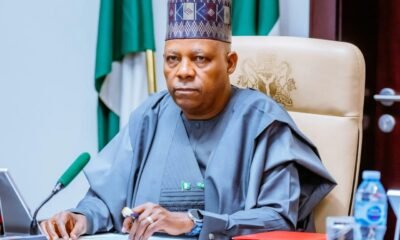
Senator Abba has launched a scathing critique of Nigeria’s handling of rising insecurity, warning that the country’s continued “approach of negotiation and silence” is emboldening armed groups responsible for repeated mass killings across several regions.
Speaking to journalists in reaction to the latest wave of violence in Benue South Senatorial District, the senator said the government appears to lack the political will to decisively confront the worsening security situation, describing the national response as “routine, repetitive and ineffective.”

He lamented that despite years of military deployments, security meetings, and repeated one-minute silences in the National Assembly, killings have persisted almost daily across the country.
“What is worrying Nigerians now is not whether government thinks it wants to fight insecurity, but why the killings are still continuing at this scale,” he said. “Why are we still unable to stamp out insecurity we already understand clearly?”
Citing Boko Haram insurgency in the North-East, banditry and mass abductions in the North-West, and recurring armed attacks in North Central Nigeria, the senator said the patterns of violence were well known, yet responses had remained largely unchanged over the years.
He questioned the effectiveness of Nigeria’s security operations, arguing that authorities often arrive after attacks have been carried out rather than preventing them.
“All we see is one-minute silence after another. Security agencies go in after the fact to recover bodies. The real question is: why are they not stopping the killings before they happen?” he said.
The senator further expressed concern over what he described as a failure of intelligence gathering and early warning systems, insisting that modern security practice globally prioritises prevention over reaction.
“Intelligence gathering is supposed to prevent attacks and enable arrests before damage is done. Why is Nigeria’s case different?” he asked.
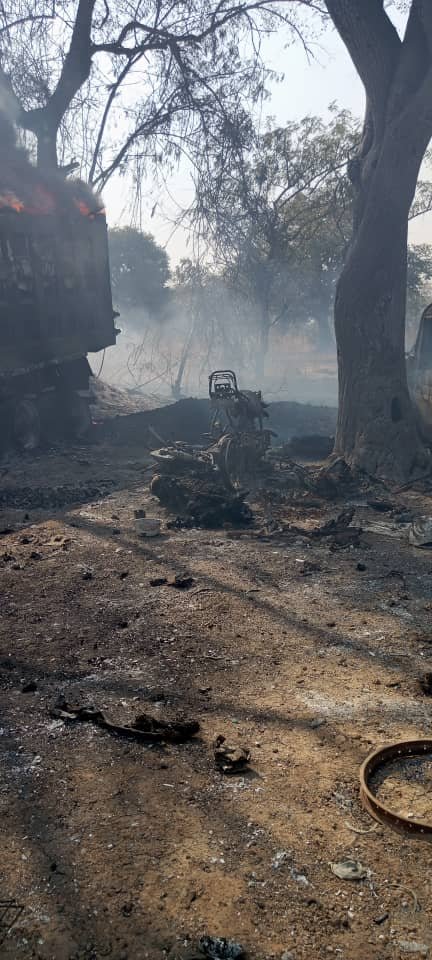
He referenced recent violent attacks in Benue State, particularly in Apa Local Government Area, where communities have reportedly suffered repeated deadly assaults.
He noted that on April 12, 2026, at least nine people were killed in Edikwu Ankpali by suspected armed herders, following earlier attacks in January 2025 that left about 11 people dead in the same axis.
According to him, renewed violence in the area has since claimed more lives, with little evidence of lasting security intervention.
The senator also recounted his personal intervention in 2025, saying he had visited affected communities and attempted to support police operations, including proposals to refurbish operational vehicles for improved deployment.
However, he claimed the arrangement collapsed, after which security presence in the area weakened.
“Because I did not provide the funds they demanded for vehicle adjustments, I never saw them again in that capacity. Today, the same communities are under attack again,” he said.
He accused the state of indirectly emboldening violent groups through what he described as a pattern of “capitulation and negotiation.”
“Why would these attackers not be emboldened when government is virtually negotiating with terrorists and bandits?” he asked.
The senator further criticised reports that security operatives sometimes avoid direct confrontation with armed groups due to superior weaponry held by non-state actors, describing it as a dangerous admission of weakness.
“You hear security personnel say they cannot engage because bandits have better weapons. That alone tells you how deep the problem has become,” he said.
Advancing his position on what should be done, the senator rejected negotiation and ransom payment as counterproductive, insisting that armed groups should be tracked and eliminated through coordinated military action.
“You do not negotiate with terrorists. You do not pay ransom. You identify them and decimate them. That is how it is done globally,” he said, citing international counter-terrorism responses as examples.
He compared Nigeria’s approach with that of other countries, arguing that even in high-pressure situations abroad, governments deploy maximum force to rescue citizens.
“Why are we not deploying the same urgency and intelligence here?” he asked.
The senator also criticised what he called a growing distraction among political leaders, alleging that governance has been overshadowed by election politics and second-term ambitions while insecurity worsens.
“People are more focused on political survival than governance. Meanwhile, citizens are bleeding,” he said.
He further condemned the practice of releasing arrested suspects under so-called “repentant” arrangements without full prosecution, warning that it weakens deterrence and undermines public confidence in the justice system.
“If those who have killed and destroyed communities are arrested and later released without consequence, then the system is not serious about justice,” he said.
The senator warned that unless Nigeria shifts from what he called a reactive and conciliatory posture to a decisive security strategy, the cycle of killings will continue unabated.