
Opinion
Nigeria Vs. Guinea-Bissau Retrospect: The Pitch Is Not Why Nigeria Lost — But It Is A Factor

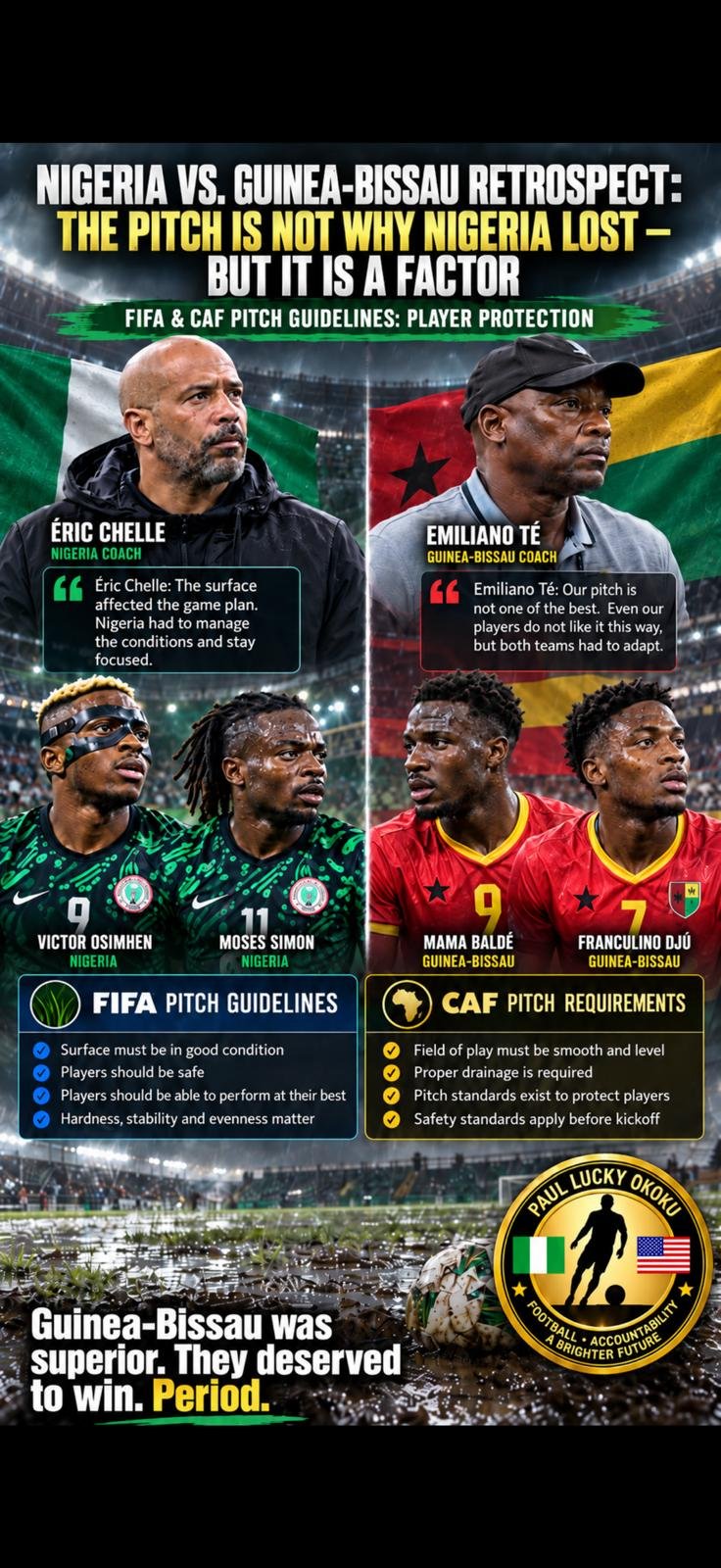
Following Nigeria’s 3–0 defeat to Guinea-Bissau, there has been considerable debate about the Super Eagles’ performance and the condition of the playing surface at the Estádio Nacional 24 de Setembro.
Before discussing that pitch, however, I want to establish something clearly.
𝐌𝐘 𝐀𝐍𝐀𝐋𝐘𝐒𝐈𝐒 𝐍𝐄𝐕𝐄𝐑 𝐄𝐗𝐂𝐔𝐒𝐄𝐃 𝐍𝐈𝐆𝐄𝐑𝐈𝐀
In my own analysis of that match, I was critical of the Super Eagles.
I said Nigeria were slow.
I said we were beaten too often to second balls.
I questioned our lack of urgency in the final third.
I pointed to missed opportunities.
I questioned our reaction when Guinea-Bissau increased the intensity.
And I again highlighted a recurring problem that has concerned me: 𝐍𝐢𝐠𝐞𝐫𝐢𝐚 𝐡𝐚𝐬 𝐭𝐨 𝐬𝐭𝐨𝐩 𝐜𝐨𝐧𝐜𝐞𝐝𝐢𝐧𝐠 𝐟𝐢𝐫𝐬𝐭.
Against Guinea-Bissau, Franculino Djú scored in the 15th minute, Mama Baldé added the second in the 66th and Álvaro Djaló completed the 3–0 victory in stoppage time. (Soccerzz)
Guinea-Bissau deserved their victory.
Nigeria played poorly.
Nothing I am about to say changes that assessment.
But acknowledging a poor Nigerian performance should not require us to pretend that the condition of the playing surface is irrelevant.
Those are two separate questions.
𝐖𝐇𝐀𝐓 𝐓𝐇𝐄 𝐏𝐋𝐀𝐘𝐄𝐑 𝐅𝐄𝐄𝐋𝐒 𝐓𝐇𝐀𝐓 𝐓𝐇𝐄 𝐒𝐏𝐄𝐂𝐓𝐀𝐓𝐎𝐑 𝐂𝐀𝐍𝐍𝐎𝐓
Those who have played the game understand that there are things a television camera cannot fully communicate.
The player feels the ground.
When a field is soft, uneven, saturated or unreliable underfoot, that information is transmitted through every movement.
You accelerate.
You stop.
You turn.
You plant one foot to strike the ball with the other.
You stretch for a second ball.
You jump while another player challenges you.
You land without always knowing precisely how the surface beneath your foot will respond.
If the ground does not feel trustworthy, the body can react differently.
Sometimes consciously.
Sometimes subconsciously.
A useful word here is 𝐬𝐭𝐢𝐦𝐮𝐥𝐮𝐬.
A slippery section is a stimulus.
A soft patch is a stimulus.
An uneven landing area is a stimulus.
The memory of a previous ankle or knee injury is a stimulus.
Human beings do not always react identically to the same stimulus.
That is why I have said:
𝐄𝐪𝐮𝐚𝐥 𝐜𝐨𝐧𝐝𝐢𝐭𝐢𝐨𝐧𝐬 𝐝𝐨 𝐧𝐨𝐭 𝐚𝐥𝐰𝐚𝐲𝐬 𝐩𝐫𝐨𝐝𝐮𝐜𝐞 𝐞𝐪𝐮𝐚𝐥 𝐫𝐞𝐚𝐜𝐭𝐢𝐨𝐧𝐬.
𝐅𝐈𝐅𝐀’𝐒 𝐏𝐈𝐓𝐂𝐇 𝐆𝐔𝐈𝐃𝐄𝐋𝐈𝐍𝐄𝐒: 𝐖𝐇𝐘 𝐓𝐇𝐄 𝐒𝐓𝐀𝐍𝐃𝐀𝐑𝐃𝐒 𝐄𝐗𝐈𝐒𝐓
FIFA itself explains why playing surfaces matter.
FIFA says the playing surface must be kept in good condition so that players are safe and able to perform to the best of their ability.

Its Quality Programme for Natural Playing Surfaces establishes standardized testing criteria for judging pitch quality.
The technical assessment considers characteristics including 𝐡𝐚𝐫𝐝𝐧𝐞𝐬𝐬, 𝐬𝐭𝐚𝐛𝐢𝐥𝐢𝐭𝐲 and 𝐞𝐯𝐞𝐧𝐧𝐞𝐬𝐬, together with the interaction between the ball and the surface. FIFA says these criteria are intended to provide a safe, high-performance surface.
FIFA’s wider Quality Programme says its standards are built around player needs and aspects including safety, performance, durability and playing comfort.
So why do those standards exist?
Because the football pitch is not simply decoration.
It is part of the equipment upon which the game depends.
If surface condition did not matter, FIFA would have no reason to measure stability.
No reason to measure evenness.
No reason to measure hardness.
And no reason to connect pitch condition explicitly with player safety.
𝐏𝐋𝐀𝐘𝐄𝐑 𝐏𝐑𝐎𝐓𝐄𝐂𝐓𝐈𝐎𝐍 𝐈𝐒 𝐀𝐋𝐒𝐎 𝐂𝐀𝐑𝐄𝐄𝐑 𝐏𝐑𝐎𝐓𝐄𝐂𝐓𝐈𝐎𝐍
A professional footballer earns his living with his body.
His ankles matter.
His knees matter.
His Achilles tendons matter.
His muscles matter.
His ability to accelerate, turn, stop and absorb contact matters.
One awkward planting of the foot can cause an injury.
One serious injury can mean surgery.
Months of rehabilitation.
Lost playing time.
A reduced contract.
And, in the worst cases, the premature ending of a career.
FIFA’s regulations may use the language of 𝐩𝐥𝐚𝐲𝐞𝐫 𝐬𝐚𝐟𝐞𝐭𝐲 rather than the phrase “career protection.”
But the practical connection is obvious.
𝐖𝐡𝐞𝐧 𝐲𝐨𝐮 𝐩𝐫𝐨𝐭𝐞𝐜𝐭 𝐭𝐡𝐞 𝐩𝐥𝐚𝐲𝐞𝐫’𝐬 𝐛𝐨𝐝𝐲, 𝐲𝐨𝐮 𝐚𝐫𝐞 𝐚𝐥𝐬𝐨 𝐩𝐫𝐨𝐭𝐞𝐜𝐭𝐢𝐧𝐠 𝐭𝐡𝐞 𝐢𝐧𝐬𝐭𝐫𝐮𝐦𝐞𝐧𝐭 𝐮𝐩𝐨𝐧 𝐰𝐡𝐢𝐜𝐡 𝐡𝐢𝐬 𝐜𝐚𝐫𝐞𝐞𝐫 𝐝𝐞𝐩𝐞𝐧𝐝𝐬.
Think about a professional truck driver travelling during severe winter weather.
He may have driven professionally for 20 years.

His licence has not disappeared.
His skill has not disappeared.
But if snow and ice cover the highway, the environment has changed the risk.
He slows down.
He becomes more cautious.
He avoids sudden manoeuvres.
And sometimes authorities close the road altogether because professional ability does not remove environmental danger.
Football is different transportation, but the principle is the same.
𝐏𝐫𝐨𝐟𝐞𝐬𝐬𝐢𝐨𝐧𝐚𝐥 𝐬𝐤𝐢𝐥𝐥 𝐝𝐨𝐞𝐬 𝐧𝐨𝐭 𝐞𝐥𝐢𝐦𝐢𝐧𝐚𝐭𝐞 𝐞𝐧𝐯𝐢𝐫𝐨𝐧𝐦𝐞𝐧𝐭𝐚𝐥 𝐫𝐢𝐬𝐤.
𝐂𝐀𝐅’𝐒 𝐎𝐖𝐍 𝐑𝐄𝐐𝐔𝐈𝐑𝐄𝐌𝐄𝐍𝐓𝐒 𝐅𝐎𝐑 𝐓𝐇𝐄 𝐅𝐈𝐄𝐋𝐃 𝐎𝐅 𝐏𝐋𝐀𝐘
CAF also has its own standards.
Its Stadium Regulations state in Article 7.01:
“The field of play must be smooth and level.”
Article 7.07 requires the field to have a drainage system so that it cannot become unplayable because of flooding.
CAF also regulates the permitted playing surface, grass height and FIFA licensing requirements for artificial turf.
Those are not meaningless sentences buried inside a document.
They establish what CAF itself regards as acceptable infrastructure for football competition.
CAF’s Safety and Security Regulations reinforce the broader principle. They apply to CAF competitions and authorised international matches and require organisers to take reasonable measures to ensure safety and security at the stadium. CAF defines those regulations as minimum safety requirements and expressly includes responsibility for the safety of stadium user groups.
In August 2026, CAF again described safety and security as a cornerstone of its competitions, while its Safe Stadium Initiative has specifically identified players among those for whom safer football environments are intended.
So the standards exist.
The purpose exists.
And therefore the question of compliance is legitimate.
𝐁𝐄𝐅𝐎𝐑𝐄 𝐊𝐈𝐂𝐊𝐎𝐅𝐅, 𝐓𝐇𝐄 𝐏𝐈𝐓𝐂𝐇 𝐖𝐀𝐒 𝐀𝐋𝐑𝐄𝐀𝐃𝐘 𝐀 𝐏𝐔𝐁𝐋𝐈𝐂 𝐂𝐎𝐍𝐂𝐄𝐑𝐍
This discussion did not begin after Nigeria lost.
Before kickoff, reports were already describing the Estádio Nacional 24 de Setembro surface as affected by persistent rainfall, with concerns about saturation, softness and unevenness. (Punch Newspapers)
Super Eagles head coach Éric Chelle also raised concern before the match. After Nigeria trained at the stadium, he said he did not want to simply label the pitch “good” or “bad,” but made clear that the condition of the surface had to be considered in determining how his team would approach the game. Reports from the Nigerian camp similarly described the pitch as a major concern. (The Guardian Nigeria)
And the concern was not limited to Nigeria.
Guinea-Bissau coach Emiliano Té also acknowledged before kickoff that the surface was not among the best and that his own players did not particularly like playing on it in that condition, even though his position was that both teams had to adapt.
That timing matters.
The pitch was being discussed before the scoreline existed.
Before Guinea-Bissau scored.
Before Nigeria lost 3–0.
So questioning the condition of the surface cannot fairly be dismissed as an explanation invented after defeat.
𝐓𝐇𝐄𝐘 𝐁𝐎𝐓𝐇 𝐏𝐋𝐀𝐘𝐄𝐃 𝐎𝐍 𝐈𝐓 — 𝐁𝐔𝐓 𝐓𝐇𝐀𝐓 𝐃𝐎𝐄𝐒 𝐍𝐎𝐓 𝐒𝐄𝐓𝐓𝐋𝐄 𝐓𝐇𝐄 𝐐𝐔𝐄𝐒𝐓𝐈𝐎𝐍
The most common response is simple:
“Both teams played on the same pitch.”
Yes.
They did.
And Guinea-Bissau adapted better.
That should be acknowledged without hesitation.
But it does not answer whether the surface met the standard that should govern an international match.
𝐓𝐰𝐨 𝐭𝐞𝐚𝐦𝐬 𝐛𝐞𝐢𝐧𝐠 𝐞𝐱𝐩𝐨𝐬𝐞𝐝 𝐭𝐨 𝐭𝐡𝐞 𝐬𝐚𝐦𝐞 𝐜𝐨𝐧𝐝𝐢𝐭𝐢𝐨𝐧 𝐝𝐨𝐞𝐬 𝐧𝐨𝐭 𝐚𝐮𝐭𝐨𝐦𝐚𝐭𝐢𝐜𝐚𝐥𝐥𝐲 𝐦𝐚𝐤𝐞 𝐭𝐡𝐚𝐭 𝐜𝐨𝐧𝐝𝐢𝐭𝐢𝐨𝐧 𝐚𝐜𝐜𝐞𝐩𝐭𝐚𝐛𝐥𝐞.
Two wrongs do not make a right.
If two truck drivers are allowed onto a dangerously icy highway, the fact that one driver reaches his destination does not prove that the road should have been open.
Likewise, Guinea-Bissau’s ability to adapt better does not, by itself, establish that the playing surface satisfied the standards FIFA and CAF have created.
Those are separate judgments.
𝐓𝐇𝐄 𝐒𝐓𝐀𝐓𝐈𝐒𝐓𝐈𝐂𝐒 𝐀𝐋𝐒𝐎 𝐓𝐄𝐋𝐋 𝐔𝐒 𝐍𝐎𝐓 𝐓𝐎 𝐂𝐎𝐍𝐅𝐔𝐒𝐄 𝐏𝐎𝐒𝐒𝐄𝐒𝐒𝐈𝐎𝐍 𝐖𝐈𝐓𝐇 𝐂𝐎𝐍𝐓𝐑𝐎𝐋
There was another important lesson in the match.
Nigeria actually had more of the ball.
SoccerZZ recorded Nigeria with 55.3% possession to Guinea-Bissau’s 44.7%. Both teams had 12 shots, but Guinea-Bissau put seven on target compared with Nigeria’s five.
365Scores similarly recorded possession at 55%–45% in Nigeria’s favour and 12 shots apiece.
So possession was not Nigeria’s biggest problem.
𝐏𝐨𝐬𝐬𝐞𝐬𝐬𝐢𝐨𝐧 𝐢𝐬 𝐧𝐨𝐭 𝐭𝐡𝐞 𝐬𝐚𝐦𝐞 𝐚𝐬 𝐜𝐨𝐧𝐭𝐫𝐨𝐥.
Guinea-Bissau were more decisive.
They converted their important moments.
Nigeria did not.
That supports, rather than contradicts, the criticism I made after the match.
𝐓𝐇𝐄 𝐑𝐄𝐀𝐋 𝐐𝐔𝐄𝐒𝐓𝐈𝐎𝐍 𝐈𝐒 𝐖𝐇𝐘 𝐓𝐇𝐄 𝐒𝐓𝐀𝐍𝐃𝐀𝐑𝐃𝐒 𝐄𝐗𝐈𝐒𝐓
This is where I believe the discussion should finally settle.
The question is not:
Did the pitch cause Nigeria to lose?
No.
Nigeria gave us enough football reasons for the defeat.
The question is different.
𝐈𝐟 𝐅𝐈𝐅𝐀 𝐬𝐚𝐲𝐬 𝐚 𝐩𝐥𝐚𝐲𝐢𝐧𝐠 𝐬𝐮𝐫𝐟𝐚𝐜𝐞 𝐬𝐡𝐨𝐮𝐥𝐝 𝐚𝐥𝐥𝐨𝐰 𝐩𝐥𝐚𝐲𝐞𝐫𝐬 𝐭𝐨 𝐛𝐞 𝐬𝐚𝐟𝐞 𝐚𝐧𝐝 𝐩𝐞𝐫𝐟𝐨𝐫𝐦 𝐭𝐨 𝐭𝐡𝐞 𝐛𝐞𝐬𝐭 𝐨𝐟 𝐭𝐡𝐞𝐢𝐫 𝐚𝐛𝐢𝐥𝐢𝐭𝐲, 𝐚𝐧𝐝 𝐢𝐟 𝐂𝐀𝐅 𝐫𝐞𝐪𝐮𝐢𝐫𝐞𝐬 𝐚 𝐟𝐢𝐞𝐥𝐝 𝐭𝐨 𝐛𝐞 𝐬𝐦𝐨𝐨𝐭𝐡, 𝐥𝐞𝐯𝐞𝐥 𝐚𝐧𝐝 𝐩𝐫𝐨𝐩𝐞𝐫𝐥𝐲 𝐝𝐫𝐚𝐢𝐧𝐞𝐝, 𝐰𝐞𝐫𝐞 𝐭𝐡𝐨𝐬𝐞 𝐬𝐭𝐚𝐧𝐝𝐚𝐫𝐝𝐬 𝐟𝐮𝐥𝐥𝐲 𝐬𝐚𝐭𝐢𝐬𝐟𝐢𝐞𝐝 𝐨𝐧 𝐭𝐡𝐚𝐭 𝐝𝐚𝐲?
That is the legitimate question.
Not because Nigeria lost.
Because the regulations existed before Nigeria arrived.
They existed before Guinea-Bissau arrived.
They existed before the rain.
They existed before kickoff.
And they existed before the final score became 3–0.
𝐘𝐨𝐮 𝐝𝐨 𝐧𝐨𝐭 𝐰𝐚𝐢𝐭 𝐟𝐨𝐫 𝐚 𝐩𝐥𝐚𝐲𝐞𝐫 𝐭𝐨 𝐬𝐮𝐟𝐟𝐞𝐫 𝐚 𝐜𝐚𝐫𝐞𝐞𝐫-𝐜𝐡𝐚𝐧𝐠𝐢𝐧𝐠 𝐢𝐧𝐣𝐮𝐫𝐲 𝐛𝐞𝐟𝐨𝐫𝐞 𝐚 𝐬𝐚𝐟𝐞𝐭𝐲 𝐬𝐭𝐚𝐧𝐝𝐚𝐫𝐝 𝐛𝐞𝐜𝐨𝐦𝐞𝐬 𝐢𝐦𝐩𝐨𝐫𝐭𝐚𝐧𝐭.
The standard exists to reduce the risk before that happens.
That is player protection.
That is the point.
𝐓𝐇𝐑𝐄𝐄 𝐓𝐑𝐔𝐓𝐇𝐒, 𝐎𝐍𝐄 𝐅𝐀𝐈𝐑 𝐂𝐎𝐍𝐂𝐋𝐔𝐒𝐈𝐎𝐍
Nigeria played poorly.
Guinea-Bissau deserved their victory.
And the condition of the pitch still deserves scrutiny.
𝐀𝐥𝐥 𝐭𝐡𝐫𝐞𝐞 𝐜𝐚𝐧 𝐛𝐞 𝐭𝐫𝐮𝐞 𝐚𝐭 𝐭𝐡𝐞 𝐬𝐚𝐦𝐞 𝐭𝐢𝐦𝐞.
That is not making an excuse.
It is refusing to discard one relevant truth simply because another truth is uncomfortable.
The players are accountable for their performance.
The governing authorities are accountable for the standards under which those players are asked to perform.
Football deserves both conversations.
𝐀𝐧𝐚𝐥𝐲𝐬𝐢𝐬 𝐢𝐬 𝐧𝐨𝐭 𝐚𝐛𝐨𝐮𝐭 𝐜𝐡𝐨𝐨𝐬𝐢𝐧𝐠 𝐨𝐧𝐞 𝐭𝐫𝐮𝐭𝐡 𝐚𝐧𝐝 𝐤𝐢𝐥𝐥𝐢𝐧𝐠 𝐭𝐡𝐞 𝐨𝐭𝐡𝐞𝐫.
It is about having enough balance to hold all the relevant truths together.
𝐏𝐚𝐮𝐥 𝐋𝐮𝐜𝐤𝐲 𝐎𝐤𝐨𝐤𝐮
FIFA Legend | CAF Silver Medalist | Former Nigerian Super Eagles & Flying Eagles International | Former Olympic Qualifying Team Member | Football Analyst | Founder, GTCF
For feedback, comments, corrections or documented contributions:
PaulOkokuMediaHub@gmail.com