Featured
THE ANTHEM, THE RED CARDS, AND THE REVENGE OF THE COSMIC JESTER: WHY SOUTH AFRICA’S WORLD CUP 2026 OPENER BECAME A CONTINENTAL ROAST

By Nicolas Adekeye
There is an old, weary proverb in the legal world: “The arc of the moral universe is long, but it bends toward justice.” There is a shorter, angrier version on the internet: “Karma is a bitch. And she never forgets your address.”
For South Africa’s return to the FIFA World Cup 2026—on Mexican soil, no less—the universe didn’t just bend. It folded itself into a sombrero, deep-fried it in schadenfreude, and force-fed it to Bafana Bafana in front of a global audience that couldn’t decide whether to laugh, cringe, or reach for the popcorn.
Let’s be clear: this isn’t gloating. This is cosmic auditing. And the books are blood red.
Before a single ball was even kicked at the iconic Estadio Azteca in Mexico City, frustration was already brewing. South African fans tuning in to watch Grammy-winning singer Tyla—the “Queen of Popiano”—perform the national anthem were left bewildered when the broadcast seemingly cut away after only a few seconds. Viewers complained that they barely saw her before the cameras moved on. One fan wrote on X, “WTF, they barely showed Tyla singing!!! We only got one 3sec side view shot of her! Damn!” Another added, “They didn’t show Tyla enough,” with a third posting, “That’s it??! Just a side profile of Tyla for 5 seconds. We didn’t even see her outfit.”
The jokes and complaints flew rapidly. Some quipped that Tyla received less screen time than the match officials. South Africans demanded answers, with one user sarcastically asking if they had blinked and missed the entire performance. The criticism was aimed squarely at the broadcast director and FIFA, with many calling for a replay of the moment. It was a bizarre opening act: a nation’s biggest musical export reduced to a five-second side profile, as if the cameraman had been instructed to find the least flattering angle possible and then get lost.

But that was only the appetizer. The main course was a banquet of beautiful, brutal, entirely self-inflicted humiliation.

For years, South African society has wrestled with a festering open wound: xenophobia. From the tragic violence in Durban to Johannesburg, the phrase “Go back to your country” has been hurled at fellow Africans from Zimbabwe, Malawi, Nigeria, and Somalia with a venom that makes Brexit arguments look like a tea party. The irony? A nation that once begged the world to isolate apartheid sport now isolates foreign workers from taxi ranks and township stalls. And when Bafana Bafana stepped onto the pitch in Mexico City, they carried that same invisible baggage: a swagger that whispered, “This tournament belongs to us. The rest are guests.”
The universe, however, had other plans. And it brought receipts.

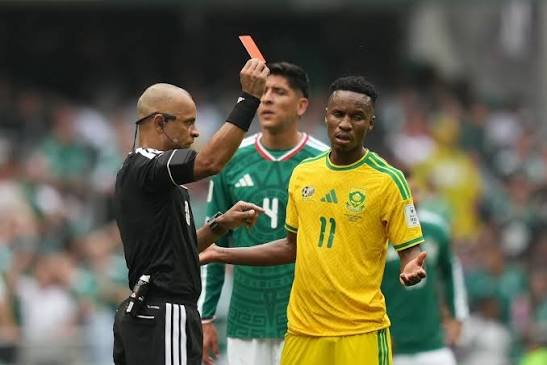
Bafana Bafana’s performance on the pitch was chaotic, ending in a 2-0 defeat to the co-hosts. The result was bad, but the discipline was worse. Yaya Sithole and substitute Themba Zwane both received red cards. This was the first time a team had received two red cards in a World Cup match since 2006. Double red. In their opening game. On live television. With Tyla probably watching from somewhere backstage, grateful for her five seconds of peace.
Former Super Eagles captain Sunday Oliseh suggested the team simply crumbled under the pressure of the massive home crowd. “South Africa didn’t lose because they are a poor side,” Oliseh said. “They lost because the stage seemed to be simply too big for them.” But here’s the thing about stages: they have lights. And lights reveal everything. The yawns during the anthem. The elbows thrown. The discipline of a toddler in a china shop.
However, the backlash on the field was matched by an ugly backlash online. In a stunning show of continental disunity, many African fans actively cheered against South Africa. Not quietly. Not politely. Openly, gleefully, with the kind of energy usually reserved for derby day rivalries.
One user wrote, “A country that deports its neighbors,” explaining their lack of support. Kenyan commentator Cornelius K. Ronoh noted on social media: “I never knew South Africa was so hated by other African countries. I witnessed Kenyans celebrate Bafana Bafana’s second red card more than Mexico scoring the second goal. It is boiling nicely!”
Let that sink in. African fans celebrated a red card against an African team more enthusiastically than they celebrated the host nation scoring. That is not football rivalry. That is continental karma served with a side of hot sauce.
Video footage even showed Nigerian supporters inside the Azteca Stadium wearing Mexico jerseys specifically to cheer against the South Africans. Not neutral. Not indifferent. Actively, joyfully anti-South Africa. Imagine flying all the way to Mexico, buying a jersey, painting your face, and screaming your lungs out—not for your own team, but for anyone playing against the team that told your cousins to go back where they came from.
The mockery continued after the final whistle, with one user posting the dagger that will haunt South African football for years: “The best part about South Africans losing to Mexico is that they can’t do anything to Mexicans living in their country.” Ouch. That is not a tweet. That is a eulogy.
Now, let’s connect the glitter-dusted dots of poetic justice. South Africa hated foreigners in their own land. At the World Cup, they became the foreigners—isolated, booed, and actively despised by their own continent. They showed contempt for the global broadcast of their own anthem moment. Their team unity collapsed into two red cards. They treated African migrants as less than human. Then they lost to a North American team while fans from across Africa wore the opponent’s colours. You cannot make this up. God is a screenwriter, and loves irony.
As the old Greeks said: “Whom the gods wish to destroy, they first make proud.” South Africa showed pride. The gods showed highlights. On replay. Forever.
And the location? Mexico, 2026. The same country where the great Cuauhtémoc Blanco once said: “Football is a mirror. Don’t complain if you don’t like your reflection.” The mirror showed a team whose fans couldn’t even get a full five seconds of their own pop star, whose players couldn’t keep eleven men on the pitch, and whose continental neighbours celebrated every mistake like a national holiday.
Here is the intellectual spine of this tragedy, and pay attention because this is the part you want to remember: No society exports what it doesn’t first cultivate at home. A team’s discipline mirrors a nation’s tolerance. A crowd’s online reputation mirrors a nation’s real-world behaviour. When you normalize hatred for the “other” in Soweto or Cape Town, don’t be shocked when your centre-back forgets how to tackle legally in Mexico City. The same muscle memory that shoves a foreign street vendor also shoves an opponent’s jaw. The same lips that refuse to welcome neighbours will find themselves celebrated by nobody.
Karma isn’t magic. It’s behavioural economics. You reap what you sow. And South Africa sowed xenophobia, harvested red cards, and fertilized the whole thing with a five-second cameo of Tyla’s side profile.
Is karma real? In the strict metaphysical sense? Debatable. But as a narrative device of consequence? Absolutely. South Africa didn’t just lose a football match. They performed a live theatrical re-enactment of the nation’s moral fissures. The broadcast cutting away from Tyla was the prologue. The double red card was the climax. The continental celebration against them was the epilogue. And the joke? The only people who didn’t see it coming were the ones in the mirror.
For Bafana Bafana, the road ahead looks steep, with suspensions looming and the weight of continental disappointment on their shoulders. While the players endured the match, South African fans who had stayed up late to watch endured a double dose of disappointment: a fleeting glimpse of their pop star and a humbling defeat on the pitch. But perhaps the real defeat happened long before the opening whistle—back home, where hatred became policy, and policy became reputation, and reputation became a stadium full of Nigerians wearing Mexican jerseys.
So yes, dear reader. Karma is indeed a bitch. But she isn’t random. She’s a bitch with a PhD in irony and a minor in broadcast production. She serves hatred cold, on a platter made from your own flag, garnished with two red cards, a five-second side profile of your biggest pop star, and an entire continent laughing at your expense.
Here is the lesson for South Africa, and for every nation tempted by the sweet poison of “us versus them”: You cannot sing “God Bless Africa” with your political actions while cursing Africa with your borders. The cosmos has ears. And it takes World Cups very, very seriously.
Final scoreline: South Africa zero points, two red cards, one five-second cameo, zero continental sympathy. Fate infinity. Lessons learned—well, we will find out. But do not hold your breath.
¡Qué bonita es la justicia poética! How beautiful is poetic justice. Now someone please show us the full Tyla performance. We blinked. We think we missed it.
Fin.
#KarmaIsABitch
#BafanaBafana
#WorldCup2026
#DoubleRedCard
#TylaDeservedBetter
#ContinentalRoast
#Mexico2026
#XenophobiaHasConsequences
Nicolas Adekeye is a Journalist/Writer