
General News
Xi, Trump Chart New Course For China-U.S. Relations, Pledge Strategic Stability

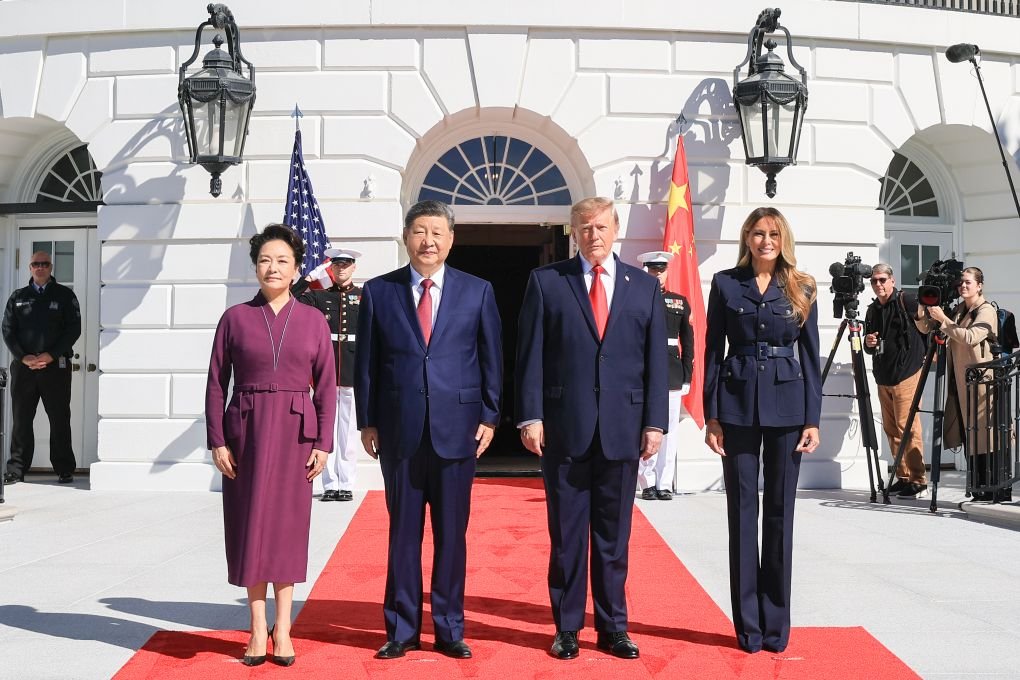
Chinese President Xi Jinping and U.S. President Donald Trump have agreed to build a constructive relationship of strategic stability based on respect, fairness and reciprocity, signalling a fresh effort by Beijing and Washington to manage competition while expanding areas of cooperation.
The understanding was reached during Xi’s state visit to the United States, his first in 11 years, which saw the two leaders hold extensive talks on bilateral relations, trade, artificial intelligence and major international and regional issues.
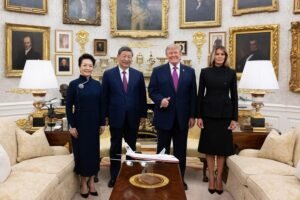
The two presidents also held an informal tea meeting at the White House on Friday, joined by their wives, Peng Liyuan and Melania Trump.
Xi said the visit had added new substance to the vision of a constructive China-U.S. relationship and produced mutually beneficial outcomes in the economic and trade fields.
He said such outcomes would benefit the people of both countries as well as the international community.
“The future of China-U.S. relations is bright,” Xi said, while acknowledging that the path towards a better relationship would inevitably encounter difficulties and challenges.
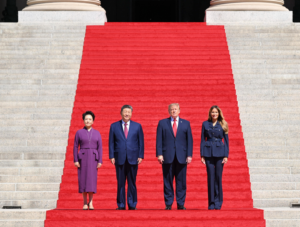
He said he was ready to work with Trump “with courage and a sense of responsibility to history” to open a new chapter in relations between Beijing and Washington.
Trump, in turn, described Xi’s state visit as constructive and successful, saying the two leaders had engaged in in-depth discussions on China-U.S. relations and major global and regional issues.
He said the meetings produced positive outcomes and expressed his intention to remain in close contact with Xi while jointly guiding the development of U.S.-China relations.
From Strategic Vision To Action
The latest understanding builds on Trump’s state visit to China in May, when the two presidents agreed to work towards a constructive China-U.S. relationship of strategic stability.
Xi used his Washington meetings to press for that broad vision to be translated into practical cooperation.
He said China and the United States should pursue a relationship in which cooperation remains the mainstay, competition is moderate, differences are manageable and peace is preserved.
According to Xi, the two countries have the capacity to achieve mutual benefit through practical cooperation, help each other succeed through healthy competition and properly manage disagreements by seeking common ground while respecting differences.
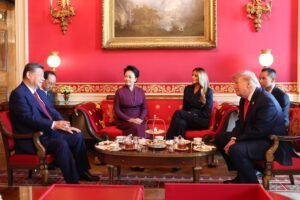
He also stressed the importance of mutual trust.
The Chinese leader said the two countries have deeply intertwined interests and substantial room for cooperation, adding that while China-U.S. collaboration could not resolve every problem in the world, many global challenges would be difficult to address without it.
Trump said he and Xi were good friends who had maintained close and direct communication.
Trade And AI At The Centre
Economic and trade cooperation featured prominently in the discussions, with Xi saying the latest round of bilateral consultations had produced a new joint arrangement.
He described the outcome as positive news for industries and people in both countries and for the global economy.
Xi stressed that cooperation must be based on equality, mutual respect and mutual benefit, saying the two sides could find solutions to their differences if they maintained that approach.
Artificial intelligence also emerged as an important area for engagement.
Although China and the United States remain competitors in AI, Xi said the two countries have even greater reasons to cooperate.
He called for both sides to leverage their respective strengths rather than guard against each other.
Xi also urged the two countries to ensure that AI remains under human control, follows a human-centred approach and is used to advance human progress.
Trump similarly stressed the importance of maintaining dialogue on AI, describing the rapidly developing technology as one that will have profound implications for humanity’s future.
100,000 Young Americans To Visit China
The summit also placed renewed emphasis on people-to-people exchanges, an area both leaders presented as important to the long-term relationship.
At the state dinner hosted by Trump, Xi recalled decades of interaction between the Chinese and American peoples, including their cooperation during the Second World War and the Ping-Pong Diplomacy that helped reopen bilateral exchanges more than five decades ago.
Trump also referred to the long history of commercial and cultural exchanges between the two countries.
Xi said stronger exchanges between ordinary citizens could deepen mutual understanding and create broader public support for China-U.S. friendship and cooperation.
As part of the new initiative, Xi announced that China would invite 100,000 young Americans to visit the country over the next five years for exchange and study programmes.
He had announced a similar five-year initiative in 2023, inviting 50,000 young Americans to China. That target has already been reached.
Xi said the future of China-U.S. relations ultimately depended on the two peoples, particularly younger generations.
The Chinese president also announced that two pandas, Ping Ping and Fu Shuang, would soon arrive at Zoo Atlanta.
Kenneth Quinn, president emeritus of the World Food Prize Foundation, welcomed the expansion of student exchanges, describing such programmes as significant for encouraging young people from both countries to understand one another.
Xi, Trump Visit National Archives
Following the tea meeting, Xi and Peng joined Trump and Melania for a visit to the U.S. National Archives.
The four walked together into the institution’s central hall and received a briefing on its history and exhibits.
Xi described the archives as a repository of the wisdom of previous generations and a source of lessons for the future.
Reflecting on the differences between China and the United States, including their histories, cultures, social systems and development paths, Xi said the two countries’ peoples nevertheless shared a common desire for better lives.
He said the relationship could develop steadily if both sides recognised and respected their differences, deepened mutual understanding, learned from each other, expanded cooperation and properly managed disagreements.
The latest engagement was marked by considerable ceremony.
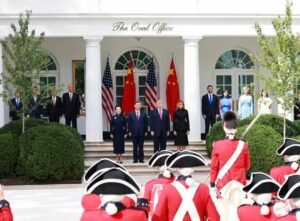
Trump personally received Xi at the airport before hosting a formal welcome ceremony at the White House, where the two presidents and their wives watched performances by U.S. Marines and reviewed honour guards representing different branches of the U.S. military.
Military aircraft also flew over the White House during the ceremony.
The two presidential couples later attended a state dinner, where Xi noted that the exchange of state visits within less than six months had made history in China-U.S. relations.
The sequence of meetings reflects an effort by both governments to maintain high-level communication at a time when Beijing and Washington remain competitors across trade, technology and other strategic areas.
The agreement on strategic stability does not remove those differences. Instead, the Washington meetings placed emphasis on establishing a framework in which competition can coexist with dialogue, practical cooperation and efforts to prevent disagreements from destabilising the broader relationship.
For Xi, the task is to translate the emerging consensus into sustained cooperation.
For Trump, the emphasis has been on maintaining direct engagement with his Chinese counterpart and pursuing outcomes he says can benefit both countries.
The durability of the new understanding will ultimately depend on how Beijing and Washington implement the arrangements reached during the leaders’ latest round of engagement.