World News
Cuban Advisers and Doctors Exit Venezuela Amid U.S. Pressure
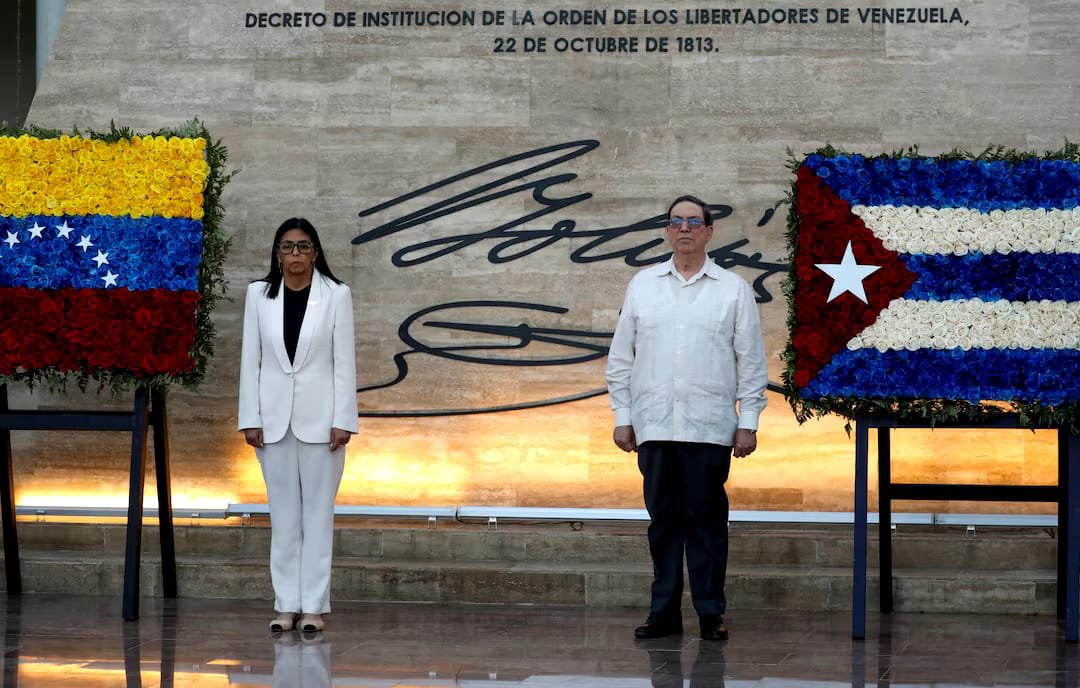
Cuba’s deep-rooted presence in Venezuela is receding as Interim President Delcy Rodríguez consolidates power and responds to mounting U.S. pressure to unwind the longstanding Havana-Caracas alliance.
In recent weeks, dozens of Cuban security advisers, doctors, nurses, and sports coaches have left the country, according to multiple sources familiar with the matter. These departures mark a dramatic shift in a relationship that had underpinned Venezuela’s Chavista governments for nearly two decades.
Unlike former leaders Hugo Chávez and Nicolás Maduro, who relied heavily on elite Cuban security forces for personal protection, Rodríguez has entrusted her safety to Venezuelan bodyguards. “The Cuban influence was absolutely essential to the survival of the Chavista government,” said Alejandro Velasco, associate professor of history at New York University.
Cuba’s involvement extended beyond personal security. Its intelligence agents were embedded across Venezuela’s military and the feared DGCIM counterintelligence unit, helping to identify and neutralize internal opposition. Thousands of Cuban doctors and other professionals also worked in social welfare programs, exchanging their services for Venezuelan oil, a crucial source of revenue for the island.
The shift comes after a U.S. military operation on January 3 captured Maduro and killed 32 Cuban personnel, according to Havana. In the aftermath, U.S. President Donald Trump vowed to end Cuba’s security role in Venezuela, describing the previous arrangement as a system in which Cuba “lived on large amounts of OIL and MONEY from Venezuela” in exchange for providing security services.
Inside Venezuela, some Cuban advisers have already been removed from key posts within the DGCIM, while others have returned to Havana on recent flights. Analysts say the departures signal more than just personnel changes. They reflect the beginning of a broader realignment in Venezuela’s domestic and international politics.
While ties between Caracas and Havana are not completely severed, Cuba’s influence is clearly waning, raising questions about the future of one of Latin America’s most consequential leftist alliances.
World News
Family Calls for Justice After Nigerian Fashion Designer Killed in US Nightclub
A Nigerian fashion designer based in the United States, 30-year-old Sheriff Shittu, has been shot dead following a confrontation with a drunk patron at a Brooklyn nightclub.
The incident occurred in the early hours of February 14 at the Quilox Restaurant and Lounge in East Flatbush, according to local reports. Police said the shooting happened around 4:25 a.m. when a suspected gunman, who was being escorted out of the club by security personnel, allegedly opened fire.
Witnesses reported that the shooting followed a heated exchange after the intoxicated patron reportedly caused a disturbance inside the lounge. Authorities noted that the suspect had allegedly behaved inappropriately toward some female guests, including Shittu’s girlfriend.
Shittu was attending the event with his younger brother, Fawaz Shittu, to celebrate a friend’s birthday. Fawaz recounted the harrowing moments following the shooting: “I was screaming his name. I was trying to wake him up,” he said. He added that the altercation escalated after the patron engaged in disorderly behaviour inside the club.
Family members have expressed concern about the nightclub’s security measures. Salem Shittu, another brother of the deceased, questioned how a gun could have been brought into the venue, saying, “He was being kicked out, and he was being escorted out when he did it.”
The suspect reportedly fled the scene and remains at large. Sheriff Shittu was rushed to One Brooklyn Health–Brookdale University Hospital Medical Centre, where he was pronounced dead.
Described by family as a promising fashion designer working to establish his career in the United States, Shittu’s death has prompted calls for justice and heightened scrutiny of nightclub security protocols. Investigations are ongoing as authorities continue their manhunt for the suspect.
Judiciary
Nigeria Wins $6.2m Arbitration Against European Tech Firm
Nigeria has secured a major legal victory after an international tribunal dismissed a $6.2 million claim filed by European Dynamics UK Ltd over a stalled national e-Procurement (eGP) project supported by the World Bank.
The contractor had claimed $2.4 million for alleged milestone completions, $3 million in general damages, and an additional $800,000 in settlement claims. Prior to the current leadership of the Bureau of Public Procurement (BPP), there were discussions around an out-of-court settlement. However, the Bureau chose to proceed with arbitration, insisting that payments must strictly reflect verified value delivered.
At the centre of the dispute was the User Acceptance Test (UAT), which the BPP said revealed significant functional deficiencies in the software system. The tribunal agreed, ruling that delivery in software contracts is only complete upon satisfactory performance validation.
The tribunal also rejected claims that the Bureau approved merging multiple project phases into one, noting that such restructuring would distort the contract’s phased payment framework.
In a final ruling not subject to appeal, Sole Arbitrator Mrs ‘Funmi Roberts dismissed all claims, saving Nigeria an estimated ₦9.3 billion in potential liabilities.
Nigeria’s legal team was led by Johnson & Wilner LLP, with Basil Udotai, Esq., spearheading the defence.
BPP Director-General Dr Adebowale Adedokun described the outcome as a signal that Nigeria “can no longer be taken for granted,” while Attorney-General of the Federation, Prince Lateef Fagbemi (SAN), said the victory shows it is “no longer business as usual” in protecting the country’s interests.
World News
Trump Imposes 10% Global Tariff After Supreme Court Strikes Down Previous Duties
U.S. President Donald Trump on Friday announced he would impose a 10% global tariff for 150 days, replacing some emergency duties that the Supreme Court recently struck down. The new tariffs, set to take effect in about three days, will be applied on top of existing duties.
Trump said the move is authorized under Section 122 of the Trade Act of 1974, which allows the president to impose duties of up to 15% for up to 150 days on countries experiencing “large and serious” balance of payments issues. Unlike other trade laws, the statute does not require prior investigations or impose procedural limits.
The announcement follows the Supreme Court ruling that declared Trump’s previous broad global tariffs under the International Emergency Economic Powers Act (IEEPA) illegal, stating that he had overstepped his authority.
“We have alternatives, great alternatives,” Trump said, adding that the tariffs could generate more revenue and strengthen the U.S. economy.
In addition to Section 122 tariffs, the administration is initiating several Section 301 investigations targeting unfair trade practices by foreign countries and companies.
While Section 122 tariffs take effect immediately for 150 days, Section 301 investigations typically take months to complete.