
General News
Nigerian Harvard Alumna Raises $7 Million to Launch World’s First Hair-Braiding Robot

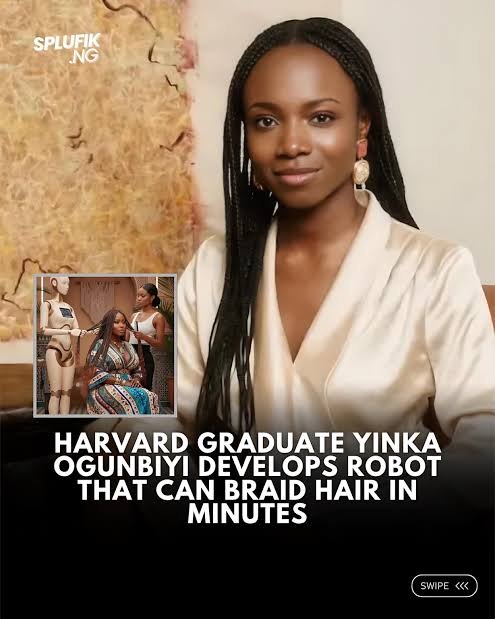
A Nigerian-American biomechanical engineer and Harvard graduate, Yinka Ogunbiyi, has secured $7 million in seed funding to commercialize HaloBraid, the world’s first patented braid-assist robot, in a move expected to transform the global Black hair and protective styling industry.



The funding round was led by venture capital firm Seven Seven Six, founded by Reddit co-founder Alexis Ohanian, with participation from AlleyCorp and Bling Capital. The startup is entering the market with strong demand, having already attracted a waiting list of more than 7,000 professional salons interested in adopting the technology.
Ogunbiyi, who holds a joint MS/MBA from Harvard Engineering School and Harvard Business School, developed the idea during the COVID-19 pandemic after spending four days installing her own knotless braids at home. The experience highlighted the lack of technological innovation in the growing hair-braiding industry.
She later partnered with co-founder David Afolabi to develop HaloBraid, a collaborative robot designed to assist, rather than replace, professional braiders.
Unlike fully automated systems, HaloBraid functions as a “cobot,” working alongside stylists by taking over the repetitive mid-shaft braiding process, which accounts for the majority of the time and physical effort involved in braiding appointments.
The braiding process remains stylist-led. Hair professionals continue to section the hair and create the foundation braid, after which HaloBraid performs the repetitive weaving before the stylist completes the finishing touches, including sealing, trimming, and styling the braids.
According to Ogunbiyi, the technology is intended to enhance—not diminish—the salon experience.
“I don’t think anything will get lost from the experience. If anything, it enriches it. Technology simply assists with the repetitive movements that consume the most time and place the greatest strain on the body,” she said.
Beyond reducing appointment times by nearly half, HaloBraid also aims to address occupational health challenges faced by hair braiders. Many stylists experience repetitive strain injuries, including carpal tunnel syndrome, arthritis, and chronic back pain, after years of continuous braiding.
By automating the most physically demanding aspect of the braiding process, the innovation is expected to improve workplace health while enabling salon owners to serve more clients and increase productivity.
The breakthrough places Ogunbiyi among a growing number of African innovators applying robotics and artificial intelligence to solve everyday challenges, while opening new opportunities in the global beauty technology market.