
International
Taiwan President Oversees Coastal Strike Drill as Annual Han Kuang War Games Intensify


President Lai Ching-te has inspected a major coastal defence exercise involving missile boats, drones and Coast Guard vessels as Taiwan’s annual Han Kuang military drills test the island’s ability to respond to a potential Chinese attack.
Taiwan President Lai Ching-te on Saturday oversaw a coastal strike exercise in the southern city of Kaohsiung, as the island conducts its largest annual military drills amid persistent tensions with Beijing.
Lai boarded a domestically developed fast-attack missile boat at a naval base and watched exercises designed to test Taiwan’s ability to detect, engage and repel forces approaching its coastline. The drills form part of the 10-day Han Kuang 42 live-fire exercise running from August 5 to 14.
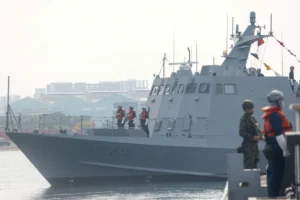
The Taiwanese president inspected the exercise from a naval facility in Kaohsiung, where participating forces practised coordinated coastal defence operations.
The exercise included low-flying attack drones simulating threats to Taiwanese positions, while an Anping-class Coast Guard catamaran took part in the operation, highlighting Taipei’s effort to integrate civilian maritime security forces into wartime planning.
The Anping-class vessels are based on the design of Taiwan’s Tuo Chiang-class fast attack ships and are capable of carrying anti-ship missiles, giving the Coast Guard a potentially important role during a military emergency.
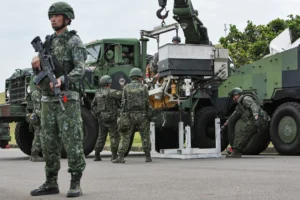
Lai told troops that Taiwan needed to continue strengthening its ability to respond to external threats and said his government would provide strong support to the military and Coast Guard.
Although he did not directly mention China in his remarks, the exercises are clearly taking place against the backdrop of growing military pressure from Beijing.
The Han Kuang exercise began on August 5 and is scheduled to continue through August 14.
Taiwan’s Ministry of National Defense says this year’s live-force exercise is being conducted as part of a broader, year-round training programme designed to make the military’s response more realistic.

The exercise is being conducted under a continuous scenario rather than as a series of isolated demonstrations. According to the Defence Ministry, the drills are intended to test how quickly Taiwan’s armed forces can transition from normal operations to wartime conditions.
The scenarios include mobilisation, protection of critical infrastructure, force preservation, counter-blockade operations and joint counter-landing operations.
Taiwan’s military is also practising the protection of key political and military targets and measures intended to maintain command-and-control capabilities even if the island comes under attack.
One of the central scenarios involves a simulated Chinese assault across the Taiwan Strait.

Taiwan’s Defence Ministry says the exercise assumes an opposing force could conduct joint fire strikes, naval movements and a multi-point amphibious landing.
Taiwanese forces are therefore practising air-defence operations, sea-air coordination, coastal strikes, near-shore defence and attacks against landing forces.
The purpose is to test whether the military can coordinate forces from different branches and use multiple layers of defence to prevent an invading force from establishing a beachhead.
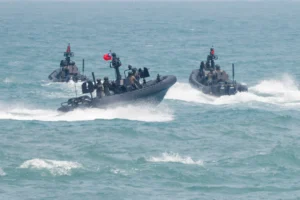
The exercise reflects Taiwan’s increasing focus on preparing for a conflict that could involve not just conventional military attacks, but also blockades, attacks on infrastructure and attempts to disrupt government command systems.
Drones have become an increasingly important feature of Taiwan’s military preparations.
During Saturday’s exercise, low-flying attack drones were used to simulate threats against defending forces.
Their inclusion reflects lessons emerging from recent conflicts, particularly the growing importance of relatively inexpensive unmanned systems for surveillance, targeting and attacks.
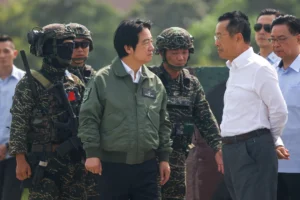
Taiwan has been seeking to strengthen its domestic drone capabilities as part of a broader effort to make its forces more mobile and difficult to disable in the event of an attack.
Lai’s participation comes just days after he took part in another dramatic element of the Han Kuang exercise.
On Thursday, the president was transported in an armoured personnel carrier to a secret command centre as part of a simulated emergency evacuation.
The exercise was designed to test continuity of government and the ability of Taiwan’s leadership to relocate if its main command facilities came under attack.
The scenario underscores one of Taipei’s major concerns: that a conflict could begin with attacks intended to disrupt Taiwan’s political leadership and military command structure.

The government is therefore testing not only frontline combat forces but also its ability to maintain decision-making and communications during an attack.
Taiwan’s military preparations are taking place as China’s People’s Liberation Army continues to conduct regular military activity around the island.
Beijing regards Taiwan as part of China and has not renounced the use of force to bring the island under its control.
Taiwan, however, is a self-governing democracy and rejects Beijing’s sovereignty claims.
China has repeatedly criticised Taiwan’s military activities and particularly President Lai, whom Beijing has accused of promoting Taiwan independence.
Lai’s government maintains that Taiwan’s defence preparations are intended to deter aggression and preserve the island’s democratic way of life.
Taiwan’s current military training reflects a broader change in how the island prepares for a potential conflict.
Rather than focusing exclusively on traditional battlefield exercises, Han Kuang now incorporates scenarios involving cyber and information threats, mobilisation, infrastructure protection, command resilience, blockades and rapid transition from peacetime to wartime.
The Defence Ministry’s planning documents describe scenarios in which an adversary could conduct a blockade while preparing an amphibious assault. Taiwan’s forces are expected to maintain operations while protecting key infrastructure and preserving combat power.
The strategy is partly based on the assumption that Taiwan’s smaller military would need to survive an initial assault and prevent an adversary from quickly achieving its objectives.
Taiwan’s geography makes its coastline a crucial part of its defence strategy.
Any large-scale amphibious invasion would require an attacking force to cross the Taiwan Strait and establish landing zones before moving inland.
Taiwan therefore seeks to make potential landing areas as difficult as possible to penetrate.
Coastal missiles, drones, artillery, aircraft, naval vessels and mobile ground forces can all contribute to a layered defence designed to slow or destroy an invading force before it can establish a secure foothold.
That is why the coastal strike drills being observed by Lai are among the most important elements of this year’s Han Kuang exercise.
The drills also come amid an increasingly complicated regional security environment.
Taiwan has complained of frequent Chinese military aircraft and naval activity around the island, while Beijing has repeatedly staged larger exercises designed to demonstrate its ability to operate around Taiwan.
For Taipei, the challenge is not simply preparing for a conventional invasion.
Military planners must also consider the possibility of a blockade, attacks on ports and infrastructure, cyber operations, disinformation campaigns and attempts to isolate Taiwan before or during a wider military operation.
The Han Kuang exercises are intended to test how the island would respond to such a crisis.
Despite the intensity of the exercises, Taiwan’s military drills do not themselves indicate that an attack is imminent.
Han Kuang is an annual exercise, although its scale and realism have increased as China’s military capabilities and activity around Taiwan have expanded.
The Taiwanese government has repeatedly described strengthening defence capabilities as a way of deterring conflict rather than provoking it.
For Beijing, however, the exercises remain politically sensitive because China regards Taiwan’s military forces as part of what it considers an unlawful separatist effort.
That opposing interpretation means even routine Taiwanese military exercises can become part of the broader strategic competition between the two sides.
The significance of this year’s Han Kuang exercise ultimately extends beyond the weapons being fired or the vessels taking part.
Taiwan is testing whether its military, Coast Guard, government agencies and command structures can continue functioning together under the pressure of a simulated war.
The Defence Ministry says the exercises are intended to strengthen joint operations, command coordination, combat responsiveness and the ability to preserve forces under attack.
For President Lai, personally overseeing the drills sends a political as well as military message: Taiwan intends to demonstrate that it is preparing seriously for any crisis while maintaining its determination to defend the island.
With the Han Kuang exercises continuing until August 14, further drills are expected to test Taiwan’s response to different stages of a simulated conflict.