
Business
India’s RBI Steps In Again as Oil Prices Put Rupee Under Pressure


India’s central bank is believed to have intervened in the foreign exchange market again to limit pressure on the rupee as elevated oil prices and rising global bond yields continue to weigh on the currency, according to traders.
The Reserve Bank of India (RBI) is believed to have supported the rupee through dollar sales by state-run banks, with market participants saying the transactions were likely carried out on behalf of the central bank.

The rupee was trading around 95.70 to the US dollar before the local spot market opened on Wednesday, relatively close to Tuesday’s close of 95.68. Traders said the stability reflected the RBI’s continued efforts to prevent excessive volatility.
The intervention comes as crude oil prices remain elevated amid continuing uncertainty over the Middle East and the status of shipping through the Strait of Hormuz. Higher oil prices are particularly important for India because the country relies heavily on imported crude, increasing demand for dollars and putting additional pressure on the rupee.

On Tuesday, the rupee closed marginally weaker despite what traders described as likely RBI intervention. It ended at 95.68 per dollar, compared with 95.6025 a day earlier.
Traders said the central bank’s presence in the market has helped contain the currency’s losses and reduce volatility. The rupee’s one-month implied volatility has fallen below 4%, its lowest level since January, according to Reuters.
The RBI has increasingly relied on market intervention in recent weeks as oil prices, geopolitical uncertainty and global bond yields have created additional pressure on emerging-market currencies.
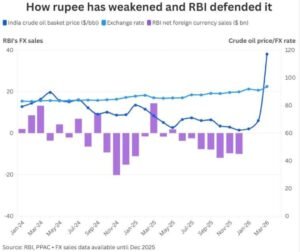
State-run banks have been repeatedly seen selling dollars at various levels, which traders believe is part of the RBI’s strategy to keep the rupee from experiencing sharp swings. Reuters reported that the central bank’s heavy foreign-exchange footprint has helped push realised rupee volatility down to around 2%.
The pressure on the currency has also been linked to India’s foreign-exchange needs following the RBI’s decision to end its discounted foreign-exchange swap window for overseas deposits earlier than originally planned.

The facility had attracted nearly $57 billion in deposits from non-resident Indians and helped lift India’s foreign-exchange reserves above $700 billion. However, the RBI ended the programme early amid concerns over liquidity, external liabilities and the diminishing benefits of keeping the facility open.
Meanwhile, oil remains a major risk for the Indian economy. Brent crude was recently trading around $92 a barrel as uncertainty surrounding the Middle East conflict and the Strait of Hormuz continued to affect global energy markets.
A sustained rise in crude prices could increase India’s import bill, widen pressure on the current account and raise imported inflation, potentially complicating monetary policy decisions.

Despite the pressure, India’s foreign-exchange position provides the RBI with significant room to manage short-term currency volatility. The country’s reserves have risen above $700 billion following strong foreign-exchange inflows.
Market participants will now watch oil prices, developments around the Strait of Hormuz and the RBI’s activity in the spot market for indications of how aggressively the central bank is prepared to defend the rupee from excessive volatility.
For now, traders expect the RBI to remain active in the currency market as India navigates the combined pressure from expensive oil, global yields and heightened geopolitical uncertainty.