
International
US Debt Crosses $40 Trillion for First Time After Doubling Under Trump, Biden

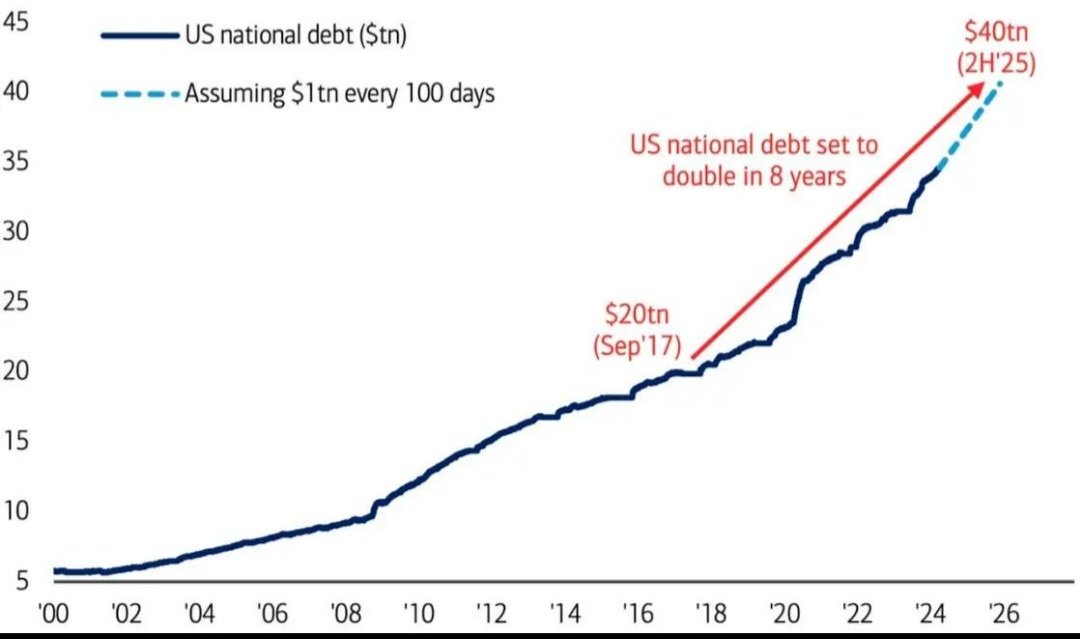
The United States national debt has crossed the $40 trillion threshold for the first time in history, marking another unprecedented milestone for the world’s largest economy and intensifying concerns over the country’s deteriorating fiscal position.
Data from the U.S. Treasury showed total public debt outstanding at approximately $40.047 trillion on August 18, comprising about $32.266 trillion held by the public and $7.782 trillion in intragovernmental holdings.

The latest figure means the country’s debt has more than doubled from the approximately $19.95 trillion recorded when Donald Trump first took office in January 2017.
The debt has grown under successive administrations, with the increase accelerating during the COVID-19 pandemic as Washington approved massive emergency spending to support households, businesses and the wider economy.
According to Reuters, the United States added roughly $7.8 trillion during Trump’s first term, another $8.4 trillion during Joe Biden’s presidency, and approximately $3.8 trillion during Trump’s second term so far.

The increase has not been driven by a single administration or spending programme. Tax cuts, defence spending, Social Security and Medicare costs, pandemic-era programmes and the rising cost of servicing existing debt have all contributed to the widening fiscal gap.
One of the most troubling developments for policymakers is the growing cost of interest payments.
Interest expenses have risen sharply as the government borrows more and refinances debt at higher rates. Reuters reported that interest costs have become larger than spending on Medicare and the Pentagon, highlighting the increasing amount of federal revenue being absorbed by debt servicing.

The milestone also comes amid higher borrowing costs for the U.S. government. Investors have demanded greater returns on longer-term Treasury securities, with the yield on a recent 30-year Treasury auction reaching its highest level since 2001.
Economists and fiscal watchdogs have warned that continued deficits could eventually place greater pressure on interest rates, investment and government spending.
The concern is not necessarily that the United States will immediately be unable to pay its debts, but that an ever-growing share of federal resources could be consumed by interest payments, leaving less room for infrastructure, social programmes, defence and other priorities.

The latest milestone has also reignited a political debate in Washington over how to address the country’s fiscal trajectory, with disagreements continuing over whether the solution should focus primarily on spending cuts, higher revenues or a combination of both.
The $40 trillion milestone comes only months after the national debt crossed $39 trillion in March 2026 and roughly five months after it passed $38 trillion.
With the debt continuing to rise, pressure is mounting on Congress and the administration to develop a long-term strategy for containing deficits before borrowing costs place an even greater burden on the federal budget.