
Opinion
Unclaimed Dividends And The Student Loan Fund: A Noble Cause, A Legal Question

By S. A. Ndanusa, PhD, OON
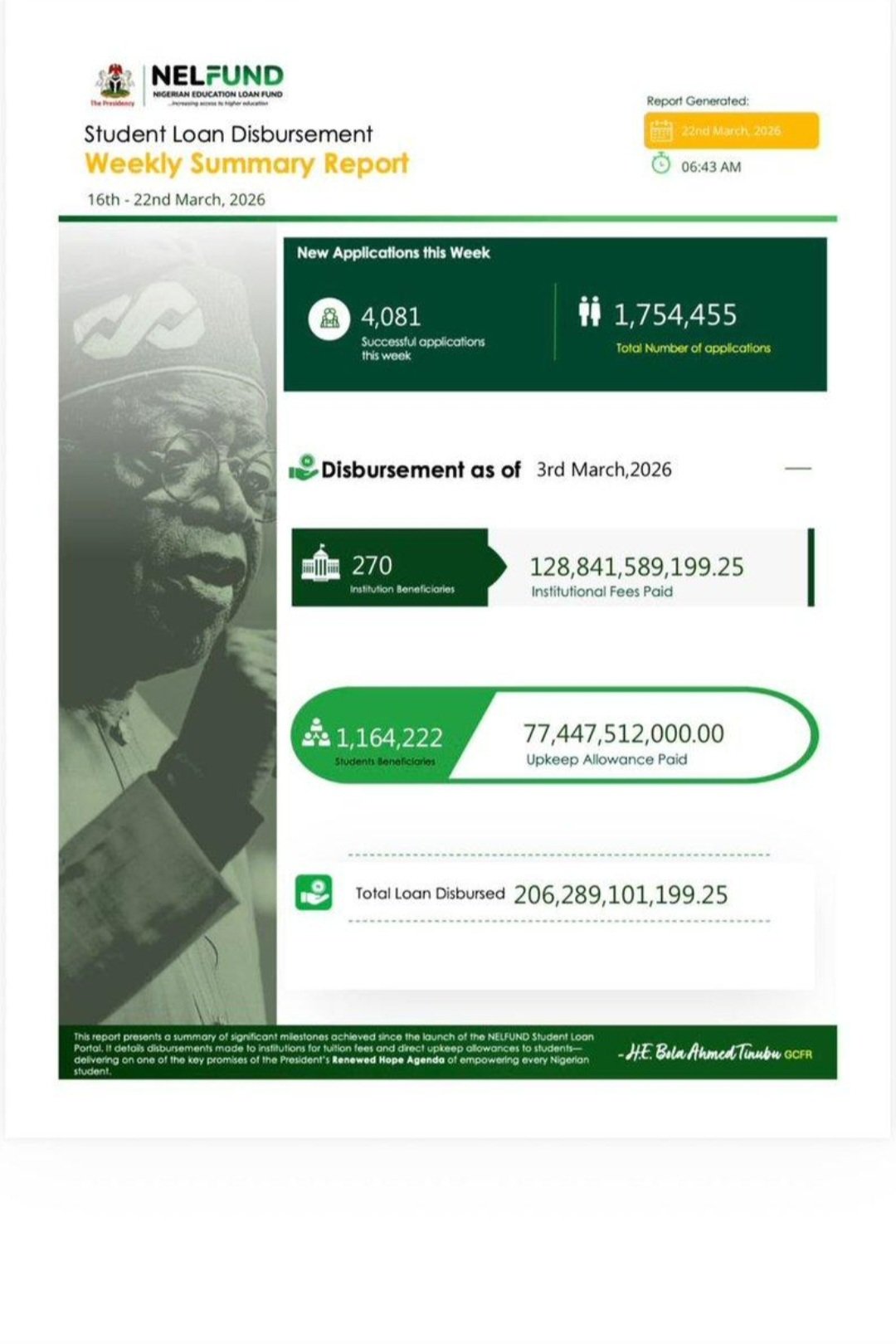
The announcement that President Bola Ahmed Tinubu has directed funds recovered by the Economic and Financial Crimes Commission, together with unclaimed dividends and dormant account balances, to the Nigerian Education Loan Fund will understandably attract public applause.
Education needs money. NELFUND is expanding. More students are seeking assistance, and the Federal Government must find sustainable ways of keeping the scheme alive. In a country where many promising young people stand at the gates of higher education with admission letters in their hands but insufficient money in their pockets, any serious effort to fund student loans deserves support.
But good intentions do not suspend the law. Indeed, the nobler the purpose, the greater the need to ensure that the means are equally sound.
Recovered proceeds of crime and unclaimed dividends do not occupy the same legal room. Once criminal proceeds have been finally forfeited to the state, free of pending claims and litigation, government may apply them to lawful public purposes, subject, of course, to the Constitution and appropriation requirements. Unclaimed dividends are different. They are not stolen funds. They are not abandoned public revenue. They are private property belonging to shareholders who, for one reason or another, have not yet collected what is due to them.
A shareholder may have died without the administrators of the estate knowing about the investment. Another may have changed address, acquired the shares under a slightly different name or encountered the familiar obstacle course of signature verification, probate and multiple subscriptions. Some shareholders may simply have forgotten. Forgetfulness, however, is not a legal instrument for transferring private wealth to government.

This does not mean that government is prohibited from touching unclaimed dividends. The legal position is more nuanced.
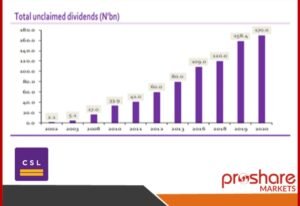
Under section 432 of the Companies and Allied Matters Act 2020, a declared dividend is a special debt owed to a shareholder and recoverable within 12 years. The Finance Act 2020 subsequently created a different framework for dividends of publicly quoted companies that remain unclaimed for at least six years. Such funds are to be transferred to the Unclaimed Funds Trust Fund, established as a sub-fund of the Crisis Intervention Fund.
The important words are “trust” and “debt.”
Under the Finance Act, the money transferred to the Fund becomes a special debt owed by the Federal Government to the affected shareholders. It remains claimable at any time and must be paid together with the yield earned on it. The arrangement is described as a perpetual trust.
Government may therefore take custody of qualifying unclaimed dividends and deploy them as a financing resource. But it does not thereby become the beneficial owner. It is, at best, a borrower and trustee. The shareholder may be absent, but ownership has not disappeared.
This is where the recent directive requires careful clarification. Is the proposed transfer to NELFUND an investment, a loan, an appropriated budgetary transfer or an outright grant? These are not semantic distinctions designed to keep lawyers happily occupied. Each carries different consequences for ownership, repayment, liquidity and accountability.
If the Unclaimed Funds Trust Fund is investing in a properly structured NELFUND instrument, with the Federal Government continuing to recognise the principal and accrued yield as a sovereign obligation, the arrangement may be legally defensible. If government is borrowing the money while maintaining adequate liquidity and a sinking fund to meet claims, that too may fall within the framework of the Finance Act.
But if “redirecting” means transferring the money permanently to NELFUND as though it were ordinary government revenue, the arrangement would be much harder to justify. A trust fund cannot become a grant fund merely by presidential benevolence. Neither can a shareholder’s asset be converted into a donation to education without the shareholder’s knowledge or consent.

There is also the question of authority. The Finance Act does not leave the Unclaimed Funds Trust Fund lying casually on a ministerial table. It places its supervision with the Debt Management Office and creates a Governing Council chaired by the Minister of Finance. Its membership includes the Governor of the Central Bank, the Director-General of the Securities and Exchange Commission, the Managing Director of the Nigeria Deposit Insurance Corporation, shareholder representatives, registrars and the Bankers’ Committee.
The DMO is required to maintain a reliable database of the liabilities, arrange for repayment of principal and yield, prepare audited financial statements and implement a plan for servicing the obligations. These safeguards exist because the money is not free money. It carries owners, obligations and consequences.
An announcement by the Minister of Education cannot tell us whether these statutory institutions have considered and approved the proposed transaction. Nor can approval by the Federal Executive Council substitute for responsibilities specifically assigned by an Act of the National Assembly.

There is also an appropriation question. The Constitution does not permit public expenditure simply because the destination is worthy. If money is to be transferred from a government administered trust fund to finance NELFUND’s operations, the expenditure must have a clear statutory and appropriation basis. FEC may approve policy, but it cannot appropriate public funds. That responsibility belongs to the National Assembly.
The Investments and Securities Act 2025 further strengthens SEC’s regulatory authority over the treatment of unclaimed dividends of public companies. In its June 2025 circular, SEC affirmed that the affected funds are to be held in trust pending claims by shareholders. Curiously, the Commission also indicated that the Unclaimed Funds Trust Fund had not then been fully established and operationalised, directing companies and registrars to continue honouring valid claims in the meantime.
This raises another simple question: has the Fund now been properly constituted and operationalised? If it has, the public should be told when, under whose management and with what governance arrangements. If it has not, it is difficult to understand how money can be redirected from a statutory fund that is not yet fully operational.
The terminology used in the announcement also deserves attention. Reference was made to a “Capital Market Trust Fund,” whereas the Finance Act establishes an “Unclaimed Funds Trust Fund.” Perhaps this is merely the looseness that occasionally accompanies a breaking news briefing. But where private assets are being moved into a public programme, language should be as precise as the accounting.
None of these questions diminishes the importance of NELFUND. On the contrary, a national student loan programme requires a funding structure strong enough to survive changes of government, fiscal pressure and the enthusiasm of the moment. The 2024 Student Loans Act already provides a dedicated revenue architecture, including one per cent of taxes, levies and duties collected for the Federal Government. Government may strengthen this with appropriated funds, recovered assets lawfully forfeited to the state, grants, endowments and properly structured investments.

What it should not do is create one social success by manufacturing another contingent liability in the shadows.
Before the directive is implemented, government should publish the formal instrument authorising it, the precise amount involved, the approval of the Unclaimed Funds Trust Fund Governing Council, SEC’s regulatory position and the relevant appropriation. It should also explain whether the transfer is a loan, an investment or a grant; what yield will accrue to shareholders; what liquidity will be maintained; and how a shareholder who appears tomorrow will recover both principal and return without being sent on a pilgrimage from the registrar to SEC, from SEC to DMO, from DMO to NELFUND and perhaps finally to the Ministry of Education.
Nigeria already has enough citizens looking for their money in government offices. We should not create a new generation of them.
The central issue is therefore not whether student loans are desirable. They are. Nor is it whether dormant private money can be put to productive use. The Finance Act contemplates that possibility. The issue is whether the government will use the funds strictly as a trustee and borrower, or quietly treat them as ownerless revenue.
NELFUND must be funded. But shareholders must also be protected. The two objectives are not enemies unless problematic implementation makes them so.
A noble destination does not remove the need for a lawful route. Government may borrow the sleeping shareholder’s money where the law permits, but it must keep the account, preserve the yield and remain ready to repay when the owner wakes up.
“Suleyman A. Ndanusa, PhD, OON, is an economist, lawyer, strategic studies scholar, and public policy thinker and practitioner with extensive experience in financial markets, regulation, governance, national Security and development.”