
World News
NASA Launches $4.3 Billion Roman Space Telescope on Mission to Explore the Hidden Universe

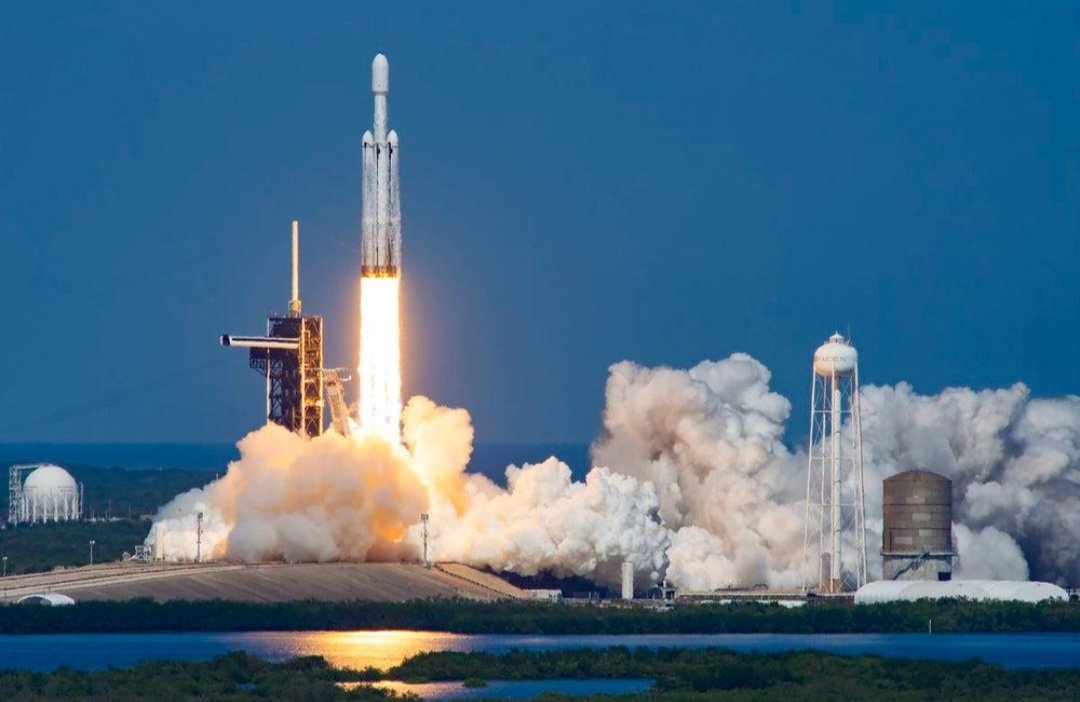
NASA has successfully launched its newest flagship space telescope, sending the Nancy Grace Roman Space Telescope into orbit on a mission aimed at answering some of the biggest questions about the universe.
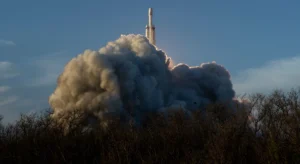
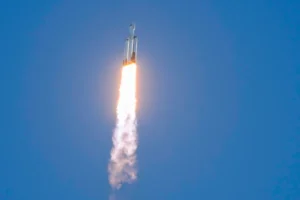
The $4.3 billion observatory lifted off from NASA’s Kennedy Space Center in Florida at 7:26 a.m. EDT on Sunday, aboard a SpaceX Falcon Heavy rocket. NASA said the spacecraft is now beginning a roughly three-month, million-mile journey to its final observation position.
Roman is designed to give scientists an unusually broad view of the cosmos. Its main mission will focus on dark matter, dark energy and planets beyond our solar system, known as exoplanets.
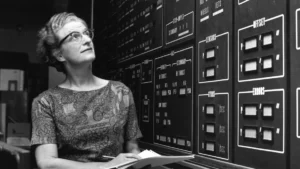
Named after Nancy Grace Roman, NASA’s first chief astronomer and a pioneering figure in space astronomy, the telescope is expected to complement the work of the Hubble and James Webb Space Telescopes.
Unlike Webb, which is designed to provide extremely detailed observations of relatively small areas, Roman will be able to survey huge sections of the sky at remarkable speed.
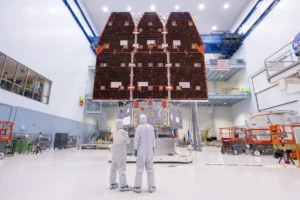
Its 300-megapixel infrared camera has a field of view more than 100 times wider than Hubble’s, allowing scientists to map enormous areas of the universe while maintaining sharp images.
NASA expects Roman to help create an unprecedented three-dimensional map of the universe, potentially covering more than two billion galaxies during its primary mission.
One of Roman’s most important goals is to investigate dark energy, the mysterious force believed to be responsible for the accelerating expansion of the universe.
Scientists will study distant galaxies and exploding stars to better understand how the universe has expanded over billions of years.
The telescope will also search for exoplanets using techniques including gravitational microlensing. Its advanced Coronagraph Instrument will demonstrate technology for directly imaging planets around other stars by blocking the glare of their host stars.
NASA hopes the mission will reveal thousands of previously unknown worlds and provide clues about how planetary systems form and evolve.
Roman also has an unusual history.
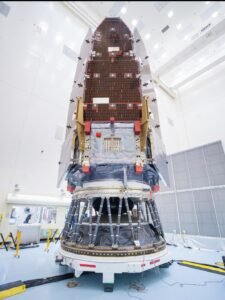
Its primary mirror is based on technology originally developed for U.S. reconnaissance satellites and later made available to NASA. The telescope is therefore turning technology once designed to observe Earth into an instrument for exploring distant worlds and galaxies.
The telescope is expected to spend at least five years carrying out its scientific mission, with the possibility of an extension.
As it travels toward its destination near the second Sun-Earth Lagrange point, about 1.6 million kilometres from Earth, scientists are preparing for a new era of wide-field space observation.
Roman’s first images are expected after it reaches its destination and completes deployment and calibration, potentially opening another window onto parts of the universe that remain largely unexplored.