
World News
IMF Chair Hails Global Economic Resilience as Delegates Walk Out on Russian Minister

The chair of the International Monetary and Financial Committee (IMFC), Mohammed Al-Jadaan, has described the global economy as remarkably resilient despite mounting geopolitical and economic pressures, while warning that governments must not become complacent.
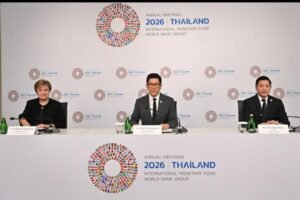
Al-Jadaan, Saudi Arabia’s finance minister, made the remarks on Saturday, October 17, at the International Monetary Fund (IMF) and World Bank annual meetings in Bangkok, Thailand. He highlighted the effects of ongoing wars, rising public debt, threats to energy and food security, and the rapid development of artificial intelligence on the global economic outlook.
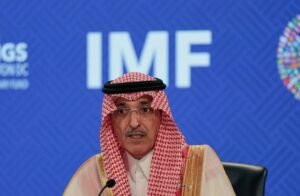
“There is no room for complacency,” Al-Jadaan said, urging governments to strengthen economic safeguards, maintain central bank independence and encourage private-sector investment. The IMF’s official statement also warned that conflicts and disruptions to key trade routes could increase commodity prices and worsen food and energy insecurity.
The meeting was also marked by a diplomatic walkout after Russian Finance Minister Anton Siluanov began addressing delegates. Reuters reported that nearly half of the committee’s delegates left the room, with representatives from several European countries among those who withdrew in protest.
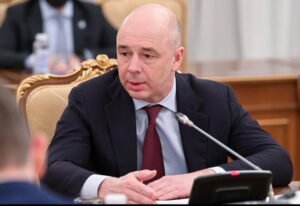
The walkout reflected continuing opposition to Russia’s participation in international financial discussions following its invasion of Ukraine in February 2022. Delegates from countries including Britain, Germany, France, Denmark, Sweden, Finland, Norway, Lithuania, Latvia and Estonia were reported to have taken part.
Bundesbank President Joachim Nagel described the walkout as a strong signal of solidarity with Ukraine. European officials have repeatedly opposed efforts to restore Russia to international forums without addressing the consequences of the war.
The United States, however, has supported maintaining dialogue with Moscow, arguing that communication is necessary to resolve international conflicts. The disagreement has exposed wider divisions among Western allies over how to engage Russia while the war continues.
Despite the tensions, Al-Jadaan said the committee had reached agreement on its concluding statement, emphasising that cooperation among members remained important. The IMFC plays an advisory role in guiding the IMF’s work and addressing major issues affecting the international monetary and financial system.
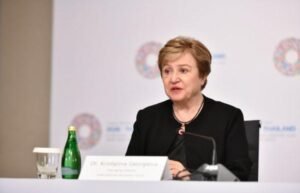
IMF Managing Director Kristalina Georgieva also acknowledged growing divisions among member countries but said there was still a desire for international cooperation, even as geopolitical fragmentation and repeated economic shocks complicate policymaking.
The meetings, which brought thousands of policymakers, financial officials and other participants to Bangkok, highlighted the challenge facing global institutions: preserving economic cooperation at a time when political disagreements threaten to undermine collective responses to shared economic risks.
The IMF has urged countries to rebuild fiscal buffers, protect vulnerable populations and sustain growth-enhancing investment as governments confront uncertainty over trade, energy supplies, debt and emerging technologies.