Foreign
U.S. Threatens Destruction of Oil Tankers if American Ships are Attacked

The United States has delivered a stark warning to Iran, threatening to systematically destroy Iranian oil tankers if American naval vessels come under further attack.
This threat was made reality on September 5, when U.S. forces struck three Iranian crude oil carriers in retaliation for a ballistic missile attack on two U.S. Navy warships.
The dramatic escalation occurred after the Islamic Revolutionary Guard Corps (IRGC) launched multiple missiles at a U.S. aircraft carrier and a guided-missile destroyer patrolling regional waters.
Both American ships successfully evaded the incoming fire, and no U.S. personnel were harmed.
Following the failed Iranian attack, U.S. Central Command (CENTCOM) forces executed immediate and severe retaliation.
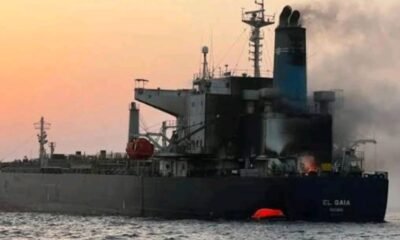
They permanently disabled the IRGC-linked crude oil carriers M/T Downy off the coast of Kharg Island and M/T Stark 1 near the port of Jask.
In a third strike, American forces completely destroyed the unladen crude oil carrier M/T Kylo, also known as the “Noxen,” in the Gulf of Oman.
The U.S. military emphasized that the crew of the Kylo was ordered to abandon ship before it was struck in multiple critical locations, rendering it completely inoperable.
This precise destruction of economic assets marks a significant shift in U.S. military strategy, targeting Iran’s oil revenue lifeline to cripple its ability to fund regional proxies.
Admiral Brad Cooper, head of U.S. Central Command, delivered a blunt message directly to the IRGC. “Let the message to the IRGC be clear: If you shoot at two of our ships, we will impose an even higher economic cost — taking out three of yours,” Admiral Cooper stated.
The United States has justified the strikes by designating the three Iranian vessels as part of a multibillion-dollar “shadow network” that finances the IRGC and its proxy groups.
The attacks have sent shockwaves through global energy markets, with Brent crude futures closing at $96.28 a barrel, their highest level since July, as tensions in the Middle East drive urgent supply concerns.
Iran has responded with defiance, vowing severe retaliation.
The Iranian armed forces warned that if the U.S. continues its “unsafe behavior” and blockade, they will launch even harsher strikes against American warships in the region and may expand their target range.
The IRGC Navy also claimed that it struck three tankers and three U.S.-affiliated vessels in the Strait of Hormuz in response to the American attacks.
The confrontation represents a significant escalation in the ongoing conflict. Analysts note that Iran’s decision to use ballistic missiles against a U.S. aircraft carrier is a major step up, indicating a willingness to take risks it previously avoided.
As the situation develops, the U.S. has made it clear that any attack on its naval forces will be met with a devastating economic response, turning Iran’s oil tankers into prime military targets.