Foreign
Wall Street Slips as Surging Oil and Climbing Yields Amplify Inflation Fears

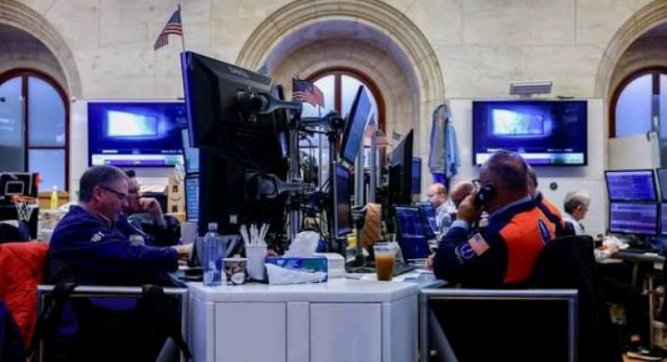
U.S. stocks fell on Thursday as a sharp jump in crude oil prices and persistently high Treasury yields reignited inflation concerns, just days before the start of a closely watched earnings season.
Brent crude surged above $105 per barrel, climbing more than 5%, as intensifying attacks on vessels in the Gulf and the Strait of Hormuz heightened fears of supply disruptions from the Middle East.
The benchmark 10-year Treasury yield hovered around 5.29%, near its highest level since 2002, while the 30-year yield stood at 5.67%.
The combination of expensive oil and elevated borrowing costs weighed heavily on risk appetite. Amazon, Tesla and Nvidia declined between 0.3% and 1.3%, leading losses among megacap growth companies. Semiconductor stocks came under even heavier selling pressure, with Marvell Technology and Intel dropping about 3% each, while AMD lost 2% and Micron Technology fell 1.4%.
“We’ve got duelling headwinds with energy prices and Treasury yields and light on the economic data front, kind of a wait and see on earnings which really kick off in earnest next week,” said Art Hogan, chief market strategist at B. Riley Wealth.

At 9:43 a.m. ET, the Dow Jones Industrial Average was down 88.19 points, or 0.17%, at 51,096.19. The S&P 500 declined 28.08 points, or 0.36%, to 7,773.69, while the Nasdaq Composite lost 155.07 points, or 0.58%, to 27,383.62.
The pullback followed losses on Wednesday, when rebounding oil prices and Treasury yields dragged the S&P 500 and Nasdaq away from record highs and ended the Dow’s four-session winning run.
On Wednesday, the Dow fell 341.41 points, or 0.66%, to 51,179.87, the S&P 500 sank 17.16 points, or 0.22%, to 7,801.77, and the Nasdaq Composite shed 61.2 points, or 0.22%, to 27,538.69.
Pressure from the bond market has been relentless. The 10-year Treasury yield reached a 24-year peak of 5.364% earlier this week before easing slightly . Dan Ivascyn, chief investment officer at bond fund manager Pimco, told the Financial Times that the benchmark 10-year yield could rise to 6% for the first time since 2000, citing high oil prices fueling inflation concerns and worries over growing U.S. public debt.
“If Treasury yields rose further, it could weigh on riskier assets such as stocks and corporate bonds,” Ivascyn said, adding that a move to 5.5% or higher would likely lead to “some decent weakness in risk markets, both credit and equity”.
Adding to inflation worries, the New York Fed’s September Survey of Consumer Expectations showed that median one-year inflation expectations jumped to 3.9%, the highest since May 2023, up from 3.6% in August.
Three-year expectations rose to 3.3%, while five-year expectations held steady at 3.0%.
Fed Governor Christopher Waller indicated that policymakers could pause at their next meeting but said further increases would probably be required to bring inflation back to the central bank’s 2% goal.
“If economic data continue to develop as expected, I anticipate additional increases to support a return of inflation towards the Federal Reserve’s 2% target,” Waller said, while noting there was “flexibility” over the pace of rate hikes.
Markets largely expect the Fed to keep rates unchanged in October, while leaving open the possibility of another increase in December, according to the CME FedWatch Tool.
Investors are now turning their attention to third-quarter results, with major financial companies including JPMorgan Chase due to report next week.
Expectations of strong corporate profits have helped support U.S. equities despite geopolitical uncertainty, higher energy costs and concerns about restrictive monetary policy.
Technology and energy are projected to deliver the strongest profit growth, while aggregate S&P 500 earnings are forecast to increase 30.6%, according to LSEG.
Eight of the S&P 500’s 11 sectors declined. Technology and healthcare were the weakest performers, while energy rose about 2% and consumer staples gained 1%. Utilities edged higher.
PepsiCo rose 2.1% despite cutting its annual core-profit forecast and announcing plans for additional cost reductions. Wolfspeed jumped 9.6% after receiving a conditional $1.5 billion loan commitment from the U.S. Department of Defence.
Declining shares outnumbered advancing ones by 1.64 to 1 on the NYSE and 2.53 to 1 on the Nasdaq.
The S&P 500 registered three new 52-week highs and 12 new lows, while the Nasdaq Composite recorded 13 new highs and 128 new lows.
Oil prices found support from multiple factors. Reports indicated that President Trump may be considering striking Iran before the midterm elections, as the U.S.-Israel war against Iran extends into its eighth month.
Attacks on tankers in the Strait of Hormuz hit their highest last week of any week since the war began, even as more crude flows out of the Gulf at higher costs and risk to cargoes and crew.
The International Energy Agency agreed to accelerate the release of oil stocks and prioritize diesel supplies under a plan launched in March, as governments seek to tackle record fuel prices and supply disruptions caused by the Iran war. However, that failed to cool the market.
Adding to supply concerns, Hurricane Isaias in the U.S. Gulf of Mexico forced Shell and Chevron to cut production, potentially affecting refinery operations along the Gulf Coast.
Fawad Razaqzada, a senior analyst at Forex.com, noted that with inventories at low levels supporting continued restocking demand, the long-term trend for oil prices remains tilted upward.
A short-term pullback would require progress toward a potential U.S.-Iran agreement, “but that looks unlikely to happen”.
“Oil price rises are again exacerbating market concerns about inflation and further pushing up bond yields,” Razaqzada said.
“Meanwhile, crude inventories have been significantly depleted, and the need for continued restocking will support oil prices, so the long-term trend remains biased upward”.
Bret Kenwell, an analyst at eToro, said stocks can withstand higher bond yields, but the market’s margin for error is shrinking.
He noted that persistently high financing costs suppress equity valuations and place greater demands on corporate performance, especially after the market’s recent rally.
“Strong earnings growth has been an important factor supporting the stock market. But as macroeconomic risks accumulate, companies need to deliver another outstanding quarterly performance. Interest rates, U.S. Treasury yields and inflation are becoming issues of increasing concern for the market. This means that to push stocks higher, bulls must provide more convincing reasons”.