
General News
INEC Unveils Real-Time Election Tracker as Voter Register Nears 100m, Begins Six-Zone 2027 Readiness Tour


The Independent National Electoral Commission (INEC) has unveiled plans to deploy a real-time election readiness tracker as it intensifies preparations for the 2027 General Election and the national voter register approaches the 100 million mark.
INEC Chairman, Prof. Joash Amupitan, SAN, disclosed this on Monday in Lagos while declaring open the South-West Zonal Interactive Meeting and Readiness Assessment for the 2027 elections.

The engagement marked the beginning of a six-zone national readiness tour by the Commission’s leadership, aimed at assessing the preparedness of its field structures ahead of the presidential and National Assembly elections scheduled for January 16, 2027, and the governorship and State Houses of Assembly elections slated for February 6, 2027.
Amupitan said the decision to take the readiness assessment directly to the zones represented a significant departure from the Commission’s long-standing practice of managing zonal preparations primarily through headquarters directorates.
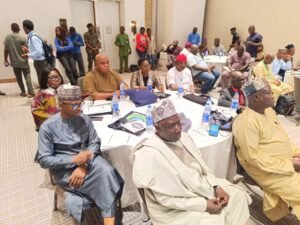
He said the exercise was designed to give the Commission’s leadership first-hand insight into the challenges confronting Electoral Officers and administrative staff who would ultimately implement the election at the grassroots.
According to him, electoral success would not be determined in conference rooms in Abuja, but at Local Government Areas, Registration Area Centres and polling units where election officials would manage the process.

“The eyes of 200 million Nigerians, and the world are fixed on us,” the INEC chairman told staff, charging them to uphold professionalism, neutrality and integrity.
Voter register nears 100 million
Amupitan disclosed that the Continuous Voter Registration conducted in three phases between August 2025 and July 2026 produced 10,772,421 new registrants, subject to ongoing Automated Biometric Identification System verification.

He said the national voter register was now approaching the 100 million mark, stressing that INEC would ensure that eligible Nigerians were not disenfranchised by logistical challenges, particularly in the distribution and collection of Permanent Voter Cards.
The chairman said the third phase of the CVR introduced an online registration portal to make registration more accessible to eligible voters.

He also highlighted the deployment of a new printable PVC technology, first used during the Osun State governorship election, as part of efforts to improve voter access and comply with Section 18(1) of the Electoral Act.
Real-time tracker to monitor readiness
At a separate two-day Strategic Operational Workshop for Administrative Secretaries in Lagos, Amupitan disclosed that INEC was developing what he described as a first-of-its-kind, real-time readiness tracker for monitoring election preparations nationwide.

The proposed Excel-based Administrative Secretary Master Operational Tracker Template will be linked to the Commission’s Election Monitoring and Support Centre dashboard and Election Project Plan.
The system is expected to provide the Commission’s leadership with real-time visibility into critical areas including distribution of election materials, recruitment and training of ad-hoc personnel and overall state-level preparedness.
Amupitan said the initiative would help replace what he described as “reactive panic with proactive management” and provide a standard mechanism for tracking the responsibilities of Administrative Secretaries.
He added that the tracker would serve beyond the 2027 elections as a permanent operational and onboarding framework for future Administrative Secretaries.
Technology, misinformation pose challenges
The INEC chairman identified voter apathy, declining public trust and the growing spread of misinformation and disinformation as major challenges ahead of the elections.
He said the competence and conduct of field personnel would remain one of the Commission’s strongest defences against false narratives capable of undermining confidence in the electoral process.
On technology, Amupitan said INEC was refining its result management systems, including the recently introduced eEC8A, to improve the verifiability and transparency of results from polling units through to the national collation centre.
He also warned staff against partisan conduct and administrative negligence, citing Section 26 of the Electoral Act, which provides for an oath of neutrality for Electoral Officers, Presiding Officers, Returning Officers and security personnel involved in elections.
Six-zone tour begins in Lagos
The South-West engagement brought together National Commissioners, directors from INEC headquarters, Resident Electoral Commissioners and other field officials from the six states in the zone.
Resident Electoral Commissioner for Lagos State, Prof. Ayobami Salami, said hosting the maiden zonal engagement was an honour for Lagos, stressing that electoral credibility was built through early preparation, competent personnel and effective coordination.
He said the South-West’s diverse electoral environment required readiness assessments that examined not only routine preparations but also logistics, technology, security and stakeholder engagement.
The Director of Planning and Monitoring, Mrs Helen Ajayi, said the engagement would assess the readiness of states in logistics, ad-hoc staff recruitment, technology, security, training, voter education and stakeholder engagement.
It would also identify operational challenges that could affect the 2027 elections, review voter registration and PVC collection, assess ICT resources and reinforce compliance with INEC’s Code of Conduct and operational guidelines.

At the Administrative Secretaries’ workshop, Secretary to the Commission, Mrs Rose Oriaran-Anthony, said the exercise would ensure that INEC headquarters and state offices worked from a common Election Project Plan.
She said each state delegation was expected to leave with a logistics risk register, an ad-hoc recruitment and deployment plan, a three-month stakeholder engagement plan and the new operational tracker template.
The workshop was supported by the European Union through the European Union Support to Democratic Governance in Nigeria (EU-SDGN), implemented with Development Alternatives Incorporated (DAI).
The Lagos engagement represents the first leg of INEC’s six-zone national readiness tour as the Commission steps up preparations for the 2027 General Election, which is expected to be one of the most closely scrutinised electoral exercises in Nigeria’s democratic history.