General News
Bayelsa Revives 831-Hectare Aquaculture Village, Begins Commercial Fish Harvest

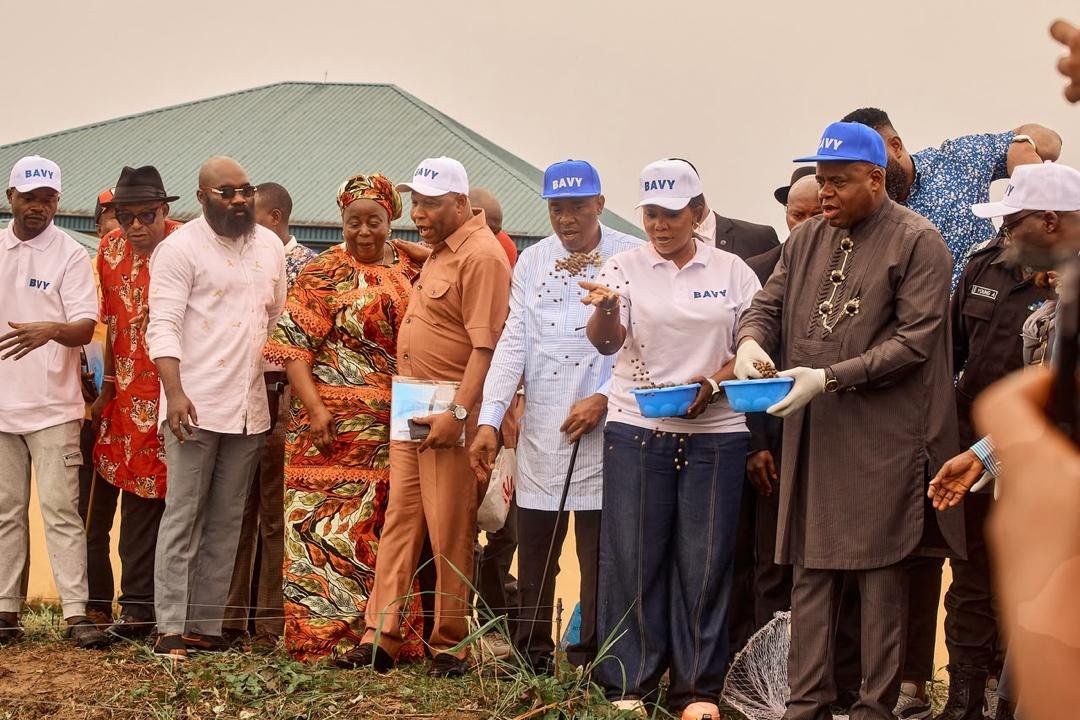
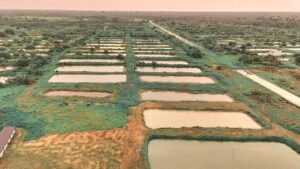
Bayelsa State has commenced large-scale fish production at its revamped Aquaculture Village in Yenegwe, as Governor Douye Diri moves to diversify the state’s economy, create employment opportunities and strengthen food security.
Diri flagged off the maiden fish harvest at the facility on Tuesday, describing its revival as a major investment in the state’s agricultural potential and blue economy.
The governor said the facility, established by the previous administration, had remained largely abandoned for years following the failure of a concession arrangement until his administration recovered and repositioned the asset.
He explained that efforts to revive the project after assuming office in 2020 were initially unsuccessful because of the existing contractual agreement, forcing his administration to terminate the non-performing concession.
According to him, the state had earlier committed about N200 million towards reviving the facility, but the intervention did not produce the desired results.
Diri said recovering the facility was necessary to protect public investments and ensure that government-owned assets contributed meaningfully to economic development.
He noted that although oil and gas remained important to Bayelsa’s economy, their finite nature and fluctuating fortunes made economic diversification imperative.
“Our future must now be built on our waters. Our fathers and forefathers relied on these waters. These waters gave them life, and these waters fed them.
“That is why our administration is investing in agriculture, aquaculture and the blue economy alongside education and the energy sector,” he said.
The governor commended President Bola Tinubu for establishing the Federal Ministry of Marine and Blue Economy, noting that the initiative provided opportunities for coastal states, particularly Bayelsa and the wider Ijaw nation, to maximise their maritime resources.
He also acknowledged the technical support provided by CSS Farms in Nasarawa State and the cooperation of the host communities in restoring the facility.
To improve access to the aquaculture village, Diri directed the Commissioner for Works to assess the deteriorated road linking the facility from Igbogene for immediate rehabilitation.
He also ordered the release of additional funds to complete another road connecting the facility to Glory Drive.
The governor said his administration’s ambition extended beyond fish production to establishing a comprehensive fisheries value chain covering processing, transportation, marketing and trade.
He encouraged young people to embrace fish farming and entrepreneurship, adding that the facility would provide practical training opportunities for students and aspiring aquaculture practitioners.
Diri expressed confidence that Bayelsa could eventually supply fish to other parts of Nigeria, given its natural environment and extensive water resources.
Earlier, the Commissioner for Marine and Blue Economy, Dr Faith Zibs-Godwin, described the maiden harvest as the revival of a major public investment and the beginning of sustained aquaculture production in the state.
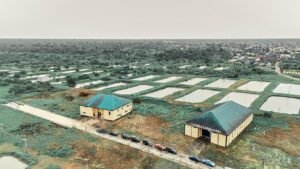
She disclosed that the facility covers approximately 831 hectares and comprises an 80-tank hatchery, 40 nursery ponds, 500 grow-out ponds, a feed mill with two production lines and a processing centre equipped with 30 smoking kilns, alongside other supporting infrastructure.
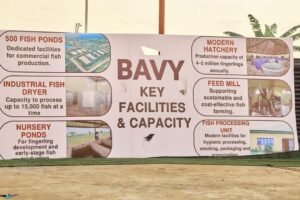
According to her, the hatchery had produced approximately 100,000 fish fry, while a pilot project involving 30,000 monosex tilapia had also been undertaken to diversify production.
She added that fresh spawning had commenced for the next production cycle, while students from Niger Delta University and members of the National Youth Service Corps were undergoing practical training at the facility.
The commissioner called on credible investors and technical partners to support the expansion of production, processing facilities, cold-chain distribution and access to wider domestic and international markets.
Representing the Minister of Marine and Blue Economy, Prof. Busayo Fakinlede commended the Diri administration for reviving the facility, assuring that the Federal Government would support Bayelsa’s efforts to develop its marine and blue economy.
He described the state as a frontline player in Nigeria’s marine and blue economy ambitions and urged investors to explore opportunities in aquaculture, fisheries and maritime infrastructure.
Fakinlede also disclosed that the World Bank had selected Bayelsa as a cluster for marine and rural economy development, citing its economic potential and readiness to advance the sector.
He further announced that the Federal Government had approved the Agge Deep Seaport project, describing it as a significant step towards expanding the state’s maritime infrastructure.
According to him, Governor Diri had been assured that the project would be realised before the end of his tenure.
He said Federal Government support for Bayelsa’s blue economy initiatives would contribute to national food and protein security.
Dignitaries at the event included the governor’s wife, Dr Gloria Diri; Deputy Governor, Dr Peter Akpe; Senator representing Bayelsa Central, Dr Konbowei Benson; and member representing Kolokuma/Opokuma/Yenagoa Federal Constituency, Hon. Oforji Oboku.
Also present were the Head of the State Civil Service, Dr Wisdom Sawyer; Acting Chief of Staff, Mr Iroro Komonibo; the Obenibe of Epie Kingdom, King Malla Sasime; and other government officials and stakeholders.
The development marks a renewed push by the Bayelsa State Government to harness its aquatic resources as an alternative source of economic growth, employment and food production.