
Government
Ghana Moves to Revive National Airline with Boeing Backing, Sets Roadmap for Take-Off

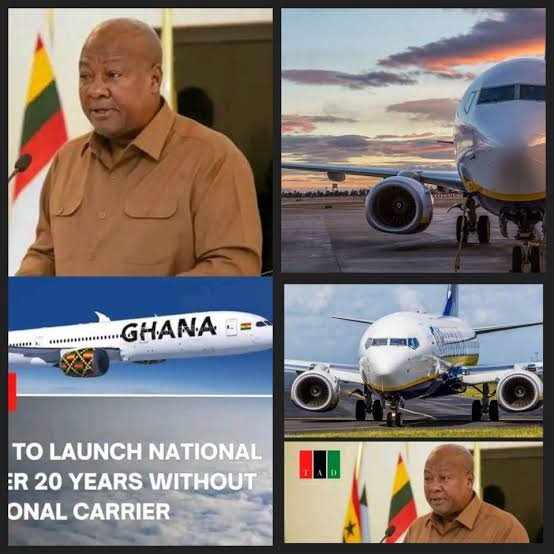
Ghana has taken another major step towards re-establishing a national airline after preliminary studies confirmed the project’s viability, with American aircraft manufacturer Boeing Group pledging support for the proposed carrier.
The development follows a meeting between Ghanaian President John Dramani Mahama and officials of Boeing Group, during which both sides discussed the roadmap for establishing the airline and the support required to move the project towards commercial operations.
According to a report by 3News on Monday, November 9, 2026, the Ghanaian government has agreed on a framework outlining the major requirements for setting up the proposed national carrier.

The roadmap includes securing a strategic airline partner, engaging a technical partner, obtaining an Air Operator Certificate (AOC), selecting suitable aircraft and finalising financing arrangements.
Boeing reportedly assured President Mahama of its continued support throughout the establishment and operational stages of the proposed airline.
A statement on the agreement said the roadmap would involve identifying strategic and technical partners, obtaining the necessary operating certification, selecting an appropriate fleet and making financing decisions.
The proposed airline is expected to strengthen Ghana’s aviation industry, expand international and domestic air connectivity and position Accra as a major aviation hub in West Africa.
The government also anticipates that the project will improve the utilisation of existing airport infrastructure and generate thousands of employment opportunities for pilots, cabin crew, aeronautical engineers, aviation managers and other professionals.

However, the airline is yet to commence operations, as several regulatory, financial and partnership requirements must first be completed.
Nigeria’s National Airline Experience Offers a Cautionary Tale
Ghana’s renewed ambition comes against the background of Nigeria’s difficult experience with establishing and sustaining a national carrier.
Nigeria Airways, established in 1958, operated for several decades before its eventual liquidation in 2003.
At its peak in the early 1980s, the airline reportedly operated a fleet of about 30 aircraft. However, years of financial difficulties, alleged corruption, mismanagement and excessive staffing contributed to its collapse.
By the time it was liquidated, its fleet had reportedly reduced to just three aircraft, while passenger numbers fell significantly. The airline also accumulated debts estimated at approximately $528 million.

Its collapse left thousands of former employees with outstanding entitlements, with the Federal Government commencing an N18 billion severance settlement for about 2,700 former workers in September 2026.
A subsequent attempt to establish another national carrier, Nigeria Air, also failed to progress into commercial operations.
The project was introduced in 2018 and later revived through a proposed partnership with Ethiopian Airlines, which secured a 49 per cent stake in 2022.
Although Nigeria Air was unveiled in May 2023, the Federal High Court in Lagos declared the partnership invalid in August 2024.
In October 2024, Aviation Minister Festus Keyamo raised concerns over the financial and contractual arrangements, including a proposed payment of approximately $112 million to Ethiopian Airlines over three years for aircraft presented as part of its equity contribution.

He also questioned provisions relating to tax exemptions, indemnities and the control of key management positions.
The project was subsequently suspended, leaving Nigeria without the proposed national carrier.
Nigeria Renews Debate Over National Carrier
Despite the setback, the question of establishing a national airline has returned to the forefront of Nigeria’s aviation policy debate.
On November 4, 2026, the Nigerian Senate rejected a proposal seeking the revival of Nigeria Air, while Senate President Godswill Akpabio called for renewed legislative efforts towards establishing a national carrier.
Akpabio maintained that Nigeria needed an airline operating under its national flag, recalling the former Nigeria Airways’ extensive fleet and international operations.
He also highlighted the difficulties associated with securing private aircraft for charter services and the pressure on domestic airlines, particularly during the December travel season.
The renewed debate reflects continuing concerns about Nigeria’s international air connectivity, the capacity of domestic operators and the country’s representation in the global aviation market.
Commercial Viability Remains Key to Ghana’s Ambition
For Ghana, the immediate challenge is translating the agreed roadmap into a functioning airline capable of surviving in an increasingly competitive aviation market.
Beyond the support of Boeing, the government will need to secure credible airline and technical partners, obtain regulatory approvals, acquire suitable aircraft and establish a sustainable financing structure.
The experience of Nigeria demonstrates that launching a national carrier is only one part of the challenge. Maintaining operational efficiency, financial discipline, transparency and effective corporate governance is equally important.
Ghana’s proposed airline could create employment, expand connectivity and strengthen the country’s aviation industry. However, the extent to which these expectations will be achieved will depend on the government’s ability to move beyond preliminary studies and deliver a commercially sustainable operation.
With the roadmap now agreed, attention will turn to the selection of partners, financing decisions and regulatory approvals that will determine when the proposed national carrier can finally take to the skies.