
Agriculture
FG Targets 20 Billion Trees, Touts Ethiopia’s Farming Model for Nigeria


Vice-President Kashim Shettima has announced plans by the Federal Government to plant 20 billion trees from the next rainy season, while identifying Ethiopia’s agricultural transformation as a model for Nigeria’s drive towards food sovereignty.
Shettima said Nigeria would draw lessons from Ethiopia’s agricultural development, particularly the Oromia regional model, to expand mechanised farming, improve food production, attract investment and strengthen the country’s food security.
The Vice-President spoke on Thursday during the Ethiopia-Nigeria Leadership Exchange, where he led a Nigerian delegation on a tour of farms and agricultural facilities in Ethiopia’s Oromia region.
He said Nigeria was pursuing a large-scale agricultural transformation programme aimed at addressing supply chain challenges, improving logistics and unlocking the sector’s economic potential.
According to him, cooperation between Nigeria and Ethiopia could help position Africa as a major global food producer while reducing the continent’s dependence on food imports.
Shettima described Ethiopia’s progress in wheat production as an example for other African countries, noting that the country had moved from importing wheat worth about $1bn annually to achieving self-sufficiency and exporting surpluses to neighbouring countries, including Djibouti and Kenya.
He also highlighted Ethiopia’s progress towards rice self-sufficiency, saying its agricultural transformation demonstrated the benefits of sustained investment in modern farming.
“We intend to embrace improved seeds, mechanisation and climate-smart agriculture,” the Vice-President said.
Shettima warned that excessive dependence on imported food could undermine national sovereignty, stressing that countries must develop the capacity to feed their populations.
“Food dependency compromises our sovereignty. Without independence in food production, a nation remains incomplete in its sovereignty,” he stated.
He expressed optimism that Nigeria and Ethiopia could jointly contribute to addressing Africa’s food security challenges through collaboration in modern agriculture, mechanisation and large-scale food production.
“I am overwhelmed with joy that the real economic renaissance of Africa is in the offing. Ethiopia has become the pathfinder, the front runner in us reclaiming our pride and our continent. We are mightily proud of them,” Shettima said.
“Africa must learn to feed itself. Ethiopia is doing it and Nigeria is on course to do the same. Ethiopia is a success story worthy of emulation.”
The Vice-President said Nigeria’s agricultural transformation would focus on high-yield seeds, modern farming practices, climate-smart agriculture and mechanisation to improve productivity and strengthen food sovereignty.
He also announced plans for a nationwide tree-planting campaign beginning in the next rainy season, with a target of planting 20 billion trees.
Shettima said the initiative would draw inspiration from Ethiopia’s Green Legacy Initiative, which combines environmental restoration with economic and livelihood benefits.
“We will embark on a massive tree-planting campaign in the next rainy season. It requires a lot of planning, energy and drive, which Ethiopia was able to galvanise its population into doing. We intend to plant 20 billion trees,” he said.
He added that the programme would support environmental restoration while creating employment opportunities for Nigerians.
Shettima further noted that the combined population and economic potential of Nigeria and Ethiopia could significantly influence agricultural development and food security across Africa.
“With a population of 100 million people, and a combined population with Nigeria of over 400 million, Ethiopia’s success will reverberate across the length and breadth of East and Southern Africa,” he said.
Earlier, the President of Oromia Regional State, Shimelis Abdisa, outlined Ethiopia’s agricultural achievements, highlighting the sector’s contribution to the country’s economy.
Abdisa said more than 200 crop varieties were cultivated across Ethiopia, while the country had expanded agricultural exports, including bananas, avocados and coffee.
He added that wheat production generated more than $3.1bn annually, noting that Ethiopian wheat remained competitive in international markets.
The Oromia president also disclosed that the region was collaborating with the Dangote Group on fertiliser production for local farmers.
He said the region’s poultry industry had expanded significantly beyond its initial capacity of two million birds, with further growth planned.
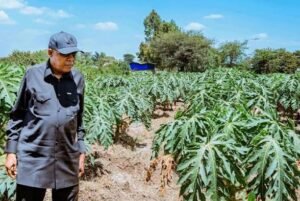
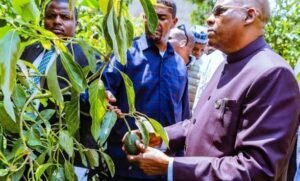
During the visit, Shettima toured wheat, banana and papaya farms, where he examined agricultural production systems and initiatives to expand food output.
The visit forms part of efforts to strengthen Nigeria-Ethiopia cooperation and identify practical approaches to agricultural modernisation, food security and environmental sustainability.