General News
IMF Continues to Operate as Colonial Debt Enforcer, New Report Finds

A new report released today has condemned the International Monetary Fund for perpetuating unequal and colonial systems through its social spending advice, revealing that the institution continues to function as a global debt enforcer rather than a development partner despite its rhetoric of transformation.
The report, titled Still cooking with a failed recipe – A review of IMF country advice on social spending, public services, debt, tax and gender equality, was published by ActionAid, Education International, the Tax and Education Alliance and partners.
It exposes staggering double standards in how the IMF treats wealthy nations compared to lower-income countries across Africa and Asia.
According to the findings, African countries are spending an average of 7.6 percent of their national budgets on public service wage bills, which is below the global average of 9 percent.
Despite this, the IMF continues to advise nations like Nigeria, Nepal, Brazil and other African countries to cut spending on essential public services to repay external debt, while simultaneously encouraging rich countries like the United Kingdom to expand public sector investments.
The report reveals that the United Kingdom spends 15.9 percent of its gross domestic product on its public workforce and is advised to increase public spending further. In stark contrast, Nigeria and Nepal spend merely 1.9 percent and 2.5 percent respectively but are still forced to freeze or cut spending on public services, crippling their ability to rebuild while repaying debt to Global North countries and lenders.
Arthur Larok, the Secretary General of ActionAid, said the IMF’s recipe book is completely outdated. He stated that by forcing lower-income nations to squeeze public workers, cut social spending, and prioritise foreign creditors over education and healthcare, the IMF is functioning as a global debt enforcer rather than a global development partner.
The report analysed 29 IMF documents covering the period from February 2022 to February 2025 across 11 diverse countries, including Ghana, Kenya, Malawi, Senegal, Nigeria, Uganda, Zambia, Zimbabwe, Brazil, Nepal and the United Kingdom.
The documents reviewed included 14 Article IV consultations, nine lending and programme documents, and six additional documents including Selected Issues papers and Technical Assistance reports.
The NGOs behind the report call out the IMF’s rigid, one-size-fits-all approach, which aggressively pushes countries to freeze public sector wages while completely ignoring how little those nations might already be spending.
At the same time, the IMF has largely ignored calls to boost social spending, failing to account for massive global gaps where countries like Senegal spend just 0.1 percent of their national budget on social programs compared to 20 percent in the United Kingdom.
Roos Saalbrink, Global Lead on Economic Justice at ActionAid International, said the IMF bizarrely argues that cutting the wages of nurses, teachers and doctors is necessary to create space for priority spending, entirely ignoring that these frontline workers are the priority. She added that on the other hand, the IMF encourages Global North countries to invest more in public services.
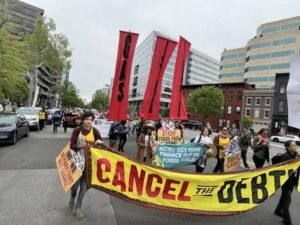
The report highlights that the IMF’s inaction on the global debt crisis is deafening. Despite three-quarters of lower-income nations now spending more on debt payments than on healthcare, the IMF refuses to support widespread debt cancellation. Instead, it acts as a global debt collector, forcing indebted countries to squeeze their citizens to satisfy wealthy overseas lenders.
Jennifer Lipenga, the Tax and Gender Equality Policy Advisor at the Tax and Education Alliance, said feminist and women’s rights movements have increasingly shown that regressive taxes such as value added taxes have disproportionate impacts on lower-income households, particularly women and other structurally marginalized groups.
Yet, she noted, the IMF’s tax advice remains regressive and is not informed by gender impact assessments, nor does it reflect global gender equality commitments that countries have signed on to, such as CEDAW.
The report concludes that the IMF remains structurally unreformed and is no longer fit for purpose, calling upon national governments to break the colonial chains imposed by the fund.
The organisations are demanding that the IMF be retired, not reformed, and that a fairer alternative multilateral space, specifically the UN Tax Convention and the UN Convention on Sovereign Debt, must replace it.
The report was co-sponsored by Afrodad, Akina Mama wa Africa, APMDD, Bretton Woods Project, CESR, Debt Justice, EndAusterity Campaign, FEMNET, Global Alliance for Tax Justice, Global Social Justice, IBON International, ITUC, Latindadd, MENAFEM, Public Services International, Tax Justice Network, Third World Network and WEDO.