
General News
Nigeria Says ISWAP Commander Killed in Joint Operation, Defends Intelligence Validity

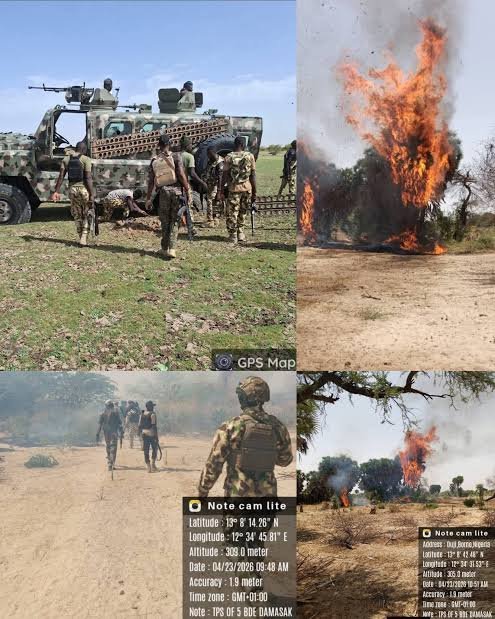
The Federal Government says there is “no ambiguity” over the reported killing of Abu-Bilal Al-Manuki, also known as Abu-Mainok or Abu-Bilal Al-Minuki, described as a senior commander of the Islamic State West Africa Province (ISWAP), insisting that the operation was the result of months of verified intelligence and coordinated surveillance.
In a statement issued on Saturday by the Presidency, the government said doubts raised in some quarters over the success of the operation were “premature and not grounded in full operational facts.”
The statement was issued by the Special Adviser to the President on Information and Strategy, Bayo Onanuga.
Intelligence confirms long-term tracking
According to security sources cited in the statement, the operation that led to Al-Manuki’s reported death was preceded by prolonged Intelligence, Surveillance and Reconnaissance (ISR) activities, including communications monitoring and phone intercepts dating back to December 2025.
Officials said the target had been under sustained observation across multiple locations in northern Nigeria, with intelligence efforts focused initially on capturing him alive before a final decision was taken to execute a kinetic strike.
The statement added that the intelligence trail was built over several months through a combination of human intelligence and digital surveillance designed to track movement patterns and operational networks linked to the insurgent commander.
Clarification on earlier reports
The government also acknowledged that Al-Manuki’s name had previously appeared in reports of suspected insurgents killed in 2024 during operations in the Birnin Gwari forest axis of Kaduna State.
However, security officials now describe that earlier assessment as a case of mistaken identity or misattribution, stressing that the Birnin Gwari theatre was not within the commander’s established operational area.
“Higher level of certainty” in latest operation
Unlike earlier claims, authorities insist that the latest operation was executed with “significantly higher precision,” supported by multi-layered intelligence verification before authorisation.
Officials said multiple intelligence sources were cross-checked before the final strike was approved, making the operation “distinct from past battlefield assessments that later required correction.”
“This time, there is no ambiguity,” the statement said.
Response to scepticism
The government also responded to public scepticism, noting that counterterrorism operations globally have sometimes faced initial uncertainty due to the complex and fluid nature of insurgent networks.
It referenced past high-profile cases in global terrorism operations where conflicting reports emerged before eventual confirmation of militant deaths, warning against using such cases to dismiss verified intelligence outcomes.
Officials said Nigeria’s security environment remains highly complex, with insurgent groups relying on aliases, cross-border movement and civilian concealment, making intelligence confirmation a multi-stage process.
Call for confidence in security operations
While acknowledging the importance of public scrutiny, the statement cautioned that premature dismissal of verified military claims could undermine morale and operational effectiveness.
Security authorities maintained that the operation was a “validated, intelligence-driven success” carried out in collaboration with international partners.
“For now, military authorities remain firm in their position: this operation represents a confirmed success against a senior ISWAP figure,” the statement concluded.