
Analysis
The Xi-Trump Bridge: Why China And The United States Need Each Other More Than They Admit

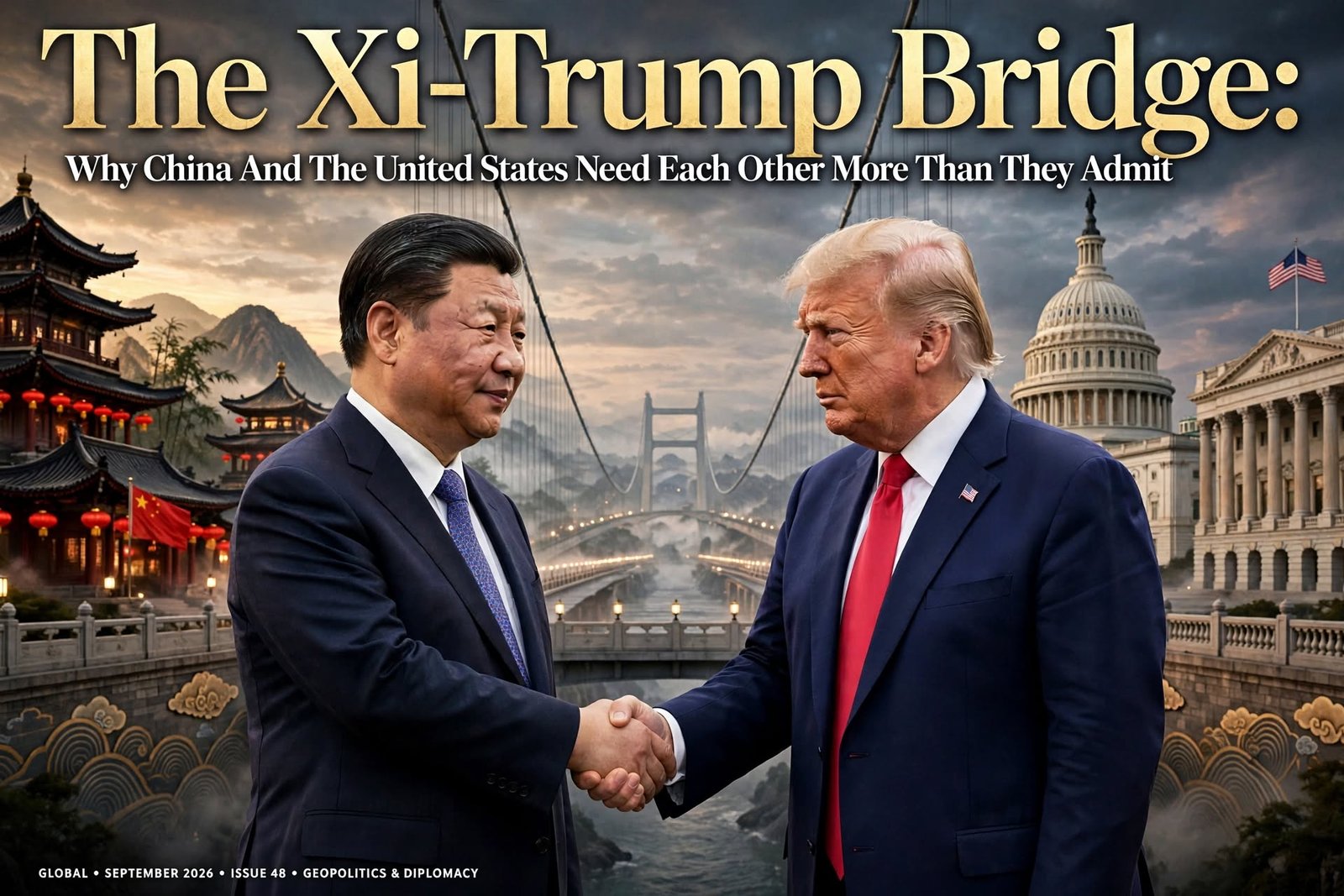
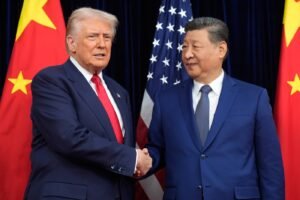
For a relationship that has spent years building walls of tariffs, technology restrictions, military suspicion and geopolitical rivalry, the arrival of Chinese President Xi Jinping in Washington carries an unmistakably different message.
The ceremony itself tells part of the story.
Xi is being accorded the full treatment of a state visit, including a formal welcome at the White House, military honours and a state dinner. The White House has confirmed that President Donald Trump will personally receive Xi at Joint Base Andrews, before the Chinese leader is honoured at a State Arrival Ceremony on Thursday.
But beneath the pageantry lies a harder reality.
The world’s two largest economies still have deep disagreements over trade, technology, Taiwan, critical minerals, artificial intelligence and other geopolitical questions. Their current trade truce is due to expire in November, making the Washington meeting more than a diplomatic photo opportunity. It is an attempt to prevent competition from sliding back into confrontation.
That is why Xi’s visit matters beyond Washington and Beijing.
The central question is no longer whether China and the United States will compete. They already do.
The question is whether they can compete without destabilising the global economy, disrupting critical supply chains or allowing strategic mistrust to become a security crisis.
A Relationship Too Important To Break
China and the United States occupy an unusual position in the international system.
They are economic giants, technological powers, nuclear-armed states and permanent members of the United Nations Security Council. Their decisions influence trade, investment, technology, energy, security and financial markets far beyond their borders. The Congressional Research Service describes both countries as leading powers in economic size, defence spending and research and technology investment.
This makes their relationship difficult to manage but equally difficult for the world to ignore.
For years, Washington and Beijing have been caught between interdependence and rivalry.
American companies depend heavily on Chinese manufacturing and the Chinese market. China, meanwhile, remains deeply integrated into global trade and depends on access to markets, technology and international investment even as it seeks greater self-reliance.
The tariff battles of recent years demonstrated the cost of confrontation.
Beginning in 2025, the two sides repeatedly raised tariffs and imposed countermeasures. China also tightened controls affecting critical minerals and rare earths, while Washington expanded restrictions involving Chinese technology and strategic industries. The confrontation produced temporary truces but did not resolve the underlying disputes.
The May 2026 Trump-Xi summit in Beijing subsequently produced commitments aimed at creating greater stability, including plans for U.S.-China Boards of Trade and Investment and Chinese commitments involving agricultural products, Boeing aircraft and critical minerals. Yet implementation has been uneven.

Washington therefore represents another test.
Can the two leaders convert a fragile truce into a more predictable relationship?
Why Xi’s Visit Is Necessary
For Beijing, stability with Washington provides strategic and economic breathing space.
China enters the Washington meeting with a strong trading position. Reuters reported that China’s exports and global trade have remained robust despite American tariff pressure, while its trade surplus is on course to remain exceptionally large.
But China also faces significant economic challenges, including weaknesses in domestic consumption, a prolonged property-sector downturn and pressure from trade barriers in major markets.

An extended period of predictable relations with the United States would therefore provide China with room to concentrate on domestic economic priorities while continuing to develop its technology and industrial sectors.
There is another consideration: access.
Chinese manufacturers remain major players in electric vehicles, batteries, solar technology, telecommunications equipment and other industries. At the same time, Beijing remains interested in access to American technology, markets and investment, even as it accelerates efforts to develop domestic alternatives.

For Xi, the Washington visit can therefore be understood as an exercise in managing competition rather than ending it.
As Chatham House’s Dr Jennifer Lind argues, neither Washington nor Beijing should underestimate the other. She notes that China’s industrial and technological strengths coexist with economic vulnerabilities, while America’s domestic challenges do not erase its considerable economic, technological, military and alliance advantages.
That balance makes dialogue necessary.
Neither side can simply assume that the other will disappear from the strategic equation.
What America Wants From China
For Trump, the calculations are equally practical.

The United States wants greater access to Chinese markets for American farmers, manufacturers and companies. It also wants China to deliver on commitments involving agricultural purchases, Boeing aircraft and critical minerals.
The May agreement included China’s commitment to purchase at least $17 billion annually in U.S. agricultural products in 2026, 2027 and 2028, alongside other market-access measures. It also included an initial commitment for 200 Boeing aircraft and Chinese action on rare earths and other critical minerals.
But some of those commitments have not progressed as quickly as Washington expected.
The Associated Press reported ahead of the Washington meeting that China’s projected purchases of American agricultural goods could fall below the agreed target and that the Boeing commitment had yet to materialise.
That leaves Trump with a straightforward negotiating challenge: obtain concrete economic benefits without reigniting the tariff confrontation.
There is also the critical-minerals question.
Rare earth elements are essential to modern manufacturing, electronics, electric vehicles, renewable energy systems and defence technologies. China has a dominant position in the global rare-earth supply chain, particularly in processing and refining. Reuters reported that this dependence has become an important factor shaping Washington’s approach ahead of the summit.
For the United States, securing more predictable access to these materials is therefore not simply a commercial issue.
It is a supply-chain security issue.
The Rare-Earth Reality
Few issues demonstrate the complicated nature of the relationship better than rare earths.

Washington wants to reduce its dependence on China.
Beijing knows that this dependence gives it leverage.
Neither position, however, completely solves the problem.
The United States can seek alternative suppliers and develop domestic processing capacity, but creating a resilient rare-earth ecosystem requires time and investment. China, meanwhile, can use its position strategically, but excessive restrictions could accelerate American and allied efforts to develop alternatives.
This creates an unusual form of mutual dependence.
The same logic applies to technology.
America possesses major advantages in advanced semiconductor technology and other areas of high-end computing. China possesses a massive manufacturing ecosystem and has rapidly expanded its capabilities in artificial intelligence, electric vehicles, batteries, telecommunications and other strategic technologies.
The competition has therefore become a race over both technology and supply chains.
The danger is that the race could fragment the global technology system into competing blocs.
AI: The New Frontier Of Competition
Artificial intelligence may be one of the most consequential issues at the Washington meeting.
China and the United States are competing to shape the next generation of AI systems, while both governments increasingly recognise that uncontrolled AI risks could cross national borders.
The Atlantic Council notes that AI has risen sharply on the bilateral agenda because both countries view it as a technology with implications for economic power and national security.
This creates an unusual opening.
The two countries may compete intensely over advanced AI while simultaneously needing mechanisms to prevent dangerous misunderstandings and manage risks.

For example, communication between governments could become important if AI systems are increasingly incorporated into military decision-making, intelligence analysis or strategic infrastructure.
The goal would not necessarily be to end technological competition.
It would be to establish rules that prevent competition from becoming catastrophic.
That distinction could become one of the most important legacies of the Washington talks.
Taiwan And The Security Question
Then there is Taiwan, perhaps the most sensitive issue between Washington and Beijing.
China considers Taiwan part of its territory and opposes moves toward formal independence. The United States maintains longstanding security relationships with Taiwan while also maintaining its own diplomatic framework with Beijing.
The issue has become increasingly intertwined with American arms sales, Chinese military activity around Taiwan and broader questions about the balance of power in the Indo-Pacific.
Experts at the Council on Foreign Relations identify Taiwan as one of the key issues that could complicate the summit.
The significance extends far beyond China and America.
Any serious military confrontation around Taiwan could disrupt shipping, semiconductor production, financial markets and international trade.
For that reason, even without resolving their fundamental disagreement, mechanisms for crisis communication and restraint matter.
A summit cannot erase the Taiwan dispute.
But direct engagement can reduce the danger of miscalculation.
The Human Bridge
Yet perhaps the most interesting dimension of Xi’s visit lies outside tariffs, missiles and semiconductors.
It is the people.
The Xinhua reports supplied for this story highlight an effort that is rarely captured by the language of strategic competition: youth exchange.
In 2023, Xi announced an initiative to invite 50,000 young Americans to China over five years for exchanges and study.
According to Xinhua, that target was reached by May 2026, two and a half years ahead of schedule.
Young Americans travelled across China, interacted with Chinese students, studied languages and participated in sports, cultural and academic programmes.
That matters because geopolitical relationships are not sustained entirely by presidents.
They are also sustained by students, researchers, entrepreneurs, journalists, artists, scientists, tourists and families.
One of the young Americans quoted by Xinhua, Kiana Haywood of Central Michigan University, described the experience as an opportunity to ask questions and experience Chinese culture directly rather than relying exclusively on distant perceptions.
That is the quieter side of diplomacy.
People who have lived alongside people from another country often possess a more complicated understanding of that country than those who know it only through headlines.
Xi has repeatedly emphasised this people-to-people dimension, drawing on relationships that began during his 1985 visit to Iowa.
The story of American teacher Ronald Sakolsky and Chinese environmentalist Yin Yuzhen offers another illustration.
Sakolsky donated $5,000 in 1999 to support Yin’s tree-planting work against desertification in Inner Mongolia. According to Xinhua, the effort eventually helped Yin cultivate a forest of more than 50,000 trees.
When the two reunited in August 2026, Sakolsky offered a single word to describe what he hoped the Xi-Trump meeting could achieve:
“Bridge.”
That word captures something governments often struggle to achieve through official communiqués.
What China Stands To Gain
For China, a successful summit could provide several benefits.
First is economic predictability.
A longer trade truce would reduce uncertainty for exporters, manufacturers and investors.
Second is access to markets.
American demand remains important to Chinese businesses, while stable commercial ties can help prevent the rapid fragmentation of global supply chains.
Third is strategic space.
A less volatile relationship with Washington could give Beijing greater room to concentrate on domestic priorities and relations with other regions.
Fourth is diplomatic stability.
China does not need the United States to agree with its worldview. But it has an interest in preventing strategic competition from becoming an uncontrolled confrontation.
Finally, people-to-people exchanges can help build longer-term understanding, particularly among young people who will eventually become business leaders, scientists, policymakers and diplomats.
What America Stands To Gain
For Washington, the benefits are equally concrete.
More predictable Chinese exports of rare earths and critical minerals could reduce supply-chain risks.
Greater Chinese purchases of American agricultural products would benefit U.S. farmers.
Aircraft orders and other industrial purchases could support American manufacturing.
A functioning bilateral investment mechanism could create channels for resolving commercial disputes.
And cooperation over AI could help establish communication between the world’s two leading AI powers.
There is also the broader economic benefit of avoiding another escalation in tariffs.
For American consumers and companies, fewer disruptions in global supply chains can mean greater predictability in prices, production and investment.
But the gains depend heavily on implementation.
Previous agreements show that announcements alone do not guarantee results. The unfinished commitments from the May summit demonstrate why verification and follow-through will matter as much as the ceremony.
And Then There Is The Rest Of The World
For the rest of the world, the most important outcome may not be a dramatic China-U.S. agreement.
It may simply be the avoidance of another escalation.
When Washington and Beijing impose tariffs, restrictions or export controls, the consequences rarely stop at their borders.
Companies shift supply chains.
Commodity prices move.
Shipping routes are affected.
Manufacturers face uncertainty.
Smaller economies are forced to adjust to rules they did not create.
Developing countries can be particularly exposed because many depend on affordable Chinese manufactured goods, American markets, international capital and stable global commodity prices.
For Africa, the stakes are significant.
China is a major trading partner, infrastructure financier and source of manufactured goods across the continent. The United States remains a major investor, donor, technology partner and market.
A more stable China-U.S. relationship could therefore create room for African economies to deepen economic ties with both powers without being forced into an increasingly rigid geopolitical choice.
The same applies to climate change.
The world cannot easily pursue ambitious climate goals if its two largest powers are locked in permanent confrontation over technology, investment and supply chains.
Solar panels, batteries, electric vehicles, energy storage and other technologies are central to the global energy transition.
Cooperation or managed competition between Washington and Beijing could affect how quickly those technologies spread and at what cost.
The World Does Not Need A Perfect Friendship
The expectation surrounding the Washington meeting should therefore be measured.
China and the United States are unlikely to resolve their fundamental strategic differences in one summit.
Their competition will continue.
Their disagreements over Taiwan, technology, trade and national security will remain.
But diplomacy does not require friendship.
Sometimes it requires something more basic: the ability to speak before acting.
The experts following the summit point to the possibility of a limited, pragmatic outcome — an extension of the trade truce, progress on agricultural and energy purchases, movement on AI dialogue and efforts to stabilise the relationship rather than transform it.
That may sound modest.
But in a relationship between two nuclear-armed powers with enormous economic influence, modest stability can have enormous consequences.
Beyond The 21-Gun Salute
The 21-gun salute, the honour guards and the state dinner will dominate the television pictures.
But the real measure of Xi’s Washington visit will come later.
It will be seen in whether American farmers receive the Chinese market access they were promised.
It will be seen in whether rare-earth supplies become more predictable.
It will be seen in whether businesses can invest with greater certainty.
It will be seen in whether Washington and Beijing can establish guardrails around artificial intelligence.
It will be seen in whether disagreements over Taiwan can be managed without dangerous escalation.
And it will be seen in whether young Chinese and Americans continue to cross the Pacific, meet each other and discover that governments may compete even when ordinary people can cooperate.
For Xi, the visit is an opportunity to reinforce China’s argument that engagement and development remain preferable to confrontation.
For Trump, it is an opportunity to seek tangible economic commitments while managing a relationship that affects American workers, companies and national security.
For the global community, the stakes are larger.
The world does not require China and America to become friends.
It needs them to remain capable of talking.
Because when the world’s two largest powers build bridges, even imperfect ones, the rest of the world has more room to breathe.
And when those bridges collapse, the consequences rarely stop at the Pacific.
The Washington summit, therefore, is not simply about Xi and Trump.
It is about whether the two powers can find a workable way to compete, cooperate and coexist without asking the rest of the world to pay the price for their rivalry.