Economy
Tinubu: Colonial Tax Laws Kept Nigerians Poor, New Reforms Already Yielding N28.7 Trillion Revenue

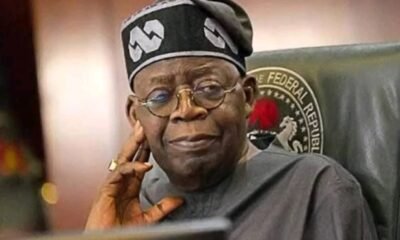
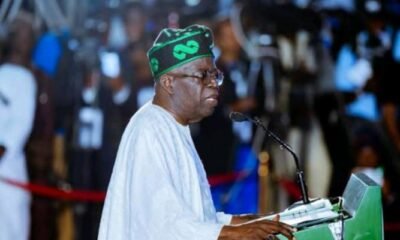
President Bola Tinubu has declared that colonial-era tax laws impoverished Nigerians through fragmentation, multiplicity, and inconsistencies, while assuring that the new tax reforms will deliver greater prosperity and inclusivity. The President made these remarks on Tuesday in Abuja at the commissioning of the 16-storey Nigeria Revenue Service Headquarters, in a statement issued by the Special Adviser to the President on Information and Strategy, Bayo Onanuga.
Bayo Onanuga quoted the President as emphasising that the new tax system is designed to be people-centred and investment-friendly, thereby advancing the nation’s development goals. President Tinubu explained that the new tax laws, which became fully operational in January, are intended to liberate the economy from the constraints of archaic laws and make it more globally competitive. “On my inauguration day, I made a solemn pledge that we will move Nigerians from the dimness of uncertainty into the clear light of renewed hope. I committed to confronting structural weaknesses, restoring financial stability, and building an economy anchored in discipline, equity, and opportunity. Today, I stand before you to reaffirm that these words were not rhetoric; they were a covenant with the Nigerian people,” the President said.
Bayo Onanuga further noted that the President commended the Executive Chairman of the NRS, Dr Zacch Adedeji, for his exceptional performance and the successful completion of the edifice, which provides a conducive working environment for 3,000 staff, along with a data processing centre, clinic, auditorium, training facilities, a gym, and a library. President Tinubu expressed delight that the NRS headquarters was completed in 30 months, after more than two decades since the foundation was laid. “We are not gathered here merely to commission an edifice. We are here to mark a milestone in a larger national journey: the deliberate strengthening of our fiscal foundation and rebuilding of confidence in public institutions. No serious nation can achieve lasting prosperity on a weak and fragmented revenue system. No government can demand trust from its citizens when taxation is opaque, inefficient or unjust. That is why this administration took the bold decision to embark on far-reaching tax and fiscal reforms,” he said.
President Tinubu also thanked the Minister of State for Finance, Taiwo Oyedele, for his leadership in modernising colonial-era tax laws into “manageable, realisable, and understandable levels.” Addressing concerns about the new tax reforms, the President assured that the NRS has repositioned itself as a revenue hub, equipped with capacity and technology, backed by research and data-driven policies, and sensitive to the needs of the people, particularly the vulnerable. “The reforms are designed to simplify our system, eliminate distortions and create a fair, transparent and investment-friendly environment. Our direction is clear: to have a revenue system that rewards enterprise, supports growth, and ensures that every contribution to the national cause is matched by feasible value for the people. The early results are encouraging and fantastic. Mr Adedeji, thank you very much. We are witnessing improved fiscal stability, strength, stronger foreign reserves, a more efficient trade ecosystem and increased investor confidence in Nigeria’s economic direction,” the President added.
Bayo Onanuga also reported that Senate President Godswill Akpabio urged Nigerians to be patient with the Tinubu administration, noting that the economic reforms are already yielding results. “Nobody has noticed that since we came on board, we have not had 3-5 km of vehicles lined up at fuel stations to buy petrol. There was a time that we were prepared to pay even N10,000 per litre for fuel, but they could not see the fuel. But today, there is no single fuel queue in Nigeria. Nobody is saying that because we encouraged and partnered with the private sector for the first time, we are now producing what we consume and consuming what we produce. We even go to the extent of sending it to other countries,” the Senate President noted.
The Speaker of the House of Representatives, Tajudeen Abbas, commended the President for strengthening the economy with new reforms. “For many years, our revenue system struggled less from a lack of effort than from a lack of coherence. We operated multiple regimes, overlapping mandates and fragmented legal frameworks. The result was predictable—high effort, low yields, limited public confidence. What has come under your administration is not only the policy directive, but also the underlying logic of the system. The reforms have sought to align rules, institutions and incentives within a single framework,” Abbas said.
In his welcome address, the Executive Chairman of the NRS, Dr Zacch Adedeji, described the commissioning of the headquarters building as “the culmination of a defining institutional journey.” Adedeji noted that five years ago, the total collection for Nigeria’s revenue was N6.8 trillion, and by 2025, the year ended with N28.7 trillion. He added that beyond taxation, fiscal governance has been strengthened to improve remittances, enhance transparency, and tighten control over public finance flows. “To put this in perspective, Mr President, in May 2023, when you assumed office, the total money available for the federation was N711 billion. By September 2025, it was N3.6 trillion, which is 400% above what we inherited,” Adedeji stated.
Bayo Onanuga concluded the statement by noting that Guan Shuai, the Managing Director of China Civil Engineering and Construction Company which completed the edifice, delivered a goodwill message stating that President Tinubu has demonstrated visionary leadership within less than three years in office by taking tough decisions that will benefit the nation and posterity. The commissioning ceremony was attended by Senate President Godswill Akpabio, Speaker Tajudeen Abbas, ministers, senators, members of the House of Representatives, private-sector leaders, and the governors of Kwara, Imo, Borno, Kogi, Plateau, and Anambra States.