
Opinion
Qatar Built a Global Airline,What Has Nigeria Built?

By Nick Agule
Qatar is a country of roughly 3 million people (500,000 are citizens) with a landmass about one-third the size of Benue State. It is largely desert, with limited agricultural potential and few natural advantages. The only resource Qatar has is oil and gas. Yet since gaining independence in 1971, Qatar has transformed those resources into productive assets that generate wealth, jobs, and global influence.
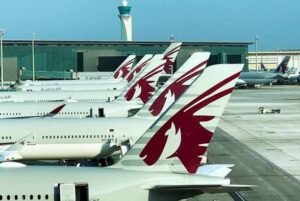
Today, Qatar Airways operates more than 300 aircraft, most of them long-haul wide-body jets serving international destinations because Qatar is so tiny it can’t operate local flights! Only 1,700 Qatari citizens own an aircraft!
In 2025, Hamad International Airport processed over 54 million passengers and nearly 283,000 aircraft movements, establishing Doha as one of the world’s leading aviation hubs. That’s about 150,000 passengers and 775 aircraft movements per day!
The significance of this achievement is not aviation itself. It is economic strategy.
Qatar did not merely consume its oil and gas wealth; it invested that wealth into productive infrastructure capable of generating recurring revenue, creating jobs, attracting foreign exchange, and strengthening the country’s geopolitical relevance. Aviation became a tool of economic diversification and national development.
The result is that Qatar Airways generated $23 billion in revenues in 2025 which is more that the total revenue of Nigeria’s federal government! The airline has also created tens of thousands of jobs which can’t be filled by Qatar residents only so a huge number of international staff work for the airline, and projects Qatar’s influence far beyond what its population or geography would ordinarily permit.
Now consider Nigeria.
Nigeria possesses 80 times more land than Qatar, the world’s 6th largest population much larger than Qatar, greater agricultural potential, larger domestic markets, and abundant natural resources. Yet too often, public policy appears focused on symbolism rather than productivity, consumption rather than value creation, and political optics rather than economic transformation.
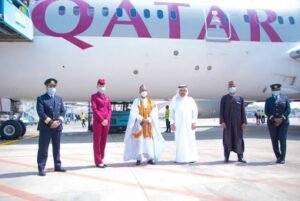
All we could boast of as a national carrier was to rent an Ethiopian Airlines aircraft, adorn it with our national colours and stage a fake commissioning ceremony all before the eyes of the International community but turn around and expect respect from them?
A nation does not become prosperous by repainting assets. It becomes prosperous by building institutions, infrastructure, industries, and enterprises that create sustainable wealth.
The central question before Nigeria is therefore not whether we can launch an airline, commission a project, or hold a ceremony. The real question is whether our public investments are creating productive assets that generate jobs, foreign exchange earnings, technological capacity, and long-term economic growth.
Every naira committed to a non-productive venture carries an opportunity cost. It is a naira that could have strengthened security, improved schools, expanded healthcare access, modernized infrastructure, supported industrialisation, or improved electricity supply.
This is ultimately a political question because economic outcomes are a reflection of political choices.
Countries do not accidentally become prosperous. Prosperity emerges when citizens consistently reward competence, vision, accountability, and results at the ballot box. Likewise, decline occurs when politics is dominated by ethnicity, religion, patronage, and personality cults rather than performance.
Those who say politics is dirty and therefore choose not to participate are, in effect, surrendering the future of their children to those who do participate. Democracy does not reward spectators; it rewards organised citizens.
If we want a Nigeria that competes with the best in the world, then citizens must become active stakeholders in governance:
1. Register and vote.
2. Vote for competence rather than ethnic, religious, or partisan considerations. If a party fields a more competent party than your party, vote the competent candidate! Doing so safeguards the future of your children.
3. Support credible candidates with your resources and influence.
4. Join political parties and reform them from within.
5. Offer yourself for public service where possible.
6. Hold elected officials accountable through civic engagement, advocacy, and lawful democratic action.
History shows that no nation has ever developed because its citizens remained passive observers – siddon lookers! Every successful society was built by citizens who demanded better governance and refused to normalise mediocrity.
Nigeria’s greatest challenge is not a lack of resources. It is the failure to convert those resources into institutions, productivity, and prosperity.
The good news is that political choices can be changed.
The future will be determined not by what politicians do alone, but by what citizens are willing to tolerate, challenge, and demand.
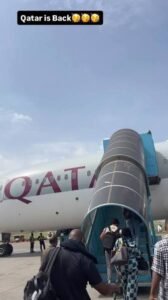
Many Nigerians believe they have secured their children’s future by relocating them abroad. Yet immigration policies are tightening across much of the world. As I write, Nigerians living and working or doing business legally in South Africa are on a flight returning to Nigeria. The US is in the hands of an anti-immigration regime. The UK will follow shortly. Your children have no other home than Nigeria. If you don’t fight to fix Nigeria, but you think you have tried for them by educating them abroad and settling them there, you have failed! You’ll be turning in your grave seeing them brutalised and killed where they are abroad and kidnapped and killed when they return to Nigeria. No matter where our children live today, Nigeria remains their ancestral home and ultimate point of reference. If we fail to build a stable, prosperous, and secure nation, we leave them vulnerable both at home and abroad.
2027 is not merely another election year. It is another opportunity to decide whether Nigeria will continue consuming its future or begin investing in it.
_Nick Agule (nick.agule@yahoo.co.uk) is a public affairs analyst._