
Opinion
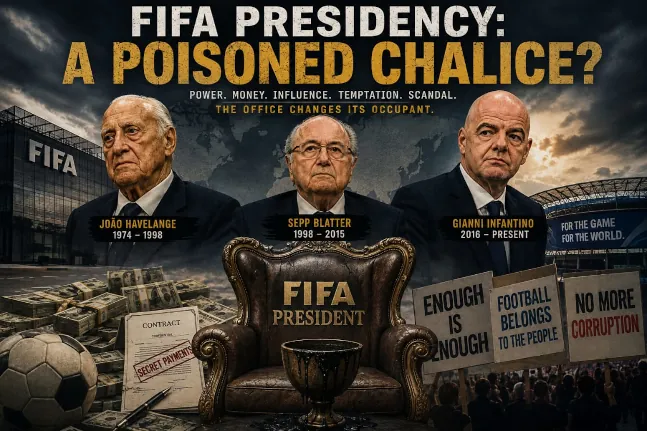
FIFA Presidency: A Poisoned Chalice?

By Chris Osa Nehikhare

There was a time when becoming President of FIFA was regarded as the highest honour in world football. The occupant of the office was expected to be the custodian of the beautiful game—a neutral guardian entrusted with protecting football from politics, greed and commercial excess.
Today, many are beginning to ask a disturbing question.
Is the FIFA presidency a poisoned chalice?
It is difficult to ignore the pattern.
The modern era of FIFA was shaped by Brazilian administrator João Havelange, who transformed football from a popular sport into a global commercial enterprise. When he assumed office in 1974, FIFA was relatively modest in financial strength. By the time he handed over to his trusted lieutenant, Sepp Blatter, football had become one of the world’s biggest commercial products.
Havelange deserves enormous credit for taking the World Cup beyond Europe and South America, expanding sponsorship, television rights and FIFA’s global reach. Football became richer than anyone could have imagined.
But wealth has a way of attracting temptation.
Long after leaving office, Havelange’s reputation became tainted by revelations surrounding the ISL marketing scandal, where secret payments and kickbacks allegedly became part of FIFA’s business culture. A man once celebrated as football’s greatest moderniser left under a cloud.
Then came Sepp Blatter.
When Blatter assumed office in 1998, he inherited an organisation overflowing with money and influence. Under his leadership, FIFA became even wealthier. World Cup revenues exploded. Development grants flowed across Africa, Asia, Oceania and the Caribbean. Smaller football nations saw Blatter as the man who finally gave them a voice against Europe’s traditional dominance.
Yet success gradually gave way to controversy.
Vote-buying allegations. Bribery investigations. Questions over World Cup hosting rights. And internal power struggles.
By 2015, FIFA was engulfed in one of the biggest corruption scandals in sporting history. Senior officials were arrested. Criminal investigations spread across several countries. Although Blatter consistently denied criminal wrongdoing, his presidency became synonymous with an era many believed had lost its moral compass. He eventually left office disgraced after almost two decades in charge.
The football world demanded reform.
Into that vacuum stepped Gianni Infantino. He was presented as the reformer. The man who would restore FIFA’s credibility.
Initially, many believed him.
Financial transparency was promised. Governance reforms were announced. And the image of FIFA appeared to improve.
But as the years passed, familiar criticisms began to emerge as power became increasingly concentrated.
Relationships with governments attracted scrutiny. Tournament expansion generated debate. Commercial interests appeared to grow stronger than football traditions.
Now, the latest controversy has pushed FIFA into yet another crisis. Infantino’s proposal to restructure the commercial ownership of the World Cup through private investment triggered an unprecedented backlash. UEFA publicly declared it had lost confidence in his leadership, with opposition spreading across other football confederations before FIFA eventually abandoned the plan.
Whether history ultimately judges Infantino harshly remains to be seen. But the similarities are becoming impossible to ignore.
Three presidents. Three different personalities. Three different eras.
Yet each presidency has eventually become overshadowed by controversy. That raises an uncomfortable question.
Perhaps the problem is no longer the men. Perhaps the problem is the office itself.
FIFA today controls billions of dollars.
It decides:
1. World Cups host.
2. Distributes development funds to more than 200 football associations.
3. Influences governments.
4. Negotiates with multinational corporations.
Its president arguably wields more influence than many heads of state.
History teaches us that whenever enormous power combines with enormous money and very little independent oversight, accountability becomes increasingly difficult.
The danger is not simply corruption. The danger is believing that because one occupies a noble office, every decision made in that office is automatically noble.
Anyways, Football has survived dictators, wars, financial crises and scandals because the game itself belongs to the fans—not to FIFA presidents. Perhaps it is time for football to ask a bigger question than who should become the next FIFA president.
Perhaps the question should be how the office itself can be redesigned so that no individual—however brilliant, however popular or however well-intentioned—can become bigger than the game.
Because history suggests that the FIFA presidency may not simply be a prestigious office.
It may well be a poisoned chalice.
(Part 2 will follow on Monday.)