
Legislature
Tinubu’s State Police Bill Scales Second Reading in Senate, Promises Sweeping Security Overhaul

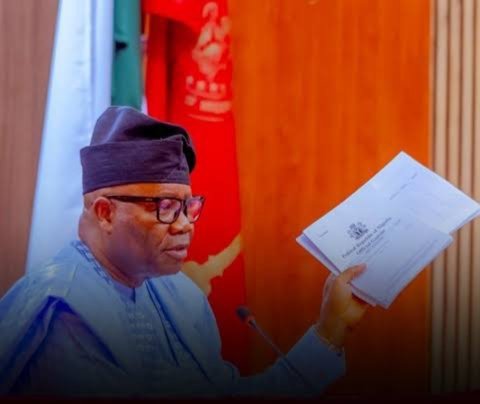
The Nigerian Senate on Wednesday began consideration of a landmark constitutional amendment bill that could fundamentally reshape Nigeria’s security architecture by paving the way for the establishment of state police services across the federation.
The proposed legislation, titled the Constitution of the Federal Republic of Nigeria (Alteration) (State Police) Bill, 2026, was presented for debate by Senate Leader, Michael Opeyemi Bamidele, who described it as a critical response to Nigeria’s growing security challenges and a major step toward deepening federalism.
The bill, transmitted to the National Assembly by President Bola Ahmed Tinubu as an Executive Bill, seeks to amend the Constitution to allow states to establish and operate their own police services while retaining a strong federal policing structure.
Leading debate on the bill’s general principles, Bamidele said Nigeria’s centralized policing model, created under the 1999 Constitution, has struggled to cope with the realities of modern security threats confronting the country.
He noted that terrorism, banditry, kidnapping, communal clashes, farmer-herder conflicts, cybercrime and organized criminal networks have stretched the capacity of the existing police system, making it increasingly difficult to effectively secure communities across the country.
According to him, the diversity of Nigeria’s geographical terrain, cultures and security realities requires a policing structure that allows for quicker and more localized responses to emerging threats.
“The realities of contemporary Nigeria have exposed significant challenges associated with a centralized policing architecture,” Bamidele told lawmakers.
He added that a growing consensus has emerged among governors, traditional rulers, civil society organizations, security experts and policy scholars in support of decentralizing policing powers while preserving national security coordination.
Dual Policing Structure
A key feature of the bill is the replacement of the existing Nigeria Police Force with a dual policing framework comprising a Federal Police Service and State Police Services.
Under the proposal, the Federal Police Service would remain responsible for national security functions such as counter-terrorism operations, border security, cybercrime, organized crime, arms trafficking, inter-state criminal activities, protection of federal institutions and policing of the Federal Capital Territory.
States wishing to establish their own police services would be required to enact enabling laws through their Houses of Assembly and meet national minimum standards prescribed by the National Assembly before commencing operations.
The proposed State Police Services would be responsible for enforcing state laws, maintaining public order, preventing and investigating crimes within their jurisdictions, and protecting lives and property.
Safeguards Against Abuse
Addressing concerns that governors could misuse state police for political purposes, the Senate Leader said the bill contains extensive constitutional safeguards to prevent abuse.
The proposed legislation expressly prohibits governors from directing state police authorities to target political opponents, individuals, groups or associations unlawfully.
It also forbids the use of police powers for partisan, ethnic, religious, sectional or personal interests.
To strengthen accountability, the bill provides for the establishment of independent State Police Service Commissions that would oversee recruitment, promotions, disciplinary procedures and administrative control of personnel.
National Standards, Federal Oversight
Bamidele said the legislation seeks to ensure professionalism and uniformity across all police formations by empowering the National Assembly to establish minimum operational standards.
The standards would cover recruitment processes, training, promotions, disciplinary measures, firearms management, use of force, complaint procedures, accountability systems, professional conduct and data management.
The bill also outlines circumstances under which the Federal Government may intervene in the affairs of a state police service, including situations involving the breakdown of public order, serious human rights violations, partisan intimidation or threats to national security.
Such intervention, however, would require written authorization from the President, be subject to Senate oversight, limited in duration and scope, and remain open to judicial review.
Strengthening Community Security
The Senate Leader argued that the establishment of state police would significantly improve intelligence gathering and community policing because officers would be more familiar with local languages, customs and terrain.
He said the reform would also allow the Federal Police Service to focus on more complex crimes and broader national security responsibilities.
According to him, the proposal aligns with the principles of true federalism by distributing policing responsibilities between the federal and state governments in line with their constitutional powers.
“This bill is not merely a security reform. It is a constitutional response to the evolving realities of our nation,” Bamidele said.
“It seeks to balance local policing autonomy with national cohesion, accountability with operational effectiveness, and federal oversight with state responsibility.”
Landmark Constitutional Amendment
The State Police Bill is widely regarded as one of the most consequential constitutional reform proposals currently before the National Assembly.
For years, advocates of state policing have argued that Nigeria’s centralized security structure has become inadequate in tackling local crimes and emerging security threats, while opponents have warned about the risk of political interference and abuse by state governments.
The new proposal attempts to bridge those concerns by creating constitutional safeguards, independent oversight mechanisms and federal checks on state policing operations.
If eventually passed by the National Assembly and approved by the required number of state legislatures, the amendment would usher in the most significant restructuring of Nigeria’s policing system since the advent of the Fourth Republic in 1999.