
General News
Nigeria Must Shift From Oil Wealth to Knowledge Economy to Achieve Sustainable Development – ARCO Founder

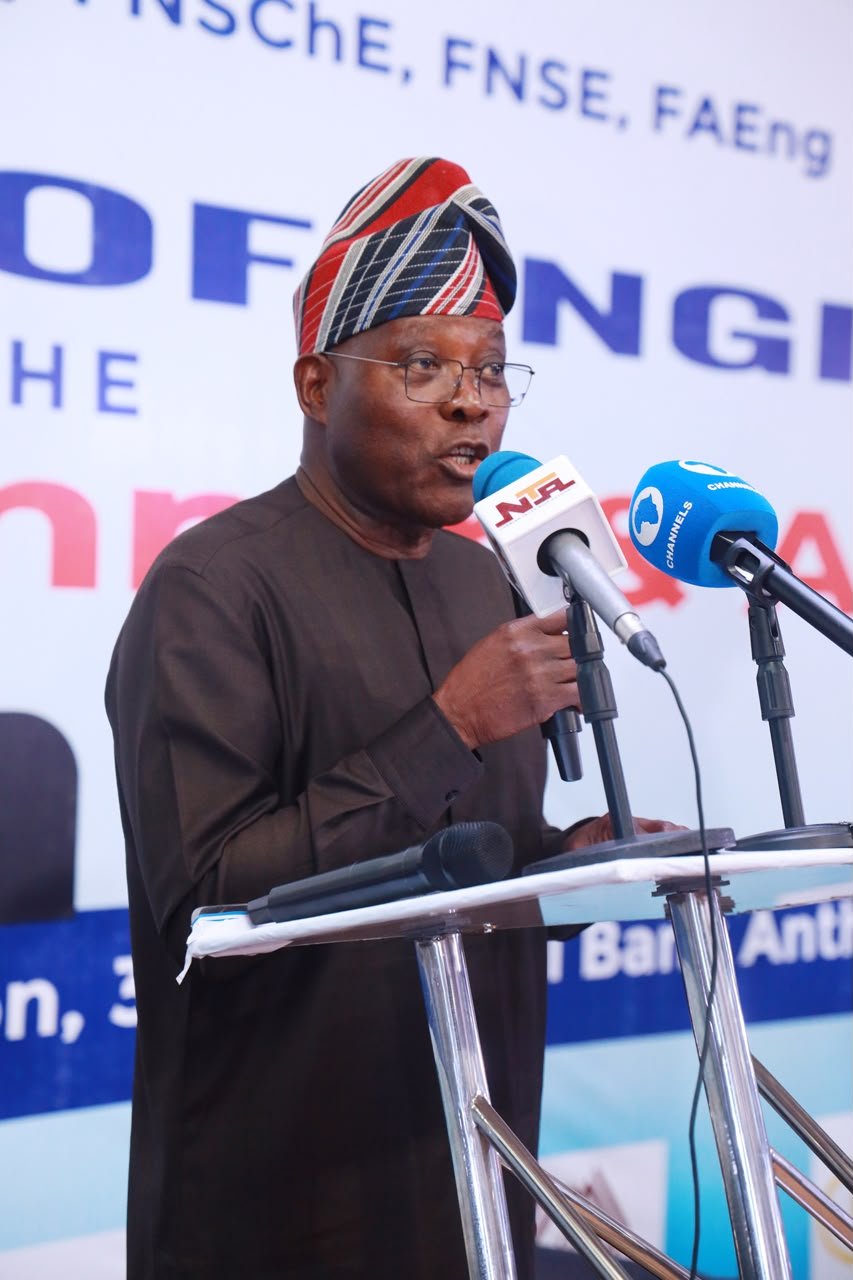
Founder of ARCO Group Plc, Alfred Okoigun, has called for a fundamental shift in Nigeria’s development strategy, urging policymakers, industry leaders and academic institutions to prioritise investments in science, engineering, research and innovation as the pathway to sustainable national prosperity.

Speaking at the Nigerian Academy of Engineering Technology Dinner and Awards Night, Okoigun said the country’s future would depend less on its vast natural resources and more on its ability to build knowledge, develop human capital and create globally competitive industries.
Delivering a lecture titled “From Resource Wealth to Knowledge Wealth: The Science of Nation Building – The Defining Question of Our Time,” he argued that while natural resources provide opportunities, they cannot guarantee long-term economic growth.


“The future will not belong to nations that merely possess resources. It will belong to nations that possess capabilities—those that can innovate, solve problems and continuously generate value through knowledge,” he said.
According to him, Nigeria has for decades focused national attention on oil, gas and mineral resources, but global experience shows that countries achieve lasting prosperity by investing in education, technology and scientific research.
He cited South Korea, Singapore and China as examples of nations that transformed their economies through deliberate investments in engineering, innovation, manufacturing and human capital, despite facing significant developmental challenges at independence.
Drawing from ARCO Group’s 45-year journey, Okoigun said the company deliberately prioritised knowledge transfer, local capacity development and technical partnerships instead of relying solely on commercial opportunities within Nigeria’s oil and gas industry.
He noted that the strategy enabled the company to expand into engineering, marine services, aviation training, asset integrity management and advanced drone technologies while creating employment opportunities for thousands of Nigerians.
“Our most valuable asset has never been equipment or capital. It has always been knowledge,” he said.
The business leader also highlighted the importance of strengthening technical institutions, describing the Petroleum Training Institute (PTI) as a successful example of how investments in skills development can drive national growth.
A graduate of PTI himself, Okoigun recalled organising Nigeria’s first Gas Re-Injection Seminar at the institute in 1982, saying the lasting value of the initiative lay not in the event itself but in the exchange of ideas and the development of local expertise.
He maintained that Nigeria’s greatest competitive advantage remains its people, pointing to the achievements of Nigerian professionals excelling in science, engineering, medicine, artificial intelligence, literature, sports and entrepreneurship across the world.
According to him, the challenge is not the absence of talent but the inability of national institutions to systematically identify, nurture and retain skilled professionals at scale.
“If Nigerians can build the future of artificial intelligence abroad, pioneer engineering breakthroughs and lead scientific discoveries globally, there is no reason Nigeria cannot become a centre of innovation and technological leadership,” he stated.
Okoigun called for a coordinated national agenda involving government, universities, private companies, investors and professional bodies to reposition education as economic infrastructure rather than a social programme.
He urged industry to collaborate more closely with research institutions, while encouraging businesses to invest in mentorship, technical training and innovation that would strengthen Nigeria’s long-term competitiveness.
“The countries that will dominate the 21st century are investing in artificial intelligence, biotechnology, robotics, advanced manufacturing, renewable energy and scientific discovery. The future is already being built. The question is whether Nigeria will help design it or simply purchase it,” he said.
He concluded by urging Nigeria to embrace a knowledge-driven development model capable of transforming ideas into industries, talent into productivity and innovation into national prosperity.
“The story of Nigeria is still being written. The choice before us is whether we will be remembered as a nation that merely possessed resources or one that built the institutions, developed the talent and created the knowledge required to compete with the best in the world,” he added.