
Featured
Paul Lucky Okoku: A Witness to the Rise of Nigerian Football

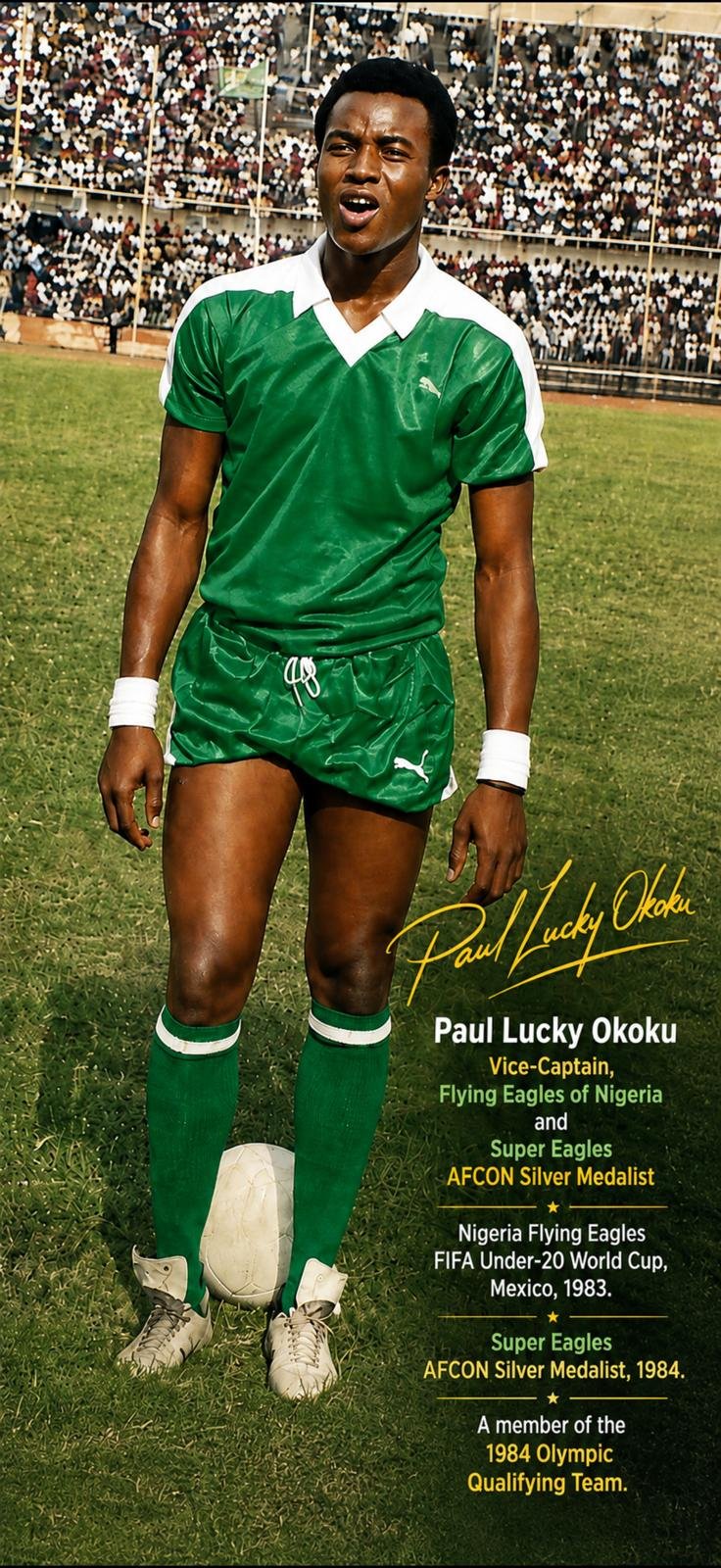
There are footballers whose names live in the record books because of trophies, goals and appearances.
Then there are footballers whose stories become bigger than the game.
Paul Lucky Okoku belongs to the second category.
More than four decades after he first wore Nigeria’s colours, Okoku remains connected to the country’s football conversation — not merely as a former international, but as a historian of his own generation, an analyst, philanthropist, advocate for former players and, most recently, a FIFA Legend.
His story is one of talent, opportunity, disruption, education and reinvention.
From Lagos Schoolboy to National Prospect
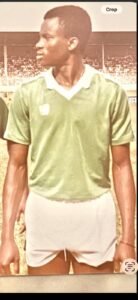
Okoku’s football journey began in Lagos, where he attended St. Finbarr’s College. He was part of a remarkable generation of young Nigerian footballers that included future national-team stars such as Stephen Keshi and Henry Nwosu.
In 1979, his performance in the Chief Adeniran Ogunsanya Youth Football Competition earned him a scholarship from the competition’s patron. It was, according to Okoku, one of the first moments when he realised that football could change the direction of his life.
But football was not simply a hobby for the young Okoku.
He represented the Youth Sports Federation of Nigeria and was part of the schoolboy generation that won major international youth tournaments, including the Gothia Cup in Sweden and Dallas Cup in the United States. He later moved through National Bank and other Nigerian clubs before becoming part of the Flying Eagles setup.
That generation would eventually make history.
The Generation That Took Nigeria to FIFA
In 1983, Nigeria’s Flying Eagles reached the FIFA World Youth Championship in Mexico.
Okoku served as vice-captain of the team, placing him at the heart of one of the most important transitional periods in Nigerian football.
It was a generation that would eventually feed the senior national team with young players capable of challenging established stars.
After returning from Mexico, Okoku and fellow Flying Eagles players found themselves training alongside the senior national team at the Bembo Games Village in Ibadan.
Then came the unexpected opportunity.
Nigeria had a crucial Africa Cup of Nations qualifier against Morocco.
With the return leg in Rabat approaching, coach Adegboyega Onigbinde needed reinforcements. Okoku, Chibuzor Ehilegbu and Isa Shofoluwe were called up from the Flying Eagles.
They were not brought in merely to make up numbers.
All three eventually played the entire 90 minutes in Rabat.
Nigeria held Morocco to a goalless draw and won the decisive penalty shootout 4–3, qualifying for the 1984 Africa Cup of Nations.
For Okoku, it was the beginning of his senior international career.
From ‘Little Giant’ to Super Eagles International
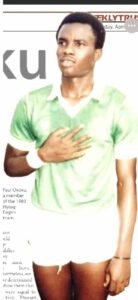
Okoku has recalled how legendary broadcaster Ernest Okonkwo encountered him before the Morocco match and described him as the “little giant” and “midfield dynamo.”
For a young footballer who had grown up listening to Okonkwo on radio, the encounter became one of the memories he carried throughout his career.
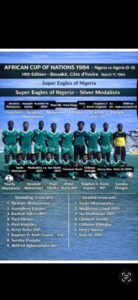
The 1984 Africa Cup of Nations in Ivory Coast followed.
Nigeria eventually reached the final before losing to Cameroon, led by stars including Roger Milla, Thomas N’Kono and Théophile Abega.
Okoku returned home with an AFCON silver medal.
It remains one of the defining achievements of his playing career.
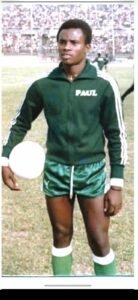
The Career That Almost Took Him to England
But one of the most extraordinary chapters of Okoku’s story happened away from the football pitch.
In 1984, he and several other young Nigerian players were preparing to travel to Britain to pursue professional football opportunities with Wolverhampton Wanderers.
They never made the trip.
According to Okoku’s own account, soldiers arrested him and fellow players at Murtala Muhammed International Airport while they were checking in for the journey.
They were taken to the National Stadium and questioned.
The incident effectively interrupted a potential move into English professional football.
For many players, such an episode could have marked the end of the dream.
For Okoku, it became a turning point.
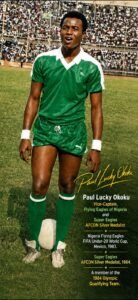
Football Became His Transportation, Not His Destination
Later in 1984, Okoku received a scholarship to study at Alabama A&M University in the United States.
It was a decision that would profoundly change the direction of his life.
He has repeatedly explained that he understood something many young athletes learn only after retirement: football careers are short, but education can last a lifetime.
“Football was my transportation through life,” he has said.
That philosophy became central to his post-playing life.
Instead of defining himself solely by what happened on the football pitch, Okoku built a second identity around education, community service and advocacy.
He graduated from Alabama A&M and eventually established a life in the United States.
The Name ‘Lucky’ Has Its Own Story
There is another unusual episode in Okoku’s international career.
His registered name was Paul Okoku, but a passport used during Nigeria’s 1984 Olympic qualifying campaign reportedly carried the name “Lucky Okoku.”
Morocco protested the Nigerian player’s participation on the basis of the documentation.
Nigeria ultimately lost that Olympic qualifying contest in Casablanca, with Morocco progressing to represent Africa at the 1984 Los Angeles Olympics.
It is one of those seemingly small administrative details that, in international football, can suddenly become a matter of national consequence.
From Player to Advocate
Okoku’s relationship with Nigerian football did not end when his playing career did.
He became increasingly vocal about the treatment of former internationals, including concerns about healthcare, welfare and the difficulties many retired players face after their careers.
He also helped establish the Association of Nigerian Ex-Internationals in Diaspora in 2010, seeking to create stronger links among former Nigerian players living outside the country.
His advocacy has sometimes been blunt.
He has criticised the Nigerian football authorities over the treatment of former players and called for stronger welfare and medical support for retired internationals.
In one article, he argued that Nigeria needed structured wellness programmes and regular medical checks for former footballers.
That concern adds another dimension to his legacy.
He is not simply remembering his generation.
He is asking what Nigeria owes the people who represented it.
Giving Back Through the Greater Tomorrow Children’s Fund
Okoku also turned his attention towards children.
He founded the Greater Tomorrow Children’s Fund, drawing inspiration partly from his own childhood experiences in Lagos.
In his recollections, he has spoken about growing up around Oke-Ira near the railway compound in Ebute Metta and watching other children ride bicycles when his own family could not afford one.
Those memories stayed with him.
Years later, they became part of the motivation behind his charitable work.
That may be one of the most important parts of his story because it reveals the connection between the boy he once was and the work he does today.
The footballer who once needed opportunities eventually became someone trying to create opportunities for others.
Four Decades Later, Football Remembered Him
Then came 2026.
During the FIFA World Cup activities in the United States, Okoku was among former footballers honoured as FIFA Legends during events in East Point, Georgia.
The recognition was significant because it closed a circle that had begun more than four decades earlier.
The young Nigerian who once travelled to Mexico with the Flying Eagles was now being recognised on the global football stage decades after his playing career.
But perhaps the more meaningful point is what happened between those two moments.
There was no straight line.
There was the uncertainty of youth.
The pressure of representing Nigeria.
The unexpected promotion to the senior team.
The AFCON final.
The abandoned opportunity in England.
The move to America.
Education.
Family.
Philanthropy.
Advocacy.
And eventually, a return to the international football spotlight.
More Than a Footballer
Okoku’s story therefore deserves to be told differently.
He should not be remembered simply as the Nigerian international who won an AFCON silver medal in 1984.
That is an important part of his story, but it is not the whole story.
He represents a generation of Nigerian footballers who helped establish the country’s presence on the FIFA youth stage, supplied talent to the senior national team and demonstrated that sporting excellence could become a pathway to education and international opportunity.
His life also raises a question that remains relevant today:
What happens to footballers when the applause stops?
Okoku’s answer has been education, service, advocacy and reinvention.
His playing career ended decades ago.
His relationship with football did not.
Today, he writes about the game, analyses its present, remembers its past and challenges its institutions.
And perhaps that is the most fitting description of Paul Lucky Okoku.
He did not allow football to become the end of his story.
He made it the beginning of another one.
The Legacy
The young player who left Lagos with football dreams eventually found himself on the biggest stages of African football.
The boy who wanted to play professionally in England found another route through education.
The former international who saw colleagues struggle after retirement became an advocate for the welfare of ex-players.
The child who remembered not having a bicycle created a foundation focused on helping children.
And four decades after first representing Nigeria internationally, the football world remembered him as a FIFA Legend.
That journey is bigger than a medal.
It is the story of what can happen when an athlete understands that the final whistle is not necessarily the end.
Sometimes, it is simply the beginning of the next chapter.
Paul Lucky Okoku is a former Nigerian international, former vice-captain of the 1983 Flying Eagles, 1984 Africa Cup of Nations silver medallist, former Olympic qualifying team member, football analyst, philanthropist and FIFA Legend.