Featured
Nigeria’s Expensive Darkness

By Lemmy Ughegbe, Ph.D
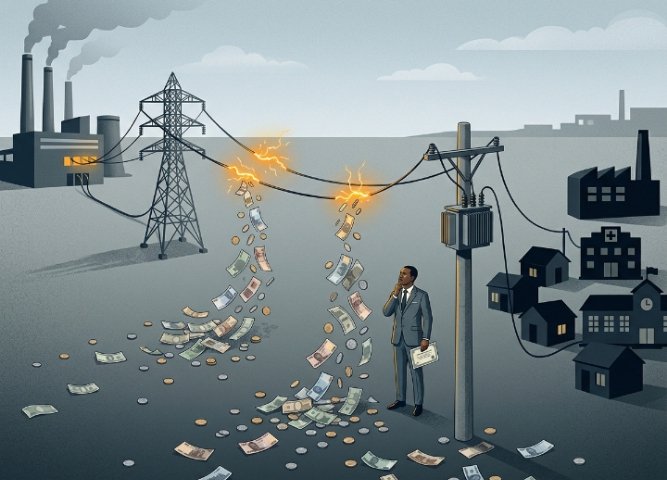
Nigeria’s electricity problem has never suffered from a shortage of money being thrown at it. What it has suffered from is a shortage of light.
That paradox has returned with the Federal Government’s latest intervention in the electricity market: a ₦728.979 billion Series 2 bond programme designed largely to settle verified debts owed to electricity generation companies.
At first glance, the figure is staggering. In a country where households routinely organise their lives around power outages, businesses spend fortunes generating their own electricity and entire neighbourhoods can remain without supply for hours or days, another intervention approaching three quarters of a trillion naira inevitably provokes a simple question: after all the money, why is reliable electricity still beyond the reach of millions of Nigerians?
But fairness requires an important distinction.
The ₦728.979 billion is not simply another pile of government money being poured into new power stations, transmission lines or transformers. The programme comprises about ₦402 billion in cash bonds and ₦326.979 billion in non cash bonds, principally intended to settle verified legacy obligations owed to electricity generation companies.
That distinction matters because debts in the electricity market are real. Generating companies produce electricity for which they are not always fully paid. Gas suppliers expect payment. Investors need confidence that contracts will be honoured. An electricity market in which participants continuously accumulate unpaid obligations cannot remain viable indefinitely.
Clearing legitimate debts is therefore not, by itself, wasteful. Indeed, refusing to address them could worsen an already fragile electricity market. The problem is what happens next.

This latest issuance follows an earlier Series 1 intervention and takes the total value of the programme to about ₦1.23 trillion. That should compel Nigeria to confront an uncomfortable question: are we fixing the structural defects that create these debts or merely financing their consequences?
There is a world of difference between rescuing an electricity market and reforming it.
Nigeria privatised significant parts of its power sector in 2013 with the expectation that private investment, commercial discipline and improved efficiency would gradually replace the old culture of government funded inefficiency. More than a decade later, however, government remains deeply involved in keeping the market financially afloat while electricity consumers continue to complain about inadequate supply, estimated billing, metering gaps and tariffs that often appear disconnected from service.
This is the contradiction at the heart of Nigeria’s expensive darkness.
Government cannot endlessly absorb liabilities while the underlying system continues generating new ones.
The electricity value chain is interconnected. Generation companies must be paid. Transmission infrastructure must be capable of evacuating electricity. Distribution companies must collect sufficient revenue. Consumers must be properly metered and billed for electricity actually consumed. Technical, commercial and collection losses must be reduced. Gas suppliers must receive payment and investors must have confidence in the rules of the market.
When one part fails, the weakness travels through the entire chain.
That is why the latest bond programme should not be judged solely by whether government successfully settles yesterday’s debts. Its real test should be whether Nigeria prevents those debts from simply accumulating again tomorrow.
Otherwise, we are not solving the problem. We are refinancing failure.
For ordinary Nigerians, the argument is even simpler. Electricity policy ultimately has meaning only when electricity reaches homes, factories, hospitals, schools and businesses reliably.
The woman running a frozen food business does not experience electricity reform through bond prospectuses. She experiences it through the number of hours her freezer remains powered without a generator.
The barber does not measure reform in billions of naira of market intervention. He measures it in litres of petrol he no longer has to buy.
The manufacturer does not judge the power sector by government announcements but by how much electricity costs as a component of production.
And the family paying an electricity bill wants to know whether the service bears any reasonable relationship to the amount being charged.
That is where Nigeria’s power debate must ultimately return: outcomes.
Government deserves credit when it takes steps necessary to stabilise the electricity market. Genuine debts cannot simply be wished away, and investors cannot be expected to continue supplying a market that does not pay its obligations.
But every financial intervention must now be accompanied by measurable structural reforms.
How quickly is the metering gap closing? How much are distribution losses declining? Are collection efficiencies improving? Is transmission capacity expanding sufficiently to accommodate available generation? Are distribution companies meeting their investment obligations? Are subsidies being transparently accounted for? And, most importantly, are Nigerians receiving more reliable electricity?
Those questions matter because ₦1.23 trillion is not an abstraction. Whether raised through bonds, appropriations or other government backed instruments, public financial commitments ultimately carry consequences for the Nigerian economy and taxpayer.
There must therefore be transparency about what liabilities are being settled, how they were verified, which companies are benefiting and what obligations those companies must fulfil after receiving payment.
Debt settlement should come with discipline.
If government clears the slate while market participants continue operating exactly as before, another mountain of debt will inevitably rise. Nigeria will then return in a few years with another intervention, another impressive figure and another explanation for why government must once again rescue the electricity market.
That cycle cannot become national electricity policy.
The deeper tragedy is that Nigeria has spent decades paying dearly for inadequate power in ways that rarely appear in official calculations. Businesses purchase generators, households buy fuel, industries invest in captive power and entrepreneurs factor unreliable electricity into the cost of virtually everything they produce.
The country therefore pays twice: first for the formal electricity system and again for the alternatives required when that system fails.
That is why darkness in Nigeria is extraordinarily expensive.
The current intervention offers government an opportunity to do more than settle accounts. It can draw a line beneath accumulated legacy obligations while insisting on a genuinely commercial, accountable and efficient electricity market in which every participant understands that rescue cannot be permanent.
Nigeria cannot continue financing yesterday’s failures while accumulating tomorrow’s debts.
The ultimate objective of electricity reform is not a healthier balance sheet for the power sector, important though that is. It is reliable electricity for Nigerians.
₦728.979 billion may help repair the finances of the electricity market. But Nigerians cannot power their homes with bonds.
They need electricity.
Until that electricity becomes substantially more reliable, Nigeria will continue paying an extraordinary price for something no country should have to purchase so expensively: darkness.

Lemmy Ughegbe, Ph.D, FIMC, CMC
Email: lemmyughegbeofficial@gmail.com
WhatsApp ONLY: +2348069716645