
Opinion
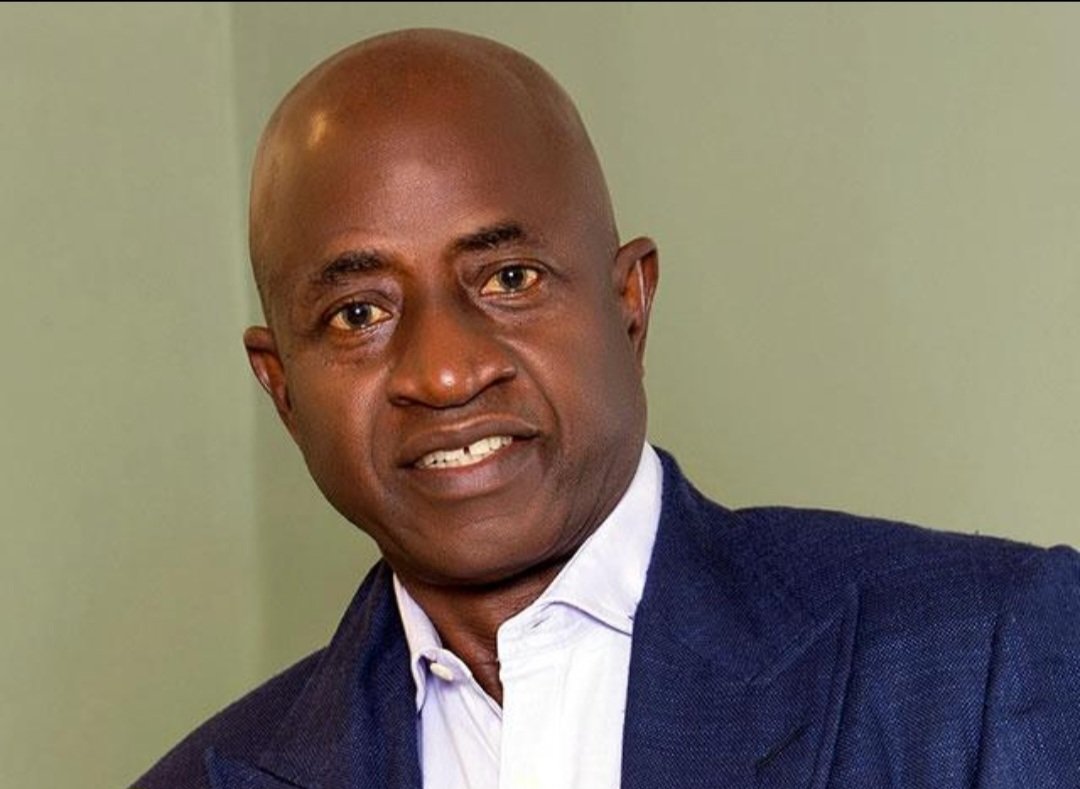
Mathematical Segun Odegbami, Mon: “Big Seg” More Than Qualifies to Be President of The Nigeria Football Federation

By Paul Lucky Okoku

If Education, Football Knowledge, Management, Integrity, Accountability and Leadership Experience Matter, What Exactly Is Missing?
AUTHOR’S NOTE
I originally intended this article to run about 600 to 700 words.
Then I started researching.
And the deeper I went, the more I realized that reducing Segun Odegbami’s record to a few paragraphs would not do justice to the breadth of his experience.
What began as a relatively short article unintentionally became something closer to an epistle.
SO GET A LARGE CUP OF COFFEE AND READ.
There is a reason.
Too often, people make sweeping statements about former footballers and leadership without examining the individual résumé.
We hear:
“Because you played football does not mean you can run the NFF.”
That statement, by itself, is true.
I understand it because I have seen the distinction since my playing days.
Being a great footballer does not automatically make someone a great coach, just as being technically brilliant in any profession does not automatically make someone a capable leader.
Leadership has to be demonstrated.
And even when leadership brings you to the top, holding the position is only the beginning:
The election gives you the office.
The statute gives you authority.
Only performance gives you legitimacy.
That distinction matters.
Some outstanding footballers make the transition into coaching and discover that being a great player does not automatically make someone a great coach.
Why?
Because coaching itself is leadership.
A coach must communicate instructions.
A coach must organize people.
A coach must mentor and advise.
A coach must hold players accountable.
A coach must manage personalities.
A coach must establish standards.
A coach must lead by example — including being prepared and arriving before the people he expects to lead.
Those are leadership responsibilities.
I understood that even more clearly when I later moved into the corporate world, because many of the principles I had learned through football — preparation, teamwork, accountability, communication, discipline and responsibility — transferred with me.
And this principle is not unique to football.
Being an excellent lawyer does not automatically make someone capable of leading a law firm.
Being an outstanding doctor does not automatically make someone an effective hospital administrator.
Being a brilliant engineer, technology professional or financial expert does not automatically mean that person can lead people or manage an organization.
Technical excellence and leadership are related, but they are not the same thing.
So yes, wearing the green-and-white shirt does not automatically make anyone a leader.
Playing professionally, even at the highest level, does not automatically qualify anyone to manage people, safeguard finances, build institutions or run an organization.
Leadership has to be demonstrated.
And that is precisely why the individual résumé matters.
But the next question should always be:
Have you actually examined the person’s résumé?
There are other former Nigerian internationals who have deliberately built serious post-playing résumés through education, coaching, management, administration, business and football development.
Those records deserve respect.
But that is precisely the point.
Former footballers should not be promoted merely because they once played the game. Neither should they be dismissed as a group with a blanket instruction to “learn the ropes.”
Judge the individual. Examine the résumé.
In Segun Odegbami’s case, that résumé deserves serious examination.
The more I researched, the more it expanded across club management, national football administration, CAF, government reform, athlete management, institution-building, education, business, media, sports diplomacy and national sports policy.
Simply saying former footballers must “learn the ropes” without examining which former footballers already possess that experience is intellectually lazy.
Do the research. Judge the individual. Examine the résumé.
I have known of Odegbami since the 1970s and later saw his influence around younger players when I moved from National Bank in Lagos to Ibadan.
But familiarity is not the basis of this article.
The record is.
PUT THE RÉSUMÉ ON THE TABLE
My own professional experience has included project management and PMO responsibilities, recruiting, interviewing, onboarding, training and assessing people for positions of responsibility, including work with a reputable consulting company in the United States.
I am also SAFe 6.0 Agilist certified, with training in organizational alignment, team coordination, accountability and delivering work to clients against defined objectives.
I mention that for one reason: evaluating people, processes and organizations against defined requirements is familiar territory to me.
So forget the famous name for a moment.
Put Odegbami’s résumé on the table.
What has he done?
What has he managed?
What has he built?
Whom has he led?
What institutions have trusted him?
Has he demonstrated initiative, accountability and management ability?
Does he understand the organization he wants to lead?
Start with football.
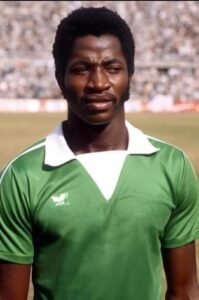
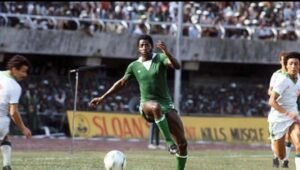
Odegbami represented Nigeria at the highest level, competed in World Cup qualifying campaigns and represented the Green Eagles at the 1978 and 1980 Africa Cup of Nations tournaments.
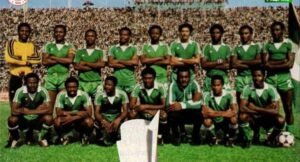
In 1980, he helped Nigeria win its first AFCON title, scoring twice in the 3–0 final victory over Algeria. He served as vice-captain of that historic championship team and also captained the Green Eagles during his international career, including at the 1980 Olympic Games in Moscow.
At club level, he was a central figure in the Shooting Stars team that won the 1976 African Cup Winners’ Cup, the first continental trophy won by a Nigerian club.
But playing pedigree is only where his résumé begins.
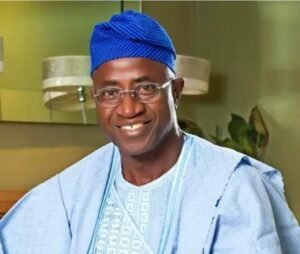
HE MOVED FROM THE FIELD INTO MANAGEMENT — AND KEPT LEADING
After retiring, Odegbami served as General Manager of Shooting Stars and later became Chairman of Gateway FC of Abeokuta.
He therefore experienced Nigerian club football from both sides of the door — as a player and as an executive.
His responsibilities moved into national football administration. He served on the board of the Nigerian Football Association, headed its Technical Committee and has described being given responsibility as Team Manager of the Green Eagles, working directly with Nigeria’s senior national team.
His experience also reached CAF structures, including service on its Players’ Committee, while his private-sector executive background includes Worldwide Sports Limited and sports and media enterprises.
That is not somebody standing outside Nigerian football waiting to be taught how the system operates.
Segun Odegbami has been inside the ropes for decades.
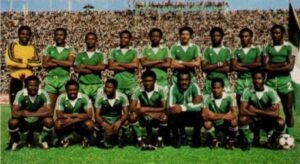
HE DID NOT JUST HOLD POSITIONS — HE BUILT AN INSTITUTION
This may be one of the strongest qualifications on his résumé.
There is an important distinction between occupying a leadership position inside an organization someone else created and possessing the initiative to conceive an idea, organize people around it, mobilize resources, build structures and sustain them.
Odegbami created the Segun Odegbami International College and Sports Academy, SOCA, established in 2007.
SOCA combines education with structured sports development, including football, basketball, tennis and track and field. Student-athletes have pursued academic and athletic opportunities, including admissions and scholarships involving institutions abroad, particularly in the United States and North America.
That matters.
A leader who builds something from the ground up has demonstrated initiative, organization, resource mobilization, problem-solving and responsibility for outcomes.
SOCA should therefore not be treated as a side note on Odegbami’s résumé.
Titles can be given. Institutions have to be built.
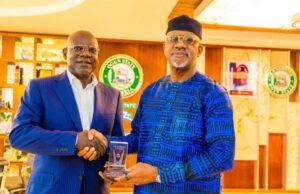
SUCCESSIVE GOVERNMENTS KEPT CALLING
Odegbami’s experience also reveals a pattern of repeated institutional trust.
In 1990, he served on the Professional Football Implementation Committee involved in establishing professional football in Nigeria.
He later became Chairman of the Governing Council of the National Institute for Sports.
In 2016, Sports Minister Solomon Dalung appointed him to a Ministerial Sports Reform Committee examining the restructuring, administration, development and sustainable financing of Nigerian sport.
In 2021, under Sports Minister Sunday Dare, Odegbami was selected for the committee charged with producing Nigeria’s 10-year Football Development Master Plan.
Different ministers.
Different administrations.
Different periods.
Yet his name continued appearing when Nigerian sport required experienced people to examine structural problems and propose solutions.
In 2025, Ogun State Governor Dapo Abiodun appointed him the state’s first Grand Sports Ambassador, with a mandate that included helping develop a stronger sports ecosystem and sports economy.
And the pattern continues.
Odegbami stated on his weekly Eagle7 Sports Radio program on September 12, 2026, that he will participate in the current FIFA/CAF engagement concerning the restructuring and future direction of Nigerian football.
So when people say former footballers must first “learn the ropes,” Odegbami presents an uncomfortable question:
HOW MANY ROPES MUST ONE MAN LEARN?
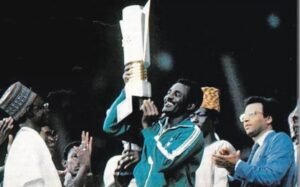
THE REST OF THE RÉSUMÉ
1. Elite athlete management.
Odegbami has described serving as an IAAF athlete representative and managing elite Nigerian athletes. That record includes Chioma Ajunwa, who became Nigeria’s first individual Olympic gold medalist at Atlanta 1996, and Charity Opara, a member of Nigeria’s silver-medal-winning women’s 4×400 metres relay team.
2. Talent development and mentorship.
Ajunwa has publicly spoken about Odegbami believing in her and helping her during a difficult stage of her career. Leadership is not merely managing structures; it is also recognizing ability, developing people and creating conditions for them to succeed.
3. Sports diplomacy.
As an Associate Fellow of the Nigerian Institute of International Affairs, Odegbami became involved in developing sport as an instrument of diplomacy.
4. Mobilizing private-sector support.
He helped drive the Sports Diplomacy Wall of Fame project honouring Nigeria’s 1976 Montreal Olympic contingent and the 1980 AFCON champions. The project brought together the NIIA and Air Peace under Dr. Allen Onyema, culminating in a permanent monument and an investiture recognizing athletes whose sacrifices had gone largely unrewarded.
That required more than having an idea. It required relationships, persuasion, organization and the ability to mobilize resources.
5. Communication.
Odegbami has spent decades as a writer, broadcaster and public speaker. Leadership requires the ability to explain a vision to players, administrators, sponsors, governments, FIFA, CAF and the public.
6. Media and business.
His experience encompasses sports media, broadcasting, private enterprise and executive management — further evidence that his résumé extends beyond football participation.
7. Academic recognition.
The Federal University Oye-Ekiti conferred on him an Honorary Doctorate Degree in Sports and Human Kinetics in 2023.
8. Continuing public service.
His appointment as Ogun State’s Grand Sports Ambassador is not merely ceremonial; the stated mandate includes helping strengthen the state’s sports ecosystem.
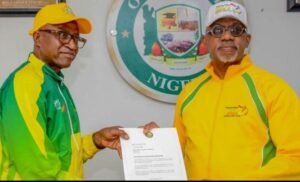
NOW COMPARE THE RÉSUMÉS
Then place Odegbami’s résumé beside the backgrounds of the last three men who became President of the Nigeria Football Federation.
Ibrahim Musa Gusau came through a long football-administration pathway. Before becoming NFF President, he had chaired the Zamfara State Football Association, served as Chairman of the Zamfara State Sports Commission, managed clubs, served on the NFF Executive Committee and twice held the position of Chairman of Chairmen. His résumé also included NFF security responsibilities and CAF assignments in safety, CHAN and youth competitions, alongside a long professional background in public-sector finance and administration.
Amaju Pinnick rose through the Delta State football and sports-administration structure. Before becoming NFF President in 2014, he had served within the Delta State Football Association, eventually becoming its Chairman, and had also served as Chairman of the Delta State Sports Commission.
Aminu Maigari brought extensive Bauchi football experience. Before becoming NFF President, he had been a player, captain, team manager and chairman of major clubs in Bauchi, chaired the Bauchi State Football Association for about a decade, headed the Bauchi sub-seat during Nigeria’s hosting of the 2009 FIFA U-17 World Cup, served on the NFF board and had acted as NFF President.
Those were legitimate pathways into the presidency.
So this is not about diminishing any of those men.
It is about applying the same standard consistently.
Now examine Odegbami’s record in its entirety — as player, national-team captain, club executive, football administrator, athlete manager, institution-builder, businessman, reform participant and sports diplomat.
If those previous backgrounds were sufficient to establish eligibility for the presidency of Nigerian football, then on what objective basis can Segun Odegbami’s résumé be dismissed as lacking experience?
THIS IS WHY I PUT MY REPUTATION BEHIND IT
My endorsement is not based on nostalgia.
It is not because Odegbami was a great footballer.
And it is certainly not an argument that former internationals should automatically inherit football administration.
I reject that argument.
A former footballer without management ability, integrity, financial stewardship, accountability or leadership capacity should not be handed an organization simply because he once represented Nigeria.
But consistency demands the reverse.
When a former footballer has acquired management experience, served inside football administration, managed clubs, worked with the national team, developed elite athletes, built an institution, participated in national reform efforts, managed private enterprises and demonstrated the ability to organize people around a vision, we should not suddenly move the goalposts because he happens to have been a player.
So if I were reviewing Segun Odegbami’s résumé for an executive football leadership position, I would not be asking whether he has checked enough boxes.
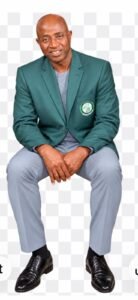
I would ask:
WHICH RELEVANT BOX HAS HE NOT CHECKED?
That is why I am comfortable putting my reputation behind this assessment.
In my judgment, Segun “Mathematical” Odegbami more than qualifies to be President of the Nigeria Football Federation.
That does not mean the office should simply be handed to him.
He should present his plans.
He should answer difficult questions.
His ideas should be challenged.
His financial stewardship should be scrutinized.
And he should be held accountable like anyone else seeking the responsibility of leading Nigerian football.
But qualification?
Experience?
Exposure?
Football knowledge?
Management?
Institution-building?
Leadership?
The résumé is there.
Football introduced Nigeria to Mathematical Odegbami more than five decades ago
What he has done since then may be the stronger reason Nigerian football should still be listening.