
International
AI Gadgets Boost China’s Holiday Retail Sales As Consumer Demand Surges

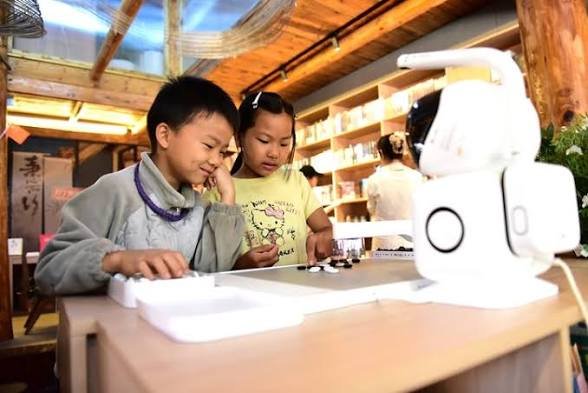
Artificial intelligence-powered gadgets are gaining popularity among Chinese consumers, with retailers recording increased customer traffic and rising sales of smart devices during the country’s week-long National Day holiday.
From AI companion robots and smart glasses to 3D printers and intelligent household appliances, the products attracted shoppers across major cities, reflecting growing interest in technologies designed to simplify daily activities, enhance entertainment and support learning.
At Z·Pilot, an artificial intelligence experience store in Shanghai, an AI-powered pet robot emerged as one of the major attractions during the holiday.
The furry device responds to voice commands and physical touch, with digital eyes that react to interactions. Its long-term memory also allows it to gradually adapt its personality to its owner’s preferences.
A store employee said AI companionship products were performing particularly well, offering consumers interactive experiences without the responsibilities associated with caring for traditional pets.
AI glasses also attracted considerable attention, with features including real-time language translation, navigation, teleprompting, photography and video recording.
The devices are particularly useful for travellers who need to communicate in unfamiliar languages or access information without constantly using their mobile phones.
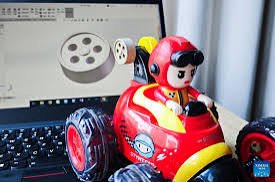
At a JD.com mall in Shanghai’s Qibao area, 3D printers drew families interested in practical applications of technology. Parents and children experimented with designing and printing model boats and cars.
Some parents said they planned to purchase the devices to encourage their children to apply classroom lessons through hands-on activities.
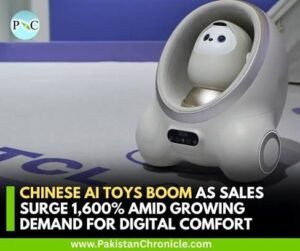
Qi, a parent who visited a robotics store with her child, said early exposure to AI would help young people understand how the technology could influence their education, careers and everyday lives.
The growing interest was also evident in other Chinese cities.
In Hangzhou, capital of Zhejiang Province, the Wensan technology mall attracted residents and tourists with more than 700 smart products, including companion robots, AI glasses, smart rings and exoskeletons.
In Beijing, a robotics and AI experience brand operated by Shoucheng Holdings attracted large crowds to its eight outlets, which offered more than 200 robotics and AI hardware products.
A representative of the brand said customer feedback indicated strong demand for AI companion products, entertainment-oriented smart devices and interactive robots.
SALES FIGURES HIGHLIGHT GROWING DEMAND
The increased interest in AI products translated into measurable gains for retailers.
According to data released by Chinese retail giant Suning.com, customer traffic at its flagship stores increased by 50 per cent year-on-year between October 1 and 7.
Sales of AI-equipped household appliances rose by more than 40 per cent during the same period, while smartwatches, AI glasses and action cameras also recorded strong performances.
The figures reflect a broader expansion of China’s artificial intelligence market, supported by the growing availability of domestic AI models and consumer applications.
Platforms and models such as DeepSeek, Kimi and Doubao have become increasingly familiar to millions of Chinese users, helping to bring AI technology into everyday activities.
China had more than 6,000 AI enterprises in 2025, while its core artificial intelligence industry recorded strong year-on-year growth, according to the report.
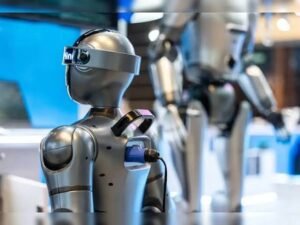
The country’s humanoid robotics sector has also expanded. An industry research report showed that China had more than 140 humanoid robot developers in 2025, with shipments reaching 14,400 units, representing 84.7 per cent of the global market.
GOVERNMENT INITIATIVES DRIVE SMART CONSUMPTION
Government policies are further supporting the expansion of AI-enabled consumer products and services.
In June, eight government departments, including China’s Ministry of Commerce, issued guidelines aimed at promoting consumption driven by artificial intelligence.
The measures called for the development of additional AI-powered products and the expansion of AI-enabled services.
A subsequent action plan on smart home consumption also strengthened support for the sector, allowing local authorities to determine eligible subsidy categories and standards under the 2026 trade-in policy.
The initiative includes provisions for supporting purchases of integrated smart home systems.
Fan Chunyan, vice president of Suning.com, said consumer adoption of AI products was accelerating beyond the initial novelty phase towards broader market acceptance.
She projected that demand for smart devices, immersive experiences and related services would continue to increase.
The holiday shopping surge highlights how artificial intelligence is becoming an increasingly important part of China’s consumer economy, as technology companies expand their product offerings and consumers explore practical applications of the technology in their homes, workplaces and daily lives.