
Featured
Ghanaian Journalist Turns Rare Reproductive Condition Into Advocacy Against Stigma


For 27-year-old Ghanaian journalist and broadcaster Asangsia Tabitha, popularly known as Yaa Bitha, hospital visits have been a recurring part of her life since childhood.
Years of surgeries, severe abdominal pain, stigma and uncertainty have shaped her experience of living with Mayer-Rokitansky-Küster-Hauser (MRKH) syndrome, a rare congenital condition affecting the development of the female reproductive system.

Rather than allow the condition to define her life, Yaa Bitha is now using her experience to advocate for women and girls living with reproductive health challenges.
Her medical journey began shortly after she was born. She underwent surgery after suffering neonatal ascites, a rare condition involving an accumulation of fluid in the abdomen of a newborn.

But the surgeries did not end her medical challenges.
At about 14, she began experiencing severe abdominal pain and swelling. Her abdomen became so enlarged that some people thought she was pregnant.
Doctors eventually discovered that she was menstruating internally, but because of the abnormal development of her reproductive system, there was no normal passage through which menstrual blood could leave her body.

The blood accumulated internally, causing severe pain and repeated medical emergencies.
Her family moved from one hospital to another in search of answers. At one point, her father, frustrated by the repeated surgeries without a clear diagnosis, took her to Nigeria to seek spiritual intervention.
It was not until 2013 that doctors diagnosed her with vaginal agenesis associated with MRKH syndrome.
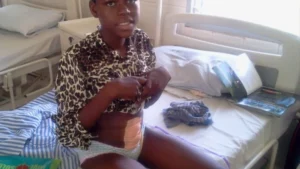
MRKH is a congenital condition in which the uterus and upper part of the vagina are absent or underdeveloped. In many cases, the ovaries and external genitalia develop normally, and the condition may only become apparent during adolescence when menstruation does not begin.
For Yaa Bitha, receiving a diagnosis finally provided an explanation for years of unexplained pain, but it also ushered in another difficult phase of treatment.
She underwent vaginoplasty and several other surgeries to reconstruct her reproductive anatomy.

According to her account, doctors created a passage to allow menstrual fluid to leave her body and used a plastic graft as part of the reconstruction.
More than a decade later, she still has the plastic component in her body. Doctors have recommended another surgery to replace it with silicone, but Yaa Bitha says she is not yet mentally prepared for another procedure.
Her body has already undergone numerous operations, and she recently experienced surgical adhesions, a complication in which scar tissue formed after surgery causes internal organs and tissues to stick together.
A Lifetime Of Treatment
Yaa Bitha’s treatment has not ended with surgery.
She says she has to undergo regular dilation to prevent the reconstructed vaginal canal from closing.
Medical specialists say vaginal dilation can be part of the treatment for women who require development or maintenance of a vaginal canal, while reconstructive surgery may be considered in some cases.
For Yaa Bitha, however, the treatment is a constant reminder of what she has endured.
She says she may eventually undergo another operation to replace the plastic component with silicone, but only when she feels emotionally and physically prepared.

Years Of Stigma And Shame
The physical challenges have been accompanied by years of stigma.
During her school years, Yaa Bitha says some girls who saw her body in the bathroom made hurtful comments about her.
She became uncomfortable using communal bathing facilities because she felt people were constantly staring at her.
The scars from her surgeries also attracted unwanted attention and speculation.
Some people wrongly attributed her appearance to sickle cell disease, asthma or HIV/AIDS.
The stigma affected her education and social life. She frequently had to visit hospitals and was sometimes unable to participate in physical education because of pain.
Watching her siblings enjoy what appeared to be normal childhoods also made her question why her own experience had been so difficult.
Her condition later affected her relationships, with some potential partners questioning whether she would ever be able to have children.
Despite the challenges, she says the unwavering support of her parents and siblings helped her overcome much of the emotional trauma.

Turning Personal Pain Into Advocacy
Yaa Bitha’s decision to speak publicly about her condition came after a recent visit to the 37 Military Hospital.
While waiting to see a gynaecologist, she noticed that many of the women around her were older patients seeking treatment for pregnancy-related conditions or fibroids.
The experience made her wonder how many other women were silently living with reproductive conditions that were poorly understood or rarely discussed.
She decided it was time to tell her story.
Since opening up about her condition, women and mothers have contacted her through social media, some seeking information about similar experiences.
Although she cannot diagnose or treat them, she helps direct them towards appropriate hospitals, specialists and medical tests.
Her broader goal is to create a support community where women and girls living with MRKH and other reproductive health conditions can access information, emotional support and appropriate medical care.
She also hopes her advocacy will help challenge the stigma surrounding reproductive health conditions.
Expert: MRKH Does Not Mean The End Of Life
Dr Andrews Baha, a medical expert, told BBC News Pidgin that MRKH syndrome occurs in approximately one in every 5,000 females globally, although reliable data on its prevalence in Africa remain limited.
He said there is currently no evidence linking the condition to anything a mother did or failed to do during pregnancy.
According to him, women living with MRKH can lead healthy and fulfilling lives when they receive appropriate specialist care.
Although many women with MRKH cannot carry a pregnancy because of an absent or underdeveloped uterus, those with functioning ovaries may have options for biological parenthood through reproductive technologies, depending on individual circumstances and access to treatment.
For Yaa Bitha, however, the most important part of her journey is helping others realise that a medical condition does not have to become an identity.
Her experience has already influenced her family. Her brother, having witnessed her struggles from childhood, decided to specialise in gynaecology.
She describes his decision as one of the greatest sources of fulfilment from her journey.
She also remains deeply grateful to her parents and siblings for standing by her through years of surgeries, hospital visits and emotional struggles.
“True love conquers everything,” she said, reflecting on the support she received from her family.
Today, Yaa Bitha continues to work as a radio and television presenter and event host.
She says she has chosen to focus on the things that bring her joy while refusing to allow her medical history to determine the limits of her future.
“If it means I have to take more medication to stay alive and accomplish my dreams, sign me up. I want to stay alive and reach 99 years,” she said.
Her message to women and girls struggling with reproductive health conditions is equally clear: seek medical attention, reject shame and do not allow a diagnosis to determine your worth.
“Living with MRKH does not mean your life is over,” she said.