
Opinion
Ike Ofoje: Where Are They Now? Beyond The Spotlight

By Paul Lucky Okoku
Three Decades of Coaching, Character and an Unblemished Reputation
From becoming the youngest captain of Enugu Rangers to nearly three decades of service at the University of South Carolina Aiken (USC Aiken), Ike Ofoje offers a powerful example of Nigerian excellence built not only on achievement, but on integrity.
There are achievements in football that can be measured easily.
Goals can be counted. Victories can be recorded. Championships can be displayed in trophy cabinets. Individual honors can be listed on a résumé.
But there is another achievement that is harder to quantify:
A good name.
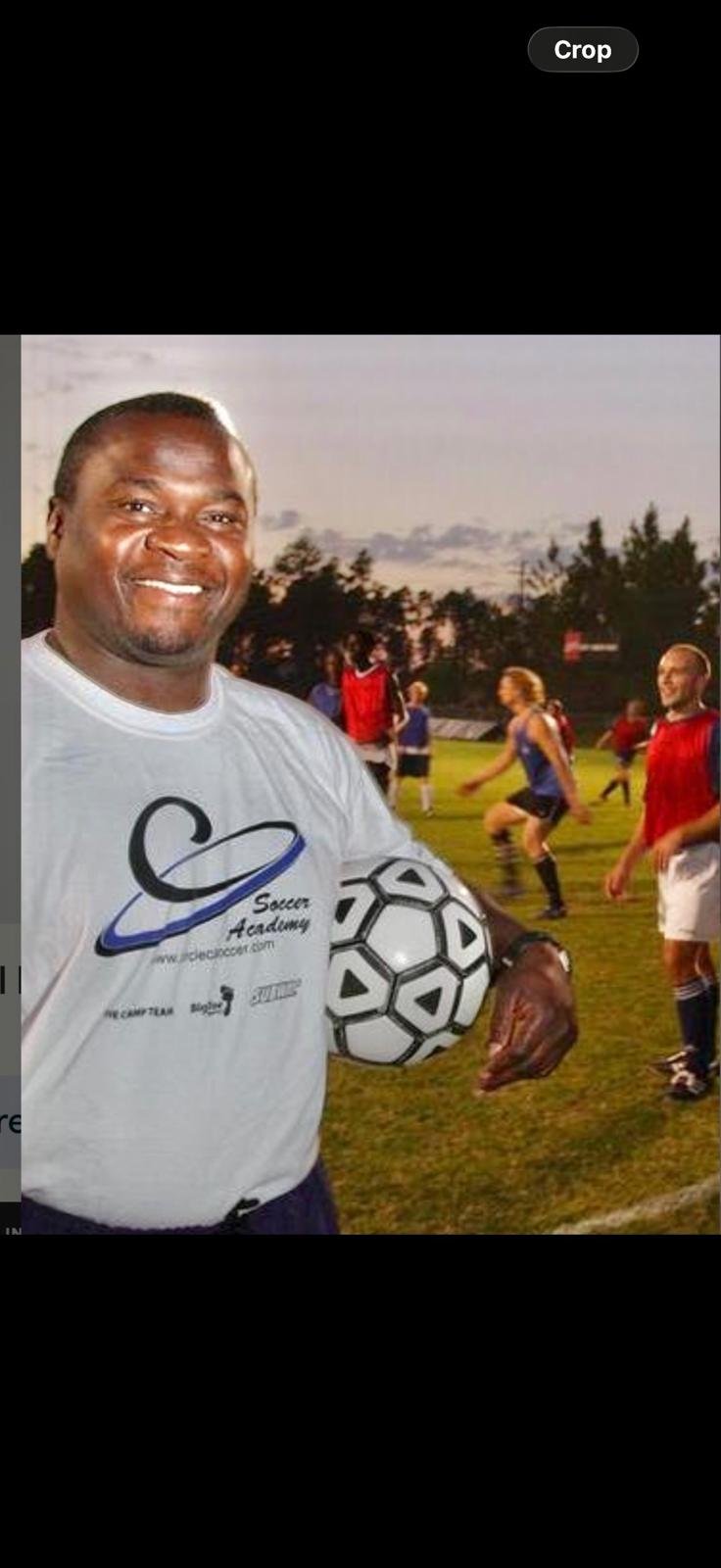
Ikechukwu “Ike” Ofoje has spent more than three decades coaching in the United States, including an extraordinary 28 years at the University of South Carolina Aiken. When he finally retired from the university in November 2023, he left behind more than statistics.
He left with his reputation intact.
And for me, that is what makes his story especially worthy of telling.
At a time when negative stories involving Nigerians can too easily dominate public conversation, we must be equally determined to recognize Nigerians who have spent decades building reputations based on service, professionalism, education and integrity.
Ike Ofoje is one of those Nigerians.
USC Aiken hired him as its men’s soccer coach in 1996. He remained there for 28 years. He subsequently founded the university’s women’s soccer program in 1997, coached both the men’s and women’s teams simultaneously through 2004, and later served as Director of Soccer Operations.
Think about what 28 years at one American university represents.
Administrations change.
Athletic directors change.
Players graduate.
Parents come and go.
University expectations evolve.
NCAA regulations change.
Winning seasons are followed sometimes by difficult ones.
And yet the institution continued to entrust Ofoje with its student-athletes and soccer programs for nearly three decades.
That kind of longevity deserves attention.
Character Beyond the Scoreboard
This is not an attempt to manufacture a perfect coaching record.
The official USC Aiken record books show the full picture: there were outstanding seasons and there were difficult seasons. Ofoje’s teams did not win every year.
But perhaps that makes his story more meaningful.
Universities do not retain coaches for nearly three decades simply because of one season or one tournament. A university coach is responsible for much more than Saturday’s result.
He is entrusted with young men and women.
He recruits them.
He communicates with their parents.
He helps establish standards of conduct.
He represents the university publicly.
He operates within institutional and NCAA rules.
And he is expected to contribute to the educational development of student-athletes whose lives will extend far beyond soccer.
When Ofoje retired, USC Aiken Athletics Director Todd Wilkinson publicly commended him for 28 years of service, saying Ofoje had poured his heart and soul into the Pacers and the Aiken soccer community, had positively touched many lives and, significantly, described him as “a man of character.”
Those four words matter to me.
A man of character.
Not simply a winning coach.
Not merely a former football star.
A man of character.
After 28 years inside the same university system, that is quite a testimonial.
My review of the publicly available record found no reported scandal or ethical controversy associated with his USC Aiken tenure. No public misconduct story overshadows his departure. Instead, the institution’s own farewell focused on service, personality, community impact and character.
That is the reputation he carried across the finish line.
Before Coach Ike, There Was Rangers
Long before young American players knew him as “Coach Ike,” Nigerian football knew Ikechukwu Ofoje as a formidable player.
And not for an ordinary football club.
He played for Rangers International of Enugu.
For younger Nigerians who may not fully appreciate what Rangers represented during that period, Rangers were much more than another league team. They were among the giants of Nigerian football, a club with an enormous following and a history that carried cultural as well as sporting significance.
Ofoje rose high enough—and young enough—to captain them.
A 2016 account published in Vanguard described Ofoje as the youngest captain of Enugu Rangers, recalling him as a powerful defender capable of being pushed into attack and possessing tremendous shooting ability.
That distinction says something about the leadership qualities people saw in him even as a young man.
You do not hand the captain’s responsibility at a club like Rangers to a youngster simply because he can kick a football.
Leadership requires trust.
Decades later, thousands of miles away, trust would again become one of the defining themes of Ofoje’s career.
From Rangers Captain to the Green Eagles: Wearing Nigeria’s Colours
Ofoje’s leadership at Rangers eventually carried him to another level every Nigerian footballer dreams about: representing his country.
He became a Nigeria international during the era when the senior national team was known as the Green Eagles, the team that would later become today’s Super Eagles.
That distinction deserves an important place in his story.
To captain Rangers was already a significant achievement. To then wear Nigeria’s national colours placed Ofoje among the relatively small fraternity of footballers who represented both one of the country’s most historic clubs and the nation itself.
The surviving public record does not provide a sufficiently complete match-by-match account for me to responsibly assign Ofoje a specific number of senior international appearances without further documentary evidence. Nigerian reporting, however, consistently identifies him as a former Nigeria international.
He did not merely compete at the highest level of Nigerian club football.
He represented Nigeria.
That matters because everything that followed—the move to the United States, his education, All-American honours, a national collegiate championship, a master’s degree and more than three decades in coaching—came after he had already experienced the responsibility of wearing Nigeria’s colours.
His journey therefore connects several chapters of football history: Rangers International, the Green Eagles, American collegiate soccer, university coaching and, eventually, the development and mentorship of younger generations.
Football Became a Pathway to Education
“Education is not a guarantee for success, but without it, you don’t stand a chance.”
— Paul Lucky Okoku
Ofoje eventually took his ability to the United States and enrolled at New Hampshire College, now Southern New Hampshire University.
His collegiate playing career was outstanding.
He played from 1987 through 1990, became a two-time first-team All-American, and was the leading scorer on the school’s 1989 national championship team. His four-year teams compiled a 72-15-4 record and reached four consecutive NCAA tournaments. He accumulated 152 career points from 58 goals and 36 assists, and Southern New Hampshire University’s Hall of Fame records still identify him among the program’s historic statistical leaders. He was inducted into the university’s Athletics Hall of Fame in 1997.
This is where Ofoje’s story becomes particularly valuable for the next generation of African footballers.
His football journey did not end when the cheering stopped.
He converted the opportunity football created into education, professional development and eventually a career.
After New Hampshire College, he played professionally for the Boston Storm for two seasons. He later coached at St. Joseph’s High School in Huntington, West Virginia, while earning a master’s degree in sports management at Marshall University. He subsequently worked as an assistant women’s soccer coach at Illinois State University before USC Aiken hired him in 1996. He also earned a USSF “A” coaching license.
That entire journey matters.
Player.
Student.
Graduate.
Professional player.
Graduate student.
Assistant coach.
Head coach.
Program builder.
Director of Soccer Operations.
Mentor.
It is what life after football can look like when opportunity meets preparation.
Building Something at USC Aiken
Ofoje did not merely inherit everything he eventually supervised.
He built.
When USC Aiken decided to establish women’s soccer, Ofoje started the program in 1997 and coached both university teams for eight seasons.
On the men’s side, he was twice named Peach Belt Conference Coach of the Year.
His players received all-region, all-conference and academic recognition. During his tenure, 16 men’s players earned all-region honors, five received Academic All-District recognition and one became an Academic All-American.
His 2006 team produced USC Aiken’s first national ranking and came within a point of the Peach Belt regular-season championship. He led the Pacers to Peach Belt championship matches in 2006, 2012 and 2014.
Then came 2014.
Ofoje guided USC Aiken to a school-record 14 victories and the first NCAA Tournament appearance in the history of the men’s soccer program. He was again named Peach Belt Conference Coach of the Year.
Those accomplishments belong in his record.
But so does something else.
From 2007 until 2013, NCAA committee records list Ofoje as serving on the Men’s and Women’s Soccer Rules Committee representing USC Aiken and the Peach Belt Conference.
That is another form of trust.
Thirty Years—and Still Giving Back
Retirement apparently did not persuade Coach Ike to walk away from the game.
In 2026, local reporting in South Carolina still found him working with young players through Aiken Futbol Club and its youth camps. The report noted that Ofoje had taught youth soccer camps for roughly 30 years and continued working with children even after leaving collegiate coaching.
Aiken Futbol Club continues to advertise Coach Ike’s AFC Soccer Camp as part of its community programming.
That is significant because community reputation is not something someone can easily manufacture for three decades.
People observe you.
Parents observe you.
Children grow up.
Former players become adults.
Colleagues move into other positions.
Your reputation travels ahead of you.
Coach Ike is still there.
Still teaching.
Still sharing the game.
Still part of the Aiken soccer community.
Still Serving Nigerian Football Through NEIFA
Ofoje’s connection to Nigerian football did not end when his playing career ended.
He continues to serve through the *Nigerian Ex-International Footballers Association (NEIFA)*, an organization of former Nigerian national-team players based largely in the diaspora.
The association emerged from an earlier organization known as the Association of Nigerian Ex-Internationals in Diaspora and was established to promote the development of Nigerian football, support former internationals facing hardship, serve as ambassadors for the game and provide a collective voice for former Nigerian players at home and abroad.

Ofoje is not simply a member of NEIFA. He serves as the association’s Financial Director, a position that carries its own measure of responsibility and trust.
For a man whose professional story has been defined by accountability and integrity, that responsibility is particularly fitting.
The association has been led by former Nigeria international Francis Moniedafe, with Ofoje serving as Financial Director.
That continued service is particularly important to me.
Former players should not disappear from Nigerian football simply because their playing days have ended. Experience gathered over decades has value. Those who represented the country have an opportunity—and, I would argue, a responsibility—to support their fellow former internationals, mentor those coming behind them and contribute constructively to the future of the game.
Ofoje has been part of that effort.
In a 2020 interview, he spoke about former national-team players organizing assistance for ex-internationals experiencing medical and financial difficulties. Rather than waiting for government to solve every problem, they sought to raise funds, develop relationships with doctors and hospitals and provide practical assistance to former colleagues.
That is another side of life BEYOND THE SPOTLIGHT
It is not merely asking, Where are they now?
It is also asking:
What are they doing with the experience, relationships and opportunities football gave them?
In Ike Ofoje’s case, the answer includes coaching, education, mentoring, community service, organizational leadership and continuing fellowship with the fraternity of Nigerians who once wore the national colours.
The Father Behind the Coach
I have also been privileged to see another side of Ike Ofoje.
In 2025, I was among the friends and former Nigerian athletes who gathered with his family in Aiken to celebrate his daughter, Dr. Avery Ofoje, as she completed medical school.
Her story deserves recognition in its own right.
Dr. Avery graduated from Boston University, where she studied Cell, Molecular and Genetic Biology and minored in African Studies, before completing medical school at the Medical University of South Carolina (MUSC). She subsequently entered combined Internal Medicine and Pediatrics residency training at the University of Maryland Medical Center.
I watched Ike that day not as Rangers captain, not as an All-American, not as a national champion and not as a university coach.
I watched him as a proud father.
There are victories that never appear in football statistics.
That was one of them.
Friendship Beyond the Spotlight
Earlier this year, I was again with Ike and members of his family for another deeply meaningful occasion.
This time we gathered at Clayton State University to honor the late Dr. T.O. “Totty” Okoro Totty, Ike’s close friend and former teammate, who was posthumously inducted into the Clayton State Athletics Hall of Fame on May 2, 2026.
Clayton State’s official record describes Totty as one of the finest coaches in the university’s history. He won 104 matches, guided the women’s program to NCAA Tournament appearances and captured both the 2005 Peach Belt regular-season and tournament championships. The university also records that Totty played alongside Ike Ofoje in Nigeria.
Watching Ike honor his departed friend reminded me that football relationships are not supposed to end when careers do.
The game gives us teammates.
Life determines whether those teammates become brothers.
Why His Story Matters to Nigeria
There is a larger reason I am writing about Ike Ofoje.
We Nigerians must become more deliberate about telling our positive stories.
This does not mean ignoring our failures.
It does not mean pretending corruption, misconduct or poor leadership do not exist.
Accountability remains necessary.
But accountability should never require us to become blind to excellence.
When Nigerians build respected careers abroad, lead institutions, raise accomplished families, mentor young people and serve their communities faithfully for decades, those stories deserve space too.
Consider what Ofoje represents.
A young Nigerian footballer became captain of one of the country’s greatest clubs.
Football took him to America.
He became an All-American.
He helped win a national championship.
He obtained a university education.
He obtained an advanced degree.
He became a professional coach.
He served one American university for 28 years.
He founded a women’s soccer program.
He developed student-athletes.
He served within the NCAA structure.
He remained involved in youth development.
And when his university said goodbye after nearly three decades, its athletic director publicly called him a man of character.
That should make Nigerians proud.
The Victory That Cannot Be Put on a Scoreboard
When I spoke with Ike about his career, one thing was clear to me: he takes enormous pride in the professional reputation he carried throughout his coaching journey.
I understand why.
A championship can be won in one season.
A reputation takes a lifetime to build.
For more than 30 years in coaching—including 28 years entrusted with student-athletes at USC Aiken—Ike Ofoje built his name one season, one player, one family and one decision at a time.
There were victories.
There were defeats.
There were championship runs.
There were difficult rebuilding years.
But through all of it, the public record that followed him to retirement was not one of scandal.
It was one of character.
And perhaps that is the most important lesson in his story.
Football fame eventually fades.
The crowd goes home.
The jersey comes off.
The statistics become history.
But your name remains.
Ike Ofoje protected his.
For Nigeria, for young footballers contemplating life beyond the game, and for those of us who believe that character must remain part of how sporting greatness is measured, Ike Ofoje stands as a shining example.
That is a legacy worth celebrating.
That is a Nigerian story worth telling.
And that is what BEYOND THE SPOTLIGHT is about.
“The boots do not cancel the books. You knew the player. Now you know the person.”
— Paul Lucky Okoku
Author’s Note
The events described in this article are drawn from my firsthand experiences and documented football history. While some private moments have been intentionally omitted out of respect for lifelong friendships and family privacy, every event included serves the story and has been presented with accuracy, integrity and respect.
As a writer, I believe that not every memory belongs in print. Some are meant to remain private. Preserving history also means respecting the trust of those who have shared life’s journey with us.
Share Note
If you enjoyed this edition of BEYOND THE SPOTLIGHT, please like, comment and share it with fellow football lovers.
This series is dedicated to preserving the stories of Nigeria’s football men and women beyond their playing careers—their triumphs, struggles, education, families, second careers, service and the lessons their journeys can offer future generations.
Our football history should not disappear when the final whistle sounds.