General News
JAMES D. WATSON, NOBEL PRIZE WINNER WHO CO-DISCOVERED DNA STRUCTURE, DIES AT 97

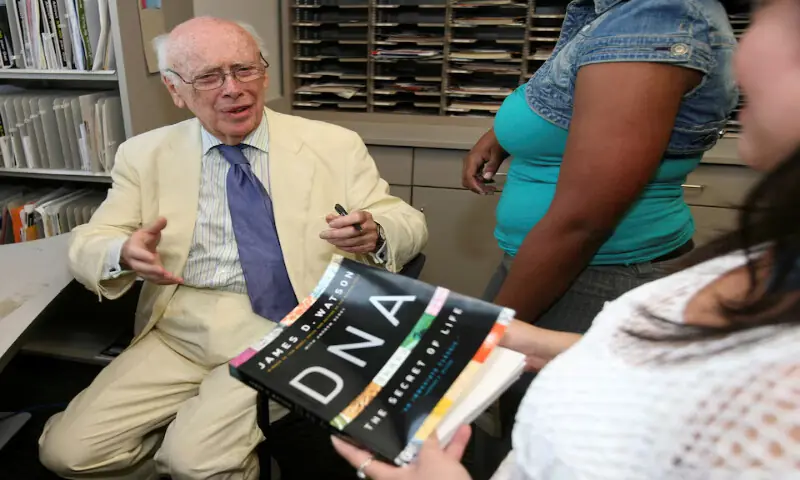
James D. Watson, the American biologist who co-discovered the double helix structure of DNA, a breakthrough that earned him the Nobel Prize and launched the genetic age, has died at the age of 97. His death was confirmed by Cold Spring Harbor Laboratory on Long Island, where he worked for many years. The New York Times reported that Watson died this week at a hospice on Long Island.
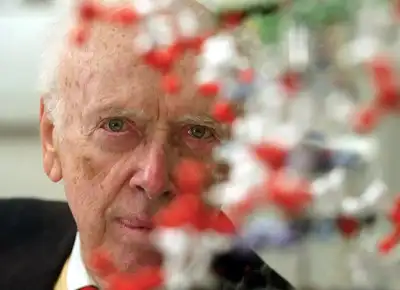
Watson’s death marks the passing of a monumental yet contentious figure in science. In 1953, while at Cambridge University with British physicist Francis Crick, Watson deduced the three-dimensional shape of DNA as two intertwined staircases. This discovery won them a share of the 1962 Nobel Prize in medicine and paved the way for genetic engineering, gene therapy, and modern biotechnology. However, Watson’s reputation was later tarnished by offensive comments on genetics and race, which led to his ostracism from the scientific community.
Even in his youth, Watson was known for his provocative style. His 1968 memoir, “The Double Helix,” offered a racy account of the DNA discovery, drawing criticism from colleagues. Crick complained that the book “grossly invaded my privacy,” and Maurice Wilkins objected to what he called a “distorted and unfavorable image of scientists” as ambitious schemers. Additionally, Watson and Crick were widely criticized for using raw data from X-ray crystallographer Rosalind Franklin without fully acknowledging her contribution. As Watson wrote in “Double Helix,” scientific research feels “the contradictory pulls of ambition and the sense of fair play.”
In 2007, Watson sparked widespread anger by telling the Times of London that he believed testing indicated the intelligence of Africans was “not really … the same as ours.” Accused of promoting racist theories, he was forced to retire as chancellor of Cold Spring Harbor Laboratory. Although he apologized, he repeated similar claims in a 2019 documentary, attributing racial differences in IQ test results to genetics, contrary to most scientists who point to environmental factors.
Born in Chicago on April 6, 1928, James Dewey Watson graduated from the University of Chicago in 1947 with a zoology degree and earned his doctorate from Indiana University. At Cambridge’s Cavendish Lab, he met Crick and began the quest for DNA’s structure. Their model revealed that nucleotides paired in a way that, as they noted in their 1953 paper, “immediately suggests a possible copying mechanism for the genetic material.” This understatement heralded the mechanism for genetic inheritance.
After the DNA discovery, Watson never matched that achievement but remained a scientific force. He joined Harvard University’s biology department in 1956, where he championed molecular biology. Harvard biochemist Guido Guidotti recalled that Watson immediately told traditional biologists “that they were wasting their time and should retire,” earning long-term enmity but attracting young scientists. In 1968, Watson brought his drive to Cold Spring Harbor Laboratory, transforming it from a “mosquito-infested backwater” into a world-class institution, as friend Mark Ptashne described.
In 1990, Watson was named to lead the Human Genome Project, but he resigned after clashing with the National Institutes of Health over patenting DNA sequences, arguing that genome knowledge should remain public. In 2007, he became the second person to have his full genome sequenced and made it public, though he avoided learning about genes linked to Alzheimer’s risk. Watson often boasted of chasing “popsies” and made disparaging remarks about women, yet he supported female scientists like MIT biologist Nancy Hopkins, who said, “I certainly couldn’t have had a career in science without his support.”
Watson considered his books his proudest accomplishment, not the double helix, which he said “was going to be found in the next year or two.” He admired writers like Graham Greene and Christopher Isherwood, and he cherished his bad-boy image, emphasized in his 2007 book “Avoid Boring People.” Despite his complexities, Watson’s legacy endures through the genetics revolution he helped ignite.