
General News
Mission to Extend Life of NASA’s Swift Telescope Encounters Trouble in Space

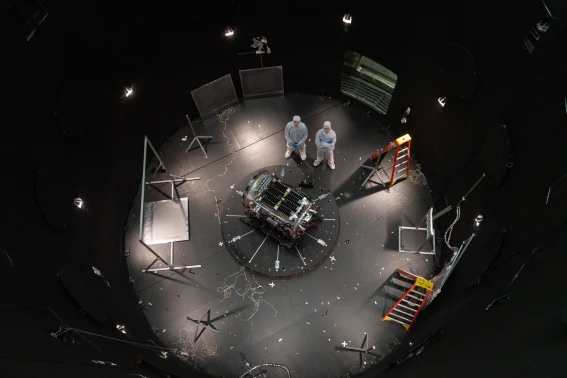
A pioneering private mission to rescue one of NASA’s oldest and most valuable space observatories has suffered a major setback after the robotic spacecraft sent to save the telescope developed serious technical problems in orbit, placing the ambitious mission in doubt. The malfunction has raised concerns over the future of the Neil Gehrels Swift Observatory, a satellite that has spent more than two decades studying some of the universe’s most powerful explosions.


The rescue effort centres on LINK, a robotic servicing spacecraft built by Arizona-based Katalyst Space Technologies under a US$30 million contract with NASA. Launched earlier this month, LINK was designed to rendezvous with the aging Swift Observatory, latch onto it using robotic arms and raise it into a higher orbit, extending the telescope’s operational life by several years. The mission is regarded as the first U.S. attempt to rescue and reboost an operational satellite in orbit using a commercial spacecraft.
However, NASA announced that LINK has experienced serious attitude-control problems, causing the spacecraft to spin uncontrollably and interrupt communications with mission controllers. Preliminary investigations indicate that two of the spacecraft’s three reaction wheels; critical components used to control a spacecraft’s orientation, have failed. Engineers have also identified reduced performance in part of LINK’s cold-gas thruster system, further complicating efforts to stabilise the vehicle.
Despite the setback, NASA and Katalyst say there are reasons for optimism. Most of LINK’s major onboard systems remain operational, and engineers continue to receive intermittent communications from the spacecraft. Ground teams are now working around the clock to regain full control before deciding whether the rescue mission can proceed as planned.
The mission was launched because the Swift Observatory, which entered service in 2004, is losing altitude far more quickly than expected. Increased atmospheric drag caused by heightened solar activity has accelerated its orbital decay, and without intervention the spacecraft could re-enter Earth’s atmosphere later this year. Swift has already been placed into a temporary safe mode, with scientific observations suspended to conserve its remaining orbital lifetime.
Swift has played a crucial role in astronomy for more than 20 years. The observatory is best known for detecting gamma-ray bursts, the universe’s most energetic explosions, and rapidly alerting telescopes around the world so they can study these fleeting events. It has also contributed to research on black holes, neutron stars, supernovae and other high-energy cosmic phenomena, making it one of NASA’s most scientifically productive space telescopes.
Beyond saving Swift, the mission has broader implications for the future of space operations. If successful, it would demonstrate that commercial spacecraft can repair, refuel or reposition aging satellites, reducing the need to replace expensive space assets and opening new opportunities for satellite servicing in both civilian and military sectors. The technology is also viewed as strategically important as the United States and China compete to develop advanced in-orbit servicing capabilities.
For now, the mission remains in a critical phase. Engineers are attempting to stop LINK’s uncontrolled rotation and restore stable communications before determining whether it can continue its rendezvous with Swift. If the problems cannot be resolved, NASA risks losing not only the rescue spacecraft but also the opportunity to extend the life of one of its longest-serving astronomical observatories.