
International
US Supreme Court Upholds Birthright Citizenship, Rejecting Trump’s Restrictions

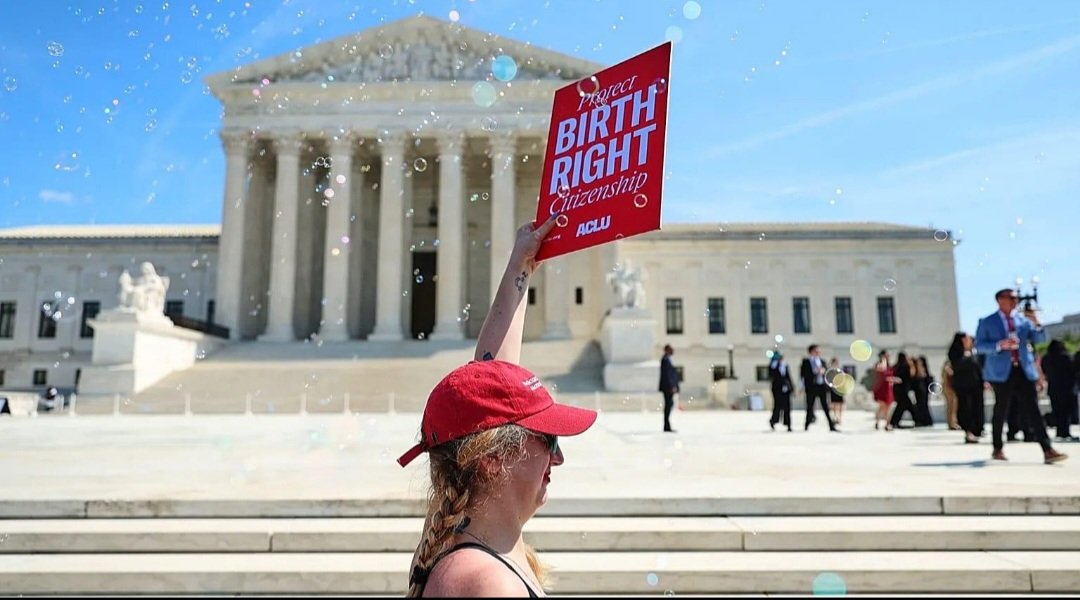
The United States Supreme Court has delivered a landmark ruling reaffirming the constitutional guarantee of birthright citizenship, striking down President Donald Trump’s executive order that sought to deny automatic U.S. citizenship to children born on American soil to parents who are in the country illegally or temporarily. The decision marks one of the most significant legal defeats of Trump’s second-term immigration agenda and reinforces a constitutional principle that has stood for more than a century.
In a 6-3 ruling, the justices held that the executive order violated the 14th Amendment of the U.S. Constitution, which states that “all persons born or naturalized in the United States, and subject to the jurisdiction thereof, are citizens of the United States.” Chief Justice John Roberts, writing for the majority, said children born in the United States to parents who are unlawfully or temporarily present satisfy the constitutional requirements for citizenship at birth.
Trump signed the executive order on his first day back in office in January 2025 as part of a broader immigration crackdown. The order would have denied citizenship to children born in the United States unless at least one parent was a U.S. citizen or lawful permanent resident. Immigration advocates argued that the policy would have affected more than 250,000 babies each year, including children of undocumented immigrants, foreign students, temporary workers and others legally living in the country on temporary visas.
The administration defended the policy by arguing that children of undocumented immigrants and temporary visa holders were not fully “subject to the jurisdiction” of the United States, and therefore were not entitled to citizenship under the Constitution. However, the Supreme Court rejected that interpretation, relying on the text and history of the 14th Amendment as well as the landmark 1898 United States v. Wong Kim Ark decision, which established that nearly everyone born on U.S. soil is automatically a citizen.
The ruling also leaves intact decisions by lower federal courts that had blocked Trump’s order from taking effect nationwide. During oral arguments earlier this year, justices across the ideological spectrum expressed skepticism about the administration’s constitutional arguments, foreshadowing Tuesday’s outcome.
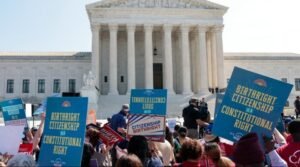
The decision was welcomed by civil rights organizations, immigrant advocacy groups and many Democratic leaders, who described it as a victory for constitutional protections and the rule of law. They argued that allowing a president to redefine citizenship through executive action would have fundamentally altered one of America’s most established legal principles.
President Trump criticized the ruling and maintained that birthright citizenship encourages illegal immigration and so-called “birth tourism.” His administration had argued that the Constitution should be interpreted more narrowly, but legal experts said the Court’s decision leaves little room for future administrations to impose similar restrictions through executive action alone. Any significant change to birthright citizenship would likely require a constitutional amendment or new legislation that withstands judicial review.
The judgment comes at the close of a Supreme Court term that featured several major rulings involving presidential authority, immigration, elections and executive power. While the Court has sided with Trump on some issues during his second term, Tuesday’s ruling represents a clear constitutional limit on presidential power by reaffirming that the executive branch cannot override rights guaranteed by the Constitution.
For millions of immigrant families and future generations, the ruling preserves a legal principle that has shaped American citizenship since the adoption of the 14th Amendment in 1868. Legal scholars say the decision will stand as one of the defining constitutional judgments of the Court’s current era and is likely to influence immigration law and civil rights debates for decades to come.