General News
2023 Election Most Open Since 1999, Says Political Strategist Ahead of 2027 Polls

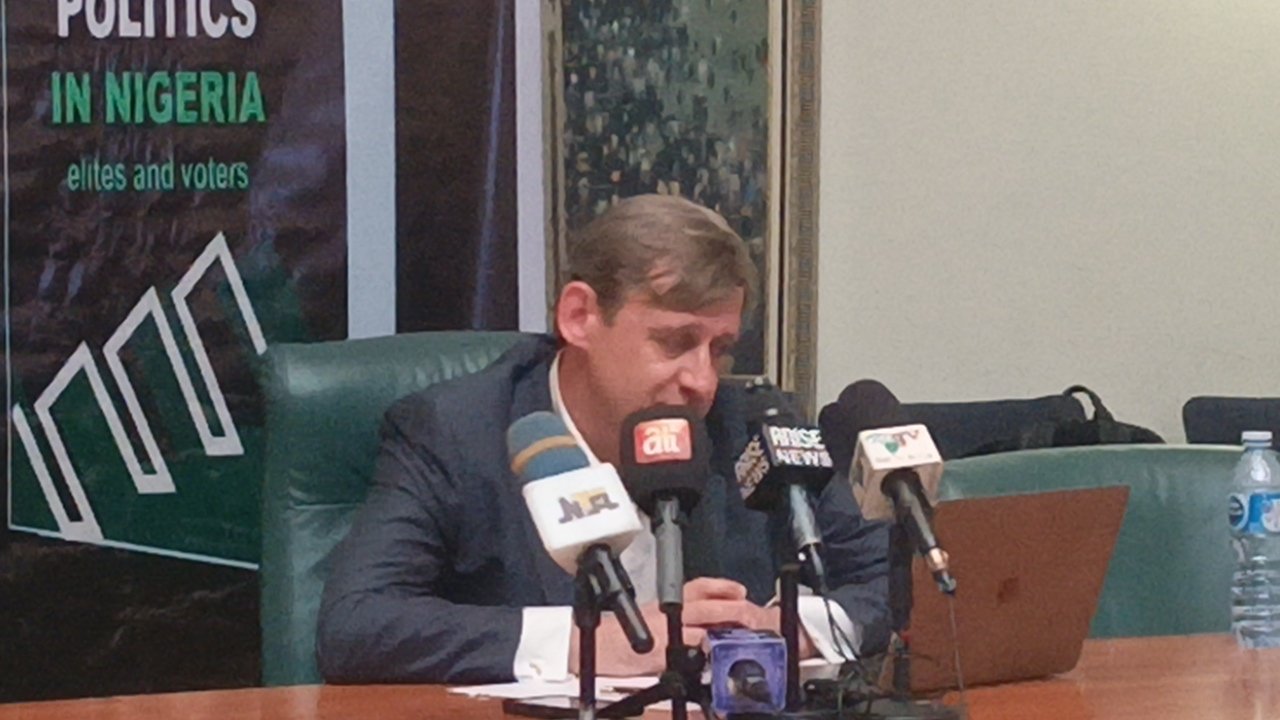
Political psychologist and campaign strategist, Dr Valentin Bianki, has described Nigeria’s 2023 presidential election as the most open contest since the country returned to democratic rule in 1999, citing intense competition among candidates and the declining share of votes secured by the winner.
Bianki made the observation during the presentation of the English edition of his book, Politics in Nigeria: Elites and Voters, at the Shehu Musa Yar’Adua Centre in Abuja on Monday.
The event examined Nigeria’s electoral politics, voter behaviour, democratic resilience and the emerging political alliances ahead of the 2027 general elections.
According to Bianki, President Bola Tinubu’s 36.6 per cent share of the votes in the 2023 presidential election was the lowest winning percentage recorded by any presidential candidate since 1999.
He argued that despite Nigeria’s relatively low rankings in some international democracy indices, the country continued to demonstrate significant political competition and the capacity of opposition candidates to challenge established power structures.
“Nigeria’s resilience is not the absence of conflict; it is an extraordinary capacity to live with conflict,” he said.
The author stressed that Nigeria’s democratic performance should not be assessed solely through international rankings but also through the competitiveness of its elections and the ability of political actors to contest power.
Digital Popularity Does Not Guarantee Electoral Victory
A major focus of the presentation was the gap between online political popularity and actual electoral performance.

Drawing on an analysis of 5.9 million Twitter accounts and 2.3 million tweets, Bianki explained how Peter Obi dominated significant portions of online political conversations during the 2023 election campaign but finished third in the presidential race.
He said the findings showed that online engagement and pre-election opinion polls did not fully reflect voter mobilisation, geographical representation and the influence of established political networks.
The research also highlighted the concentration of politically active Twitter users in Lagos and the South-West, alongside participation by Nigerians in the diaspora who were unable to vote in the election.

Bianki further pointed to the limitations of phone and online polling methods, noting that digital visibility did not necessarily translate into votes at polling stations.
With voter turnout recorded at 26.7 per cent, he emphasised the importance of grassroots political organisation in determining electoral outcomes.
“Votes are individual. Mobilisation is not,” he said.
Book Links Election Results to Political Appointments
The book also examines the relationship between presidential election results, federal cabinet representation and the distribution of federal resources across geopolitical zones.
Using a hand-coded dataset of federal ministers appointed since 2010, Bianki presented findings suggesting a correlation between the proportion of votes a presidential candidate received from a geopolitical zone and that zone’s representation in the federal cabinet.

The research also identified a relationship between cabinet representation and federal transfers across geopolitical zones, excluding the oil-producing South-South region from that particular comparison.
Following the 2023 elections, the North-West’s share of cabinet positions declined from 27 per cent to 19 per cent, while its share of federal transfers fell from 16 per cent to 14 per cent, according to the study.
Bianki also examined the geographical distribution of the August 2024 #EndBadGovernance protests, observing that demonstrations were concentrated in northern Nigeria while the South remained comparatively quiet.
The findings raised questions about regional expectations, political representation and the management of Nigeria’s diversity within the federal system.
Tinubu Cabinet Shows Generational Shift
The study further identified a generational change in Nigeria’s federal political leadership.
According to Bianki, the average year of birth of ministers in Tinubu’s cabinet was 1966, compared with 1957 under the administrations of former Presidents Goodluck Jonathan and Muhammadu Buhari.

Ministers born after 1971 accounted for 20 per cent of Tinubu’s cabinet, up from three per cent in the earlier comparison, while members of the generation that experienced the Nigerian Civil War represented 14 per cent.
Bianki said the transition could have implications for institutional continuity, political decision-making and the informal restraints that have historically influenced Nigeria’s governing elite.
He argued that strengthening institutions would become increasingly important as fewer members of the political leadership retained direct memories of the Civil War.
Opposition Must Turn Discontent Into Organisation
Looking ahead to the 2027 general elections, Bianki said emerging political alignments would be shaped by the rivalries, alliances and lessons of the 2023 contest.
He cautioned that public dissatisfaction with the government would not automatically translate into electoral victory for opposition parties, stressing the need for effective coordination, organisation and voter mobilisation.
“Dissatisfaction is real; coordination is the scarce resource. Dissatisfaction is an emotion. Opposition is an organisation,” he said.

He added that Nigerian voters would ultimately determine the outcome of the next election.
“My hope for Nigeria is simple: preserve stability without sacrificing democracy, and preserve democracy without sacrificing stability,” he said.
The discussion was moderated by communications specialist and ARISE News foreign correspondent Alkasim Abdulkadir, while Abuja-based journalist and compère Mbazan Anongo hosted the question-and-answer session.
Former Minister of Foreign Affairs, Yusuf Maitama Tuggar, who served from 2023 to 2026, endorsed the book in a review, praising its analytical rigour and use of data-driven evidence.
Published by Fortis Press in 2026, Politics in Nigeria: Elites and Voters examines the 2023 elections, the first two years of the Tinubu administration and the processes through which Nigeria’s political elite is recruited.
The 292-page book draws on more than 550 references and original research conducted by the author and his team.
Its English edition is currently available as a limited preprint, with Bianki seeking a Nigerian publishing partner to facilitate a full edition ahead of the 2027 elections.
He also invited Nigerian publishers, universities, research institutes, think tanks and media organisations to explore collaboration opportunities around the work.