
Opinion
2027 Poll: The APC Direct Primary Feat

By Ehichioya Ezomon
Nigeria’s opposition political parties – which slow-walked as they hastened to meet the shortened deadlines set by the Independent National Electoral Commission (INEC) to finalise internal processes culminating in their primaries for all elective positions in the 2027 General Election – have been over the moon since Thursday, May 21, 2027, when an Abuja Federal High Court struck down the contentious electoral timelines the parties have rejected even in compliance.
The once-pretentious “main oppostion” African Democratic Congress (ADC) has predicted “exodus” from the ruling All Progressives Congress (APC) that’s concluded, with a flourish, its week-long primaries, from Saturday, May 16 to Saturday, May 23, 2026, using, as icing on the cake, the choice, and affirmation of President Bola Ahmed Tinubu as the candidate of the party for the January 16, 2027, presidential poll.
On Sunday, May 24, 2026, at the President Bola Ahmed Tinubu International Conference Centre in Abuja, Nigeria’s capital city, which serves as the APC’s National Collation Centre for the primaries, the party showed off its political dominance across the country, crediting 10,999,162 votes to Tinubu, and 16,503 votes to his challenger, Osifo Stanley, Edo State-born businessman-turned politician and former presidential candidate of the Alliance for Social Democrats (ASD) in 2019.
The Chairman of the Presidential Primary Election Committee and former Senate President Anyim Pius Anyim, announcing Tinubu as winner of the two-horse, direct primary race, noted that the APC membership stands at 12,643,316, while 11,069,756 members were accredited for the shadow poll and 11,015,665 voted in the 8,809 wards in the 774 local government areas of the country.
“It is my pleasure to announce the results with President Bola Ahmed Tinubu polling 10,999,162 votes and the challenger, Osifo Stanley, scored 16,503 votes,” Anyim declared.
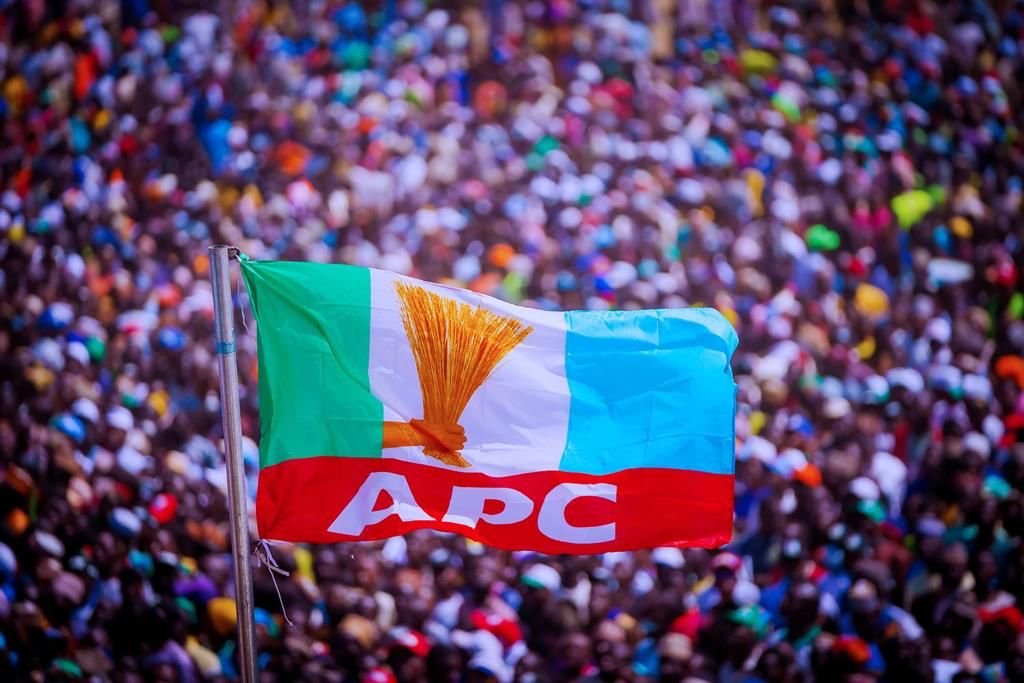
Subsequently, the APC National Chairman, Prof. Nentawe Yilwatda, led members of his National Working Committee (NWC) “to present Tinubu with the Certificate of Returns and the party’s flag, having been returned as the standard bearer of the party in 2027 general election.”
As the court’s given them a window of opportunity, till September 2026 – for the submission of their membership registers, and substitution of candidates for the poll to the INEC – the opposition parties should emulate the APC, and go for direct primaries to choose their candidates.
So far, the ADC seems to’ve picked up the tantalising gauntlet, to rub shoulders with the ruling party, by choosing its presidential candidate in a direct primary today, Monday, May 25, 2026, in Nigeria’s 8,809 wards, with the ADC National Publicity Secretary, Mallam Bolaji Abdullahi, crowing in a statement in Abuja on May 24, 2026, thus:
“The ADC remains proud to stand today as the only truly democratic party in Nigeria, because it is the only political party whose choice of Presidential candidate is determined through open primaries.” Wonders! Didn’t the APC conclude its open and direct presidential ballot 48 hours earlier, as watched globally?
Notwithstanding, the APC primaries were akin to a general election, with paraphernalia of a nationwide franchise rolled out in the 8,809 wards, 774 local government councils, 360 federal constituencies, and 109 senatorial districts in the 36 States of the Federation, and the Federal Capital Territory (FCT), Abuja.
An unprecedented feat – a replica of the staggered primaries in the United States of America to choose candidates for the four-yearly November General Election, and the Midterms every two years for off-cycle election – only the APC, with controlling dominance in 31 States and the FCT, Abuja, could yet pull it off among the 22 registered political parties!
In controversial circumstances, though, many APC heavyweight politicians – seeking to return to office or replace incumbent governors, and members of the national and state assemblies – lost at the primaries (consensus or direct) where the crucial voices and votes of ordinary members of the APC were heard and counted, a sign of what to expect in the January and February 2027 poll.
Amending the Electoral Act 2026, the National Assembly (NASS) deleted the notoriously-abused selection of candidates by mostly hand-picked “delegates” by state governors and powerful party leaders, and mandates that consensus or direct primary shall be used to choose candidates for elections.
Ogun State Governor and APC’s candidate for Ogun East senatorial district in 2027, Prince Dapo Abiodun, on May 21, summed up the essence of direct primaries during the governorship primary at Ward 3, Iperu 1, in Ikenne Local Government Area, for the emergence of Senator Solomon Olamilekan Adeola (alias ‘Yayi’) (APC, Ogun West), as the party’s flag bearer for 2027.
“The Electoral Act was amended, and in line with that amendment, primaries can either be conducted through consensus or direct primaries. What you have witnessed in the last one week is democracy at its best, where government is truly by the people and for the people,” Abiodun said.
“The direct primary process promotes inclusiveness by allowing registered party members at the ward level to openly exercise their franchise through the queue system… I was a beneficiary of direct primaries in 2019, and I believe it always reflects the wishes and aspirations of the people,” he added.
Despite the reforms introduced by the NASS in the Electoral Act, the usual “Nigerian factor” to game the system hasn’t vanished from primaries. Trust the ingenious APC governors, and powerful members, they attempted – and many succeeded– to deploy the “consensus option” to whip in or weed out opposing aspirants within the party.
The governors ensured that aspirants, who challenged or resisted their bid for re-election or to further their political career at the Senate as “a retirement benefit,” or their “anointed” candidates, never advanced to the primaries; and if they did, were defeated via induced machinations of the governors or party leaders.
The “opposition within” were determined to’ve their way in many of the APC states for direct primaries, forcing the party leadership to approve the mode for selection of candidates, resulting in incumbents and potential replacements losing the contests under “Operation A4” pattern of balloting that allows voters to queue behind the posters of their preferred aspirants.
The “Option A4” system was popularised by the regime of self-styled Military President Ibrahim Badamasi Babangida (1985-1993) for the political transition to, and the conduct of the June 12, 1993, presidential election won decisively by businessman-turned politician, Chief Moshood Kashimawo Olawale (MKO) Abiola, but was denied the presidency by the same military that “invented” the method of primary, and organised the ballot that’s acclaimed as the freest, fairest, transparent and credible election in Nigeria’s history.)
There’re complaints of manipulation of the APC primary processes: Sreening out of perceived strong or disloyal aspirants; imposition of candidates; disqualification of aspirants; disenfranchisement of registered members; late arrival or absence of supervisory party officials and ballot materials; starving voting points (wards) of ballot materials; violence and voter-attacks by political thugs; announcements of “fake results” even as voting was ongoing; and claims by multiple aspirants of winning the primaries.
Not surprising, but still novel, was the withdrawal of Rivers State Governor Siminalayi Fubara from his bid for re-election, citing “the need for peace and unity, above personal interest, in Rivers” – an action observers attributed to the running battle with his political godfather, former Governor and Minister of the FCT, Abuja, Chief Nyesom Wike, who’s vowed to make Fubara a “one-term governor (OTG).”
Also noticeable was the postponement of the governorship primaries in Bauchi and Kwara, allegedly occasioned by failure of party leaders to coerce members to accept their “consensus candidates” – a development the APC national spokesman, Felix Morka, explained away as, “to allow for consultations with stakeholders.”
“The All Progressives Congress hereby announces the rescheduling of the governorship primary elections in Bauchi and Kwara States to Friday, May 22, 2026,” Mr Morka said on Thursday, May 21, in a statement.
“The decision was approved by the National Working Committee following consultations with relevant stakeholders and in furtherance of the party’s commitment to ensuring a transparent, orderly, peaceful and credible primary election process,” Morka added.
Due to these shenanigans, the APC emplaced appeal committees across the country, to redress the issues: to uphold, reverse or cancel the screening, consensus or direct primary results. Did the appeal committees’ rulings meet the expectations of aggrieved aspirants and members of the party? This wasn’t hard to fathom from the primaries in which known and “unknown” quantities won handily or lost woefully!
The conduct of the primaries of such a magnitude, and the outcomes therefrom, is a breath of fresh air in a political environment suffused with all manner of electoral manipulation and malfeasance, widespread violence of bodily harm and death, and destruction of ballot materials and public and private property.
Some may argue that the APC primaries weren’t different from those held by some of the 22 parties in the running for the 2027 election. Most of the parties never conducted actual primaries. They hid behind the shortened deadlines for meeting the INEC requirements, to announce outcomes of “imaginary” or convoluted congresses, conventions and/or primaries.
The APC, conducting a week-long open and direct primaries up to the presidential level, should be applauded for pulling-off an unmatched feat in Nigeria’s electoral evolution, and emulated by the crisis-riven opposition parties, which’ve failed to put their house in order about eight months to the general election.
As the morning shows the day – and as the opposition parties and their leaders continue in their war of attrition – the APC, through its successful conduct of the primaries, has signalled its preparedness and readiness for the 2027 election, which the opposition has tagged as “Tinubu against Nigerians,” as if aliens were those that voted at the APC one-week primaries across Nigeria.
Bookmark this: The APC members’ displayed commitment, confidence, determination, enthusiasm, and momentum – to choose their candidates, at the wards, via direct primaries, and physical or voice vote to affirm those chosen by consensus – will be carried to the 2027 General Election, to elect the President and members of the National Assembly on January 16, 2027, and 28 Governors and members of the State Houses of Assembly on February 6, 2027, respectively.
This is hoping that, as an abiding philosophy of the opposition to cry foul play when they face a possible, or actual defeat at the poll, Nigeria’s opposition politicians and their parties won’t surrender to defeat even when the ballots for 2027 are yet cast. They should gird their loins for the ultimate battle!
• _Mr Ezomon, Journalist and Media Consultant, writes from Lagos, Nigeria. Can be reached on X, Threads, Facebook, Instagram and WhatsApp @EhichioyaEzomon. Tel: 08033078357_ .