
International
Rare Shark Stranding in Ireland Sheds New Light on the Long, Slow Life of the Greenland Shark

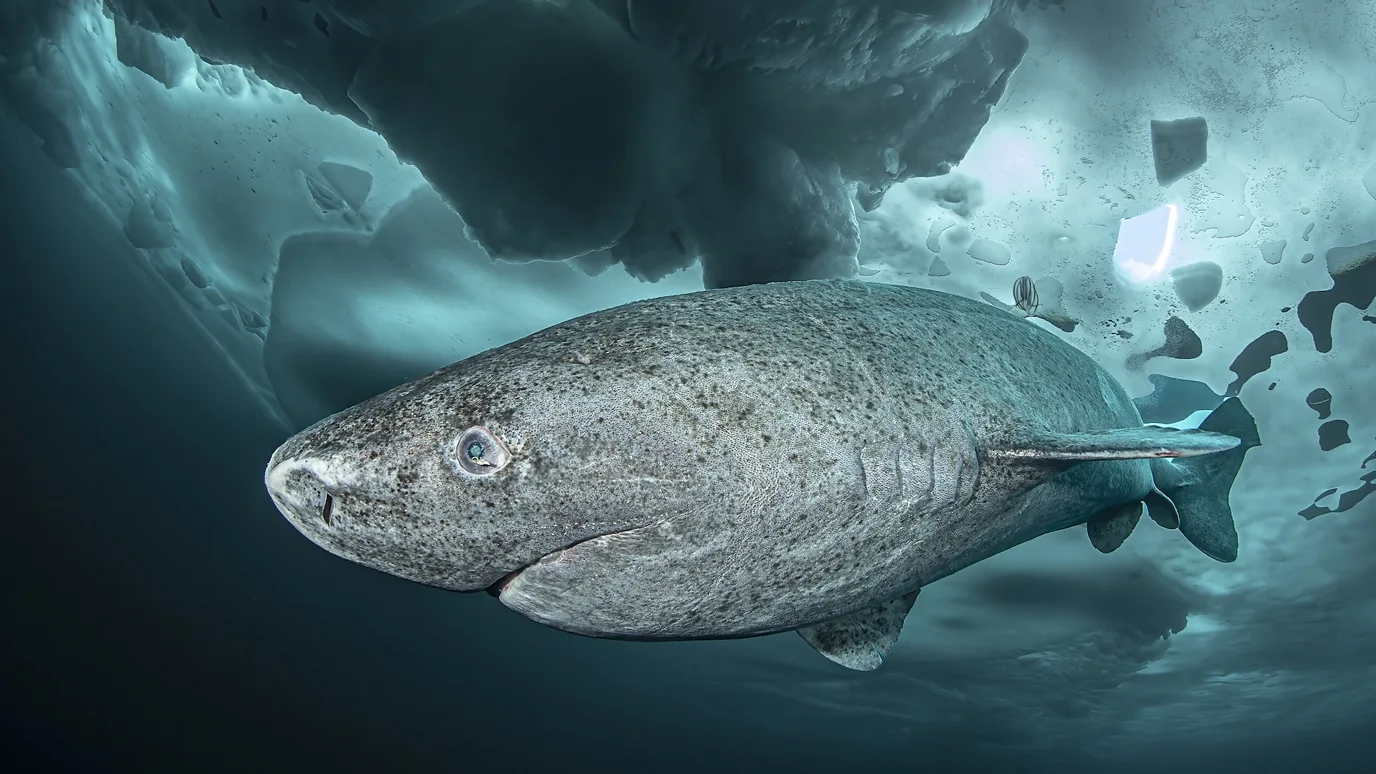
Marine scientists say the rare stranding of a Greenland shark on Ireland’s west coast has provided an extraordinary opportunity to study one of the world’s most mysterious and longest-living vertebrates. The unexpected discovery has offered researchers valuable biological samples and fresh insight into a species that normally inhabits the icy depths of the North Atlantic and Arctic oceans, where encounters with humans are exceptionally rare.
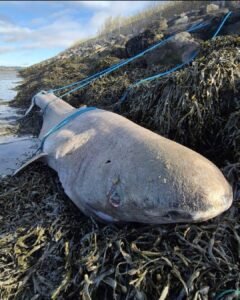
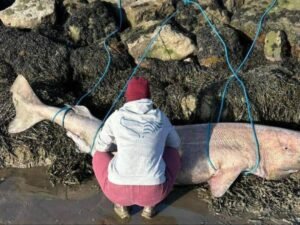
The shark was discovered stranded on a beach along Ireland’s Atlantic coastline, drawing marine biologists, conservationists and curious residents eager to witness an animal that few people ever see outside deep water. Researchers described the moment as remarkable, with one scientist saying the team was “all just in awe” as they examined the enormous fish.
Greenland sharks (Somniosus microcephalus) are among the slowest-moving sharks on Earth and are renowned for their extraordinary lifespan. Scientific studies suggest some individuals can live for more than 250 years, while the oldest may survive for up to 400 years, making them the longest-lived known vertebrates. They grow slowly; often less than a centimetre each year, and may not reach sexual maturity until they are around 150 years old.
Because the species spends most of its life at depths of several hundred to more than 2,000 metres in freezing waters, scientists have limited opportunities to study it in its natural habitat. Strandings are therefore considered exceptionally valuable for research, allowing experts to examine anatomy, genetics, parasites, diet and overall health without disturbing wild populations.
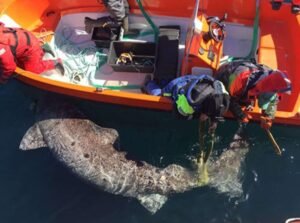
Following the discovery, researchers collected tissue samples, measured the shark’s body and conducted a detailed post-mortem examination. They hope laboratory analysis will help determine the animal’s approximate age, health status and possible cause of death, while also improving understanding of how Greenland sharks survive in cold, high-pressure environments.
Scientists are particularly interested in the shark’s unusually slow metabolism. Living in near-freezing water, Greenland sharks conserve energy by moving slowly and feeding opportunistically on fish, squid and marine mammals. They are also known to scavenge carcasses that sink to the ocean floor, playing an important ecological role in deep-sea ecosystems.
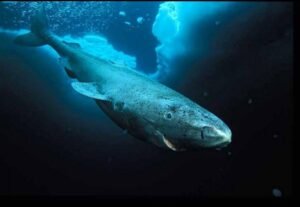
Researchers say the Irish specimen may also help answer broader questions about how climate change is affecting Arctic marine life. Rising ocean temperatures and changing sea currents could alter the distribution of deep-sea species, potentially increasing encounters between Greenland sharks and coastal environments. Understanding these shifts will be important for future conservation planning.
The stranding has attracted widespread public interest, with marine experts emphasizing that Greenland sharks pose little threat to humans despite their large size, which can exceed six metres (20 feet) in length. Instead, they are regarded as gentle, slow-moving predators that have adapted to one of the harshest environments on Earth.
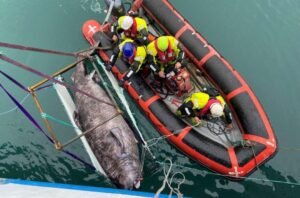
Scientists hope continued analysis of the stranded shark will deepen knowledge of a species that has remained largely hidden beneath the Arctic seas for centuries. They say every rare encounter helps fill critical gaps in understanding the biology, evolution and conservation needs of one of the planet’s most extraordinary marine animals.