
International
Trump Isn’t Named, But His Presidency Hangs Over Clinton, Bush and Obama Essays

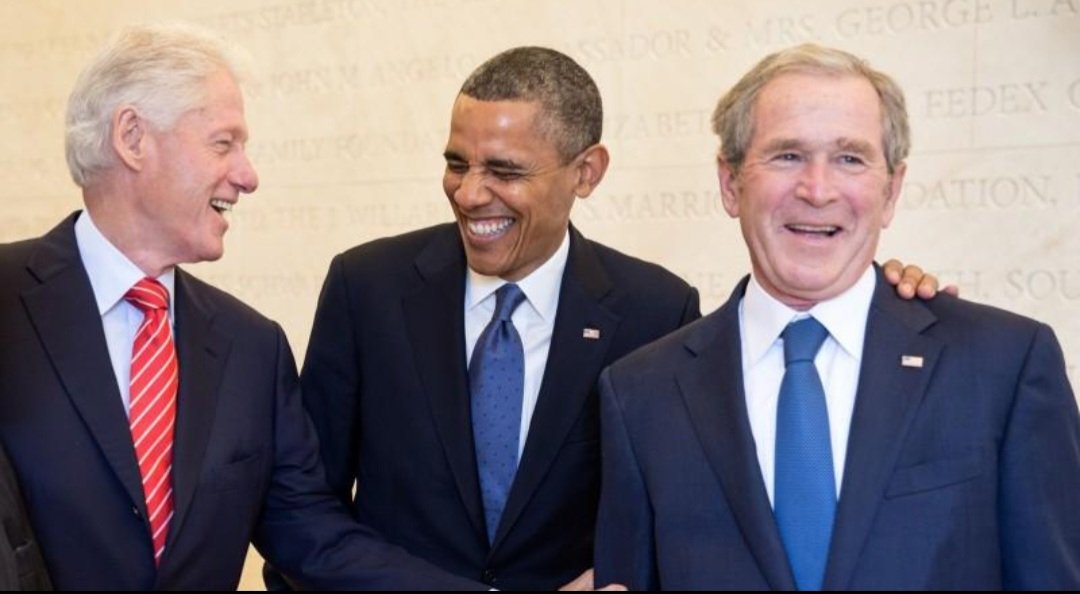
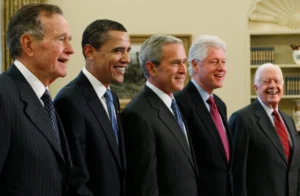
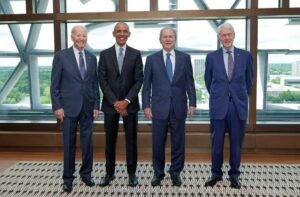
Three former U.S. presidents; Bill Clinton, George W. Bush and Barack Obama, are taking part in an ambitious historical project examining the nation’s presidents and first ladies, but their essays have attracted attention for another reason: the current president, Donald Trump, is nowhere in the series.
The former presidents are among a group of historians, political figures, writers and public intellectuals contributing to “In Pursuit,” a 250th-anniversary project designed to examine the lessons of America’s presidential history as the country approaches the 250th anniversary of its independence.
Although Trump is not mentioned in the essays, several of the themes explored presidential power, humility, constitutional limits, democracy and the relationship between leaders and institutions, inevitably invite comparisons with the current political era.
The omission of Trump is deliberate.
The In Pursuit project covers 43 U.S. presidents, from George Washington through Barack Obama, but excludes both Trump and former President Joe Biden.
Organisers say the two most recent presidents were considered too close to the present for the kind of historical assessment the project is attempting to make. The essays are being published chronologically, with new contributions appearing weekly through December.
That explanation has not stopped readers from interpreting some of the essays through the lens of Trump’s presidency.
The project is being led by Colleen Shogan, the former U.S. archivist who was fired by Trump in 2025. Shogan has insisted that contributors were instructed not to write partisan or ideological pieces.
She told The Associated Press that the goal was to allow Americans to examine the successes and failures of the country’s first 250 years and draw lessons for the future.
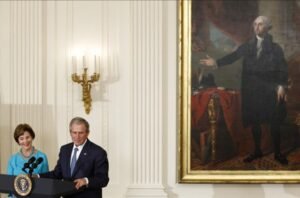
George W. Bush’s contribution was the first essay in the series.
Writing about America’s first president, George Washington, Bush focused heavily on humility and the willingness to surrender power.
Bush pointed out that Washington voluntarily resigned his military command after the Revolutionary War, even though he had enormous influence, and later stepped away from the presidency after two terms.
Washington’s decision to relinquish power helped establish a tradition of peaceful transitions and limited presidential tenure that eventually became embedded in the Constitution.
Bush described Washington’s willingness to give up power as one of the most consequential decisions in American political history.
The essay did not mention Trump.
Yet its timing and subject matter immediately attracted attention because Trump has repeatedly spoken about the possibility of remaining politically powerful beyond the traditional limits of presidential service.
AP noted that Bush’s discussion of Washington’s refusal to cling to power is difficult to read without thinking about Trump’s refusal to accept his 2020 election defeat and his subsequent comments about potentially seeking a third term.
The significance of Bush’s essay is partly in what it does not say.
Bush has generally avoided directly criticizing Trump, despite the two men belonging to the same Republican Party and Trump having frequently attacked Bush-era policies and members of the Bush family.
Instead, Bush’s essay praises qualities that have become central to debates over presidential leadership: humility, self-restraint, dignity and putting the interests of the nation above personal ambition.
Bush wrote that the presidency is temporary while the republic is permanent, presenting Washington as an example of a leader who understood the difference between holding power and owning power.
The approach allows Bush to make a broader historical argument without explicitly turning the essay into a contemporary political attack.
Barack Obama also participated in the project, writing about Abraham Lincoln, another president whose leadership is frequently invoked in discussions about American democracy and national division.
Obama’s essay focuses on Lincoln’s understanding of government and the relationship between individual liberty and the common good.
The former president portrays Lincoln not simply as the larger-than-life figure Americans remember from monuments and history books, but as a politician who developed his ideas gradually before reaching the White House.
Obama’s central lesson is that individual liberty does not necessarily conflict with collective responsibility.
The essay argues that government can help people achieve things that individuals cannot accomplish as effectively on their own.
That theme takes on contemporary significance in an era of intense arguments over the size and role of government, although Obama does not use his essay to directly discuss Trump’s presidency.
Bill Clinton’s contribution examines Theodore Roosevelt, focusing on his approach to political reform and his efforts to challenge powerful corporate interests.
Roosevelt’s presidency offers a particularly rich historical subject because he combined populist rhetoric with an expansion of federal power and a willingness to confront some of America’s most powerful business interests.
Clinton highlights Roosevelt’s efforts to broaden the concept of who belonged within the American political community while also acknowledging the president’s discriminatory and exclusionary views toward Black and Indigenous Americans.
That willingness to acknowledge both accomplishments and failures is one of the defining characteristics of the In Pursuit project.
Rather than presenting historical figures as heroes without flaws, contributors are being encouraged to examine the contradictions within their leadership.
The essays are not intended to function as presidential tributes.
According to the organisers, the purpose is to examine what can be learned from the entire American presidential experience; including mistakes, failures and controversial decisions.
That approach is significant because debates over American history have become increasingly political.
Questions about how slavery, racism, colonialism, civil rights, immigration, war and presidential power should be taught and remembered have become major points of political disagreement.
In Pursuit is attempting to position itself outside those partisan battles by asking contributors to focus on historical lessons rather than contemporary political campaigns.
The project extends well beyond former presidents.
Among the contributors are:
Michelle Obama, writing about Jacqueline Kennedy
Hillary Clinton, writing about Eleanor Roosevelt
Chief Justice John Roberts, writing about William Howard Taft
Ken Burns, writing about Franklin D. Roosevelt
Karl Rove, writing about William McKinley
Condoleezza Rice, writing about George H.W. Bush
Michael Beschloss, writing about Lyndon Johnson
Stanley McChrystal, writing about Ulysses S. Grant
Doug Brinkley, scheduled to examine Barack Obama.
The mix of contributors is deliberately bipartisan and includes historians, journalists, military leaders, political figures and presidential family members.
Another essay that has drawn attention was written by retired Gen. Stanley McChrystal about Ulysses S. Grant.
McChrystal emphasised Grant’s commitment to constitutional principles and his resistance to political pressure.
One of the essay’s central lessons is that military and political leaders should remain loyal to the Constitution rather than to an individual.
That idea has obvious contemporary resonance given the increasing emphasis in American politics on personal loyalty to political leaders.
McChrystal’s essay therefore joins Bush’s discussion of humility in presenting historical leadership lessons that can easily be applied to current political debates without explicitly naming today’s politicians.
The initiative appears to have found an audience.
According to Shogan, the essays had accumulated more than 1 million views on Substack, while the accompanying podcast had recorded approximately 160,000 audio downloads and nearly 64,000 YouTube views at the time of AP’s report.
A documentary about the project is scheduled to air on PBS in October.
The popularity suggests that there is an appetite for historical material at a time when American politics is increasingly dominated by partisan arguments over the past.
At its core, In Pursuit is an attempt to use America’s 250th anniversary as an opportunity for national reflection.
The project asks a relatively simple question: What can Americans learn from the leaders who have already occupied the presidency?
The answer is not always flattering.
Some essays celebrate courage, humility and public service. Others examine corruption, political failure, discrimination, excessive ambition and institutional breakdown.
That is why Trump’s absence is both straightforward and politically interesting.
He is excluded because organisers say his presidency is too recent to be assessed historically. Yet the themes emerging from the essays; the limits of presidential power, the peaceful transfer of authority, constitutional loyalty and the danger of personal ambition make the current political moment difficult to ignore.
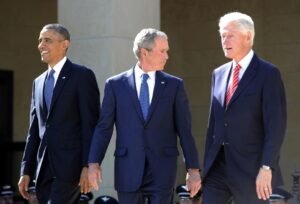
For Clinton, Bush and Obama, the project offers an unusual platform.
Rather than directly confronting the sitting president, they are speaking through history.
Bush writes about Washington’s decision to surrender power.
Obama writes about Lincoln’s understanding of government and the common good.
Clinton examines Roosevelt’s efforts to confront entrenched interests while acknowledging his shortcomings.
None of the three needs to mention Trump for readers to draw their own comparisons.
And that may ultimately be the most intriguing feature of the project.
As America prepares to celebrate 250 years of independence, the country’s former presidents are looking backward to explain what presidential leadership should mean, while the present occupant of the White House remains conspicuously absent from the historical exercise.